
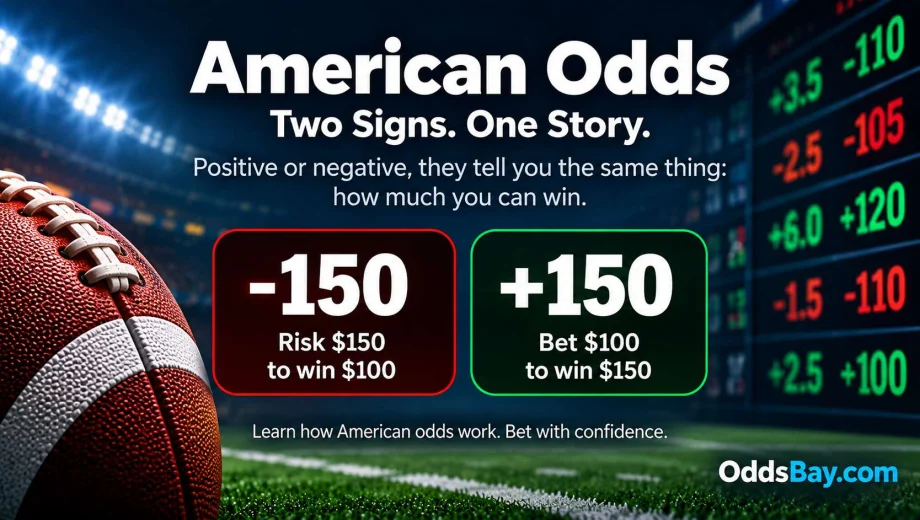
American odds are a way of expressing a betting price. The plus or minus sign tells you how the number is scaled around a $100 reference point; it does not tell you whether a wager is “good,” whether a team will win or whether a sportsbook is making a prediction with certainty.
Once the notation becomes familiar, the same price language can be applied to moneylines, spreads, totals and many other markets. For the broader process, see How to Bet on Sports.
What negative American odds mean
A negative price uses the quoted number to show the amount that would need to be risked to win $100 in profit at that price. At -150, the standard reference is $150 risked for $100 profit. If the bet wins, the returned amount includes the original stake plus the profit.
The stake can be scaled. At -150, risking $15 corresponds to $10 in potential profit; risking $75 corresponds to $50. The relationship is proportional.
What positive American odds mean
A positive price shows the profit associated with a $100 risk. At +150, a $100 stake corresponds to $150 in potential profit. A $20 stake at the same price corresponds to $30 in potential profit.
Positive does not mean “better” and negative does not mean “worse.” They are prices. Whether a price is attractive depends on the probability assigned to the outcome and the alternatives available.
Converting odds to implied probability
For negative American odds, implied probability can be calculated as |odds| ÷ (|odds| + 100). For positive odds, use 100 ÷ (odds + 100).
Using those formulas, -150 corresponds to 60% implied probability and +150 corresponds to 40%. These are mathematical translations of the quoted prices. They should not automatically be treated as true outcome probabilities, particularly because sportsbook markets can contain margin.
Price comparison in practice
If the same selection is offered at -120 and -125, -120 requires less risk for the same reference profit. If the same selection is +120 and +125, +125 offers more profit for the same reference stake. This is why price comparison can matter even when the bettor has already decided which market and selection to consider.
See How Moneyline Betting Works for a direct application. The same principle appears in point spreads and totals, where the line itself may also differ.
Odds format versus underlying price
American, decimal and fractional odds can express the same underlying economic price in different notation. Changing display format does not inherently change the wager. A bettor comparing books should therefore focus on the economic terms rather than assuming that one notation represents a different market.
Common mistakes
- Reading the sign as a recommendation rather than a pricing convention.
- Confusing profit with total return, which includes the returned stake.
- Assuming implied probability equals a sportsbook’s exact forecast of reality.
- Comparing prices without checking that the event, market and selection match.
- Ignoring a changed spread or total because the American price looks better.
American Odds FAQ
Does -200 mean I must bet $200?
No. The $200 figure is the conventional reference amount required to win $100 in profit at that price. Stakes can be scaled proportionally.
Is +200 twice as likely to win as +100?
No. American odds are not a linear probability scale. Convert each price to implied probability before comparing them in probability terms.
Do decimal odds change the value of the wager?
Changing the display format alone does not change the underlying economic price. American, decimal and fractional formats can express equivalent terms.
The main idea
American odds are a compact language for risk, potential profit and implied probability. Once that language is understood, it becomes easier to compare the actual price attached to moneylines, spreads and totals instead of looking only at the name of the selection.