
Betting odds do more than describe a potential payout. They also imply a probability. Learning to translate a price such as +150 or -200 into a percentage gives you a clearer way to interpret what a market price means and compare it with your own estimate of an outcome.
This percentage is called implied probability. It is one of the most useful building blocks in sports betting because it connects the language of odds with the language of probability.
What implied probability means
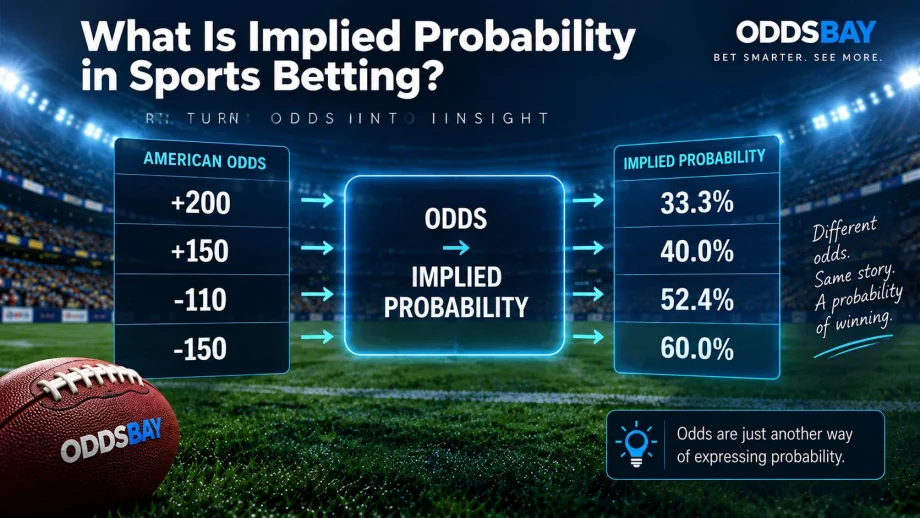
Implied probability is the probability represented by a betting price. If American odds are +150, the corresponding implied probability is 40%. If the price is -150, the implied probability is 60%.
That does not mean the sportsbook is declaring that the outcome has an objectively correct 40% or 60% chance of occurring. The displayed price is a market price, and sportsbook margin can be embedded in the available prices. Implied probability is therefore best understood as a way to translate odds into a common percentage scale.
How to calculate implied probability from positive American odds
For positive American odds, divide 100 by the odds plus 100:
Implied probability = 100 ÷ (positive odds + 100)
At +150, the calculation is 100 ÷ 250 = 0.40, or 40%. At +200, it is 100 ÷ 300 = 0.333, or about 33.3%.
Positive odds represent the profit on a hypothetical $100 winning stake. The larger the positive number becomes, the lower the implied probability.
How to calculate implied probability from negative American odds
For negative American odds, use the absolute value of the odds and divide it by that number plus 100:
Implied probability = |negative odds| ÷ (|negative odds| + 100)
At -150, the calculation is 150 ÷ 250 = 0.60, or 60%. At -200, it is 200 ÷ 300 = 0.667, or about 66.7%.
Negative odds show how much would hypothetically need to be risked to win $100 in profit. As the negative number becomes larger in magnitude, the implied probability rises.
Why percentages make odds easier to compare
American odds are compact, but they are not always intuitive. A percentage gives you a common frame of reference. Converting +120, -105 and -135 into implied probabilities makes the relationship between those prices easier to see.
This becomes especially useful when you begin comparing prices across sportsbooks. Two books can offer different odds on the same selection. Converting both prices into implied probabilities helps show how meaningful that difference is.
Implied probability is not the same as your probability estimate
A market-implied percentage and your own estimate answer different questions. The implied probability tells you what probability corresponds to the displayed price. Your estimate is your judgment—or the output of a model—about how often the outcome should occur.
The gap between those two numbers is where bettors often begin thinking about price and value. But the calculation alone does not prove that a bet is good. Your own probability estimate can be wrong, and the market price may include margin.
Why two sides can add to more than 100%
If you convert both sides of a typical two-way market into implied probabilities, their total may exceed 100%. That excess is connected to the sportsbook’s built-in margin, often called vig or juice.
For that reason, you should not automatically interpret each displayed implied probability as a pure market forecast. Our guide to sportsbook vig and margin explains why the raw percentages can exceed 100%.
How implied probability connects to line shopping
Price differences that look small in American odds can matter over repeated bets. If one sportsbook lists a selection at +120 and another lists the same selection at +130, the underlying implied probabilities are different—and so are the potential returns.
This is why understanding probability naturally leads to line shopping and odds comparison. Before comparing prices effectively, it helps to understand what those prices represent.
A practical way to use implied probability
When you encounter a price, translate it mentally or with a calculator into a percentage. Ask what the price implies, whether margin is affecting the market, and how the price compares with other available quotes. That process turns odds from a payout notation into information you can interpret.
If you are still building your foundation, start with our guide to how sports betting works, then use implied probability as the bridge between odds, price comparison and market behavior.
Key takeaway
Implied probability converts betting odds into a percentage. It does not tell you with certainty how likely an outcome is, but it gives you a consistent language for interpreting prices, comparing markets and understanding concepts such as vig and line shopping.