
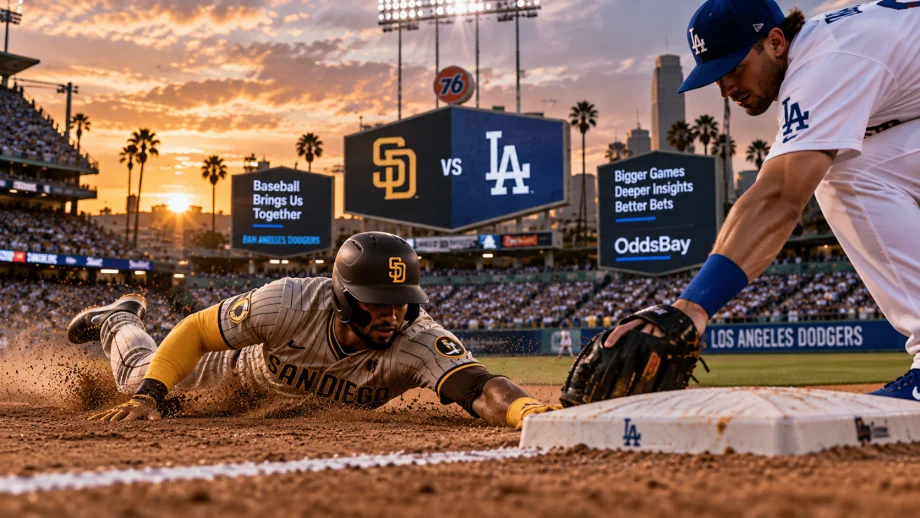
Research snapshot: September 22, 2026. MLB listed the September 23 game for 10:10 p.m. ET (7:10 p.m. PT) at Dodger Stadium. San Diego listed Robbie Ray as probable (13-8, 3.60 ERA, 138 strikeouts), while the Dodgers’ starter remained TBD at the research snapshot. Entering September 22, MLB standings showed San Diego at 87-69 and Los Angeles at 96-60. Probable pitchers and game information can change, so this preview separates confirmed context from items that still need verification closer to first pitch.
San Diego Padres at Los Angeles Dodgers is exactly the kind of late-season game that belongs in OddsBay Intelligence™: the schedule is immediate, the competitive context matters, and the betting decision can change as information becomes firmer. The article is deliberately built around what is known and what is not. Ray gives one side of the run-prevention equation; the unresolved Dodgers starter makes patience and re-pricing central to the betting process. That distinction matters because a useful preview is not a prediction dressed up with statistics. It is a framework for deciding which information deserves weight, which information remains uncertain, and whether the available price compensates for that uncertainty.
Game identity and why the timing matters
Sport: MLB
Away: San Diego Padres
Home: Los Angeles Dodgers
Game date: September 23, 2026
Scheduled start: 22:10 ET
Venue: UNIQLO Field at Dodger Stadium
OddsBay event ID: UNRESOLVED
That identity block is more than housekeeping. OddsBay can use it to associate this article with the correct event without guessing from a headline. Editorially, it also forces the analysis to stay anchored to one game and one information window. Readers should know whether a statement describes the market when the article was researched, a season-long tendency, or a condition that still needs confirmation.
Start with the run-prevention chain, not a single pitching number
Baseball prices often invite bettors to reduce a matchup to the starting pitchers. That is understandable because the starter influences the first several innings, the handedness environment and the likely shape of the game. But the full run-prevention chain is starter, expected workload, defensive support, bullpen bridge and late-inning relief. A starter can pitch well and still leave a side exposed if the bullpen path is thin; conversely, an average starter can be supported by a favorable relief structure. The correct question is not simply “Who has the better ERA?” It is “What run-prevention path is the current price asking me to buy?”
For Padres–Dodgers, the probable-pitcher information above should be treated as a live input rather than a permanent fact. If a starter is still TBD, that uncertainty is itself relevant. If both starters are named, the next step is workload: recent pitch counts, rest, efficiency and any team incentive to manage innings. None of those should be invented. If they cannot be verified, the analysis should stop short of claiming them.
Lineups matter after the pitcher names are known
A pitcher’s handedness does not create a bet by itself. The actual lineup determines how much platoon leverage exists, where the on-base ability sits, whether key power is present and how deep the opposing order looks that day. Late-season baseball increases the importance of checking the posted lineup because teams can rest players, manage workloads or use different combinations. Until lineups are confirmed, the responsible approach is to describe the questions that matter rather than pretend the answers are already available.
For this matchup, bettors should compare the confirmed batting order with the assumptions embedded in any earlier handicap. If a key bat sits, the effect is not automatically a fixed number of cents on the moneyline or a guaranteed move in the total. Markets are multi-variable systems. The useful task is to re-evaluate expected offense, bench depth and matchup quality after the lineup becomes real, then compare that revised view with the price actually available.
Moneyline, run line and total are three different decisions
The moneyline asks whether one team’s win probability is mispriced. The run line asks a different question about margin and game shape. The total asks how the combined scoring environment compares with the posted number. A bettor can reasonably like one market and reject the others. In MLB especially, it is a mistake to treat the run line as merely a cheaper version of the moneyline; bullpen volatility, extra-base power, home-team ninth-inning rules and one-run game frequency all affect the distribution differently.
The same separation applies to totals. Starting pitching is important, but so are lineup quality, bullpen availability, park environment and weather when relevant. An under thesis that depends entirely on a starter working seven innings is fragile if that workload is not supported. An over thesis that depends on a tired bullpen is equally weak if bullpen usage has not been checked. OddsBay’s approach should make the dependency visible rather than hiding it behind a pick.
Price discovery: compare the number, not just the team
Two bettors can have the same baseball opinion and receive different long-run results if one consistently accepts worse prices. That is why the OddsBay MLB Game Intelligence layer matters. The goal is not to tell a reader that one sportsbook is always best; it is to make comparison habitual. A moneyline at -118 and the same side at -125 are not identical purchases. A total of 8.5 at different juice is not identical either. Price is part of the handicap.
Market movement also needs discipline. If a number changes, that observation is real only when the earlier and later prices are verified with timestamps. The reason for the move is a separate question. Without reliable evidence, OddsBay should not claim that a lineup change, pitcher announcement or injury “caused” the market to move. The correct language is descriptive: the price changed after or around a piece of news, while causation remains unproven.
What to monitor between publication and first pitch
The highest-value update checklist is straightforward: confirm the starting pitchers, confirm the lineups, review meaningful player availability, check bullpen usage from the previous several games, verify weather or roof conditions when they can affect play, and then compare the current moneyline, run line and total across operators. That process is especially important in late September because the information environment can change quickly even when the basic matchup does not.
Readers should also distinguish “must win” language from actual baseball probability. Standings pressure can affect managerial choices, but urgency does not magically improve contact quality, command or relief pitching. The standings explain why a game matters; they do not supply an automatic wager. For Padres and Dodgers, competitive context should be used to ask better questions about deployment and workload, not to override price.
How this fits the broader OddsBay workflow
If you are new to comparing baseball markets, the OddsBay sports betting guide explains the basic relationship between odds, implied probability and price shopping. For game-specific work, the MLB intelligence hub is the more relevant companion because it keeps the focus on current events, operator differences and the timing of observations.
This article is also designed to work as part of a batch rather than as an isolated page. The AL Central pieces, for example, can be read together because the standings are moving across multiple fields. West Coast games can be revisited later in the day because they provide more time for starter and lineup confirmation. That is the advantage of a game-aware editorial system: publication timing can match the information cycle instead of treating every preview as equally fresh all day.
Betting decision framework
Before making a decision on Padres–Dodgers, write down the thesis in one sentence and identify what would invalidate it. If the thesis depends on a named starter, what happens if that starter changes? If it depends on a platoon edge, what happens if the lineup is different? If it depends on bullpen superiority, is the relevant relief group actually available? If it depends on a price, what is the maximum number at which the edge still exists? This turns a vague opinion into a falsifiable process.
Then compare markets. Sometimes the moneyline expresses the thesis most cleanly. Sometimes a first-five market isolates the starting-pitcher view from late bullpen uncertainty. Sometimes the total is the better expression because both sides of the matchup point toward the same run environment. And sometimes the best decision is to wait. “No bet yet” is a valid conclusion when the most important information is unresolved.
Bottom line
Five-inning markets versus full-game exposure
One practical way to express a starter-driven opinion in Padres–Dodgers is to compare first-five-inning markets with full-game markets. The first five reduce, but do not eliminate, bullpen influence and can make sense when the handicap is concentrated in the starting matchup. Full-game pricing brings relief depth, bench decisions and late leverage into the equation. Neither is inherently superior. The point is to match the market to the thesis instead of choosing a market first and inventing a thesis afterward.
That distinction becomes even more important when one starter is TBD or when late-season workload management is possible. If the central uncertainty sits after the fifth inning, a first-five market may isolate the cleaner part of the analysis. If the perceived edge is bullpen depth, the opposite can be true. The bettor should be able to explain why the chosen time horizon captures the expected advantage.
Park and scoring environment without overfitting
UNIQLO Field at Dodger Stadium is part of the context, but park reputation should not become a shortcut. Park effects interact with weather, handedness, batted-ball shape and the actual hitters in the lineup. A famous hitter-friendly or pitcher-friendly label is not enough to justify a total. The better method is to treat the park as one input and wait for game-day conditions before making claims that depend on wind, temperature or roof status.
This is also where sample-size discipline matters. A handful of recent high-scoring games does not prove that the park or teams have entered a new permanent run environment. Recent performance can help identify questions, but season context and matchup mechanics should prevent recency from becoming the entire handicap.
Bullpen leverage and the hidden second matchup
Every MLB game contains a second matchup after the starters leave. Which relievers are available, which were used on consecutive days, who handles the highest-leverage pockets and how the opposing lineup is distributed by handedness can change the late innings. Because those facts can shift daily, the article does not label a bullpen “available” or “unavailable” without evidence. Instead, bettors should check the previous series and the manager’s recent usage before committing to a full-game position.
For Padres–Dodgers, that late-game map can also influence live betting. A pregame view may become stronger or weaker once pitch count, velocity, command and bullpen deployment are visible. Live markets move quickly, so the same price discipline applies: the fact that a game is underway does not make every reaction actionable.
What would make this preview materially different tomorrow?
A good current-game article should be able to answer that question. For Padres–Dodgers, a starter confirmation or change, a meaningful lineup absence, unexpected bullpen usage the night before, or a material move in the market could all change the evaluation. That is why the article records a research snapshot rather than pretending to be timeless. OddsBay Intelligence can prioritize the story while the event is upcoming and then remove it from game-priority once the game goes live, while the analysis remains useful as a record of the pregame process.
Padres vs. Dodgers deserves attention because it combines an immediate late-season game with information that can materially change the handicap before first pitch. The strongest approach is not to chase a dramatic narrative. Verify the pitchers and lineups, understand the bullpen path, separate moneyline/run line/total logic, compare operator prices and timestamp any meaningful market observation. If new information changes the assumptions, change the handicap with it.
OddsBay’s job is to make that process easier to see. The OddsBay ecosystem is built around comparison and game intelligence, not certainty theater. For this September 23 matchup, the edge—if one exists—should come from better information discipline and better price selection, not from pretending that late-season urgency guarantees an outcome.
Verification note
Schedule, standings and probable-pitcher context in this article was checked against MLB.com on September 22, 2026. Probable pitchers are explicitly subject to change. Odds and market movement are not stated unless independently verified at a defined observation time.