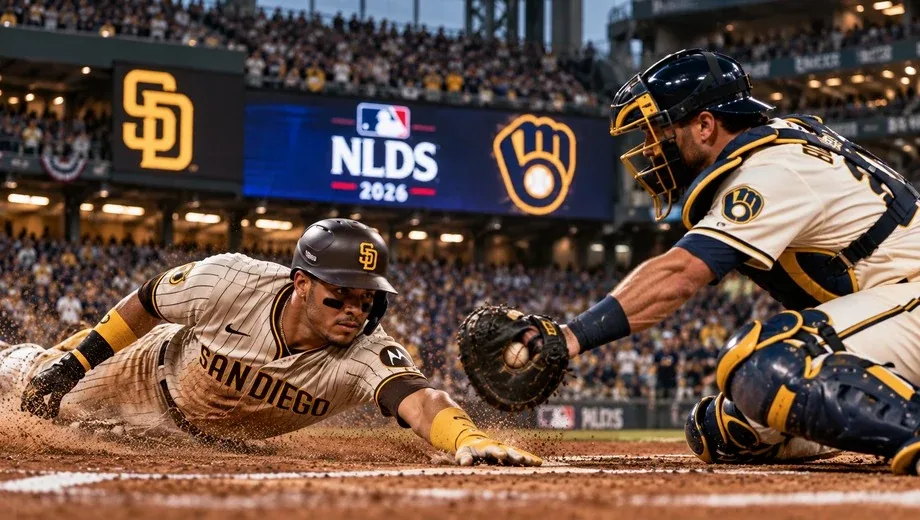
San Diego's problem is not that an elimination game demands aggression. Everyone knows the Padres are down 0-2. The harder problem is deciding where aggression buys the most win probability without exhausting the very pitchers needed to finish the night. Milwaukee has come from behind twice, its bullpen has thrown nine scoreless innings in the series, and the Padres now have to build a 27-out plan around Nick Pivetta while knowing there is no value in saving tomorrow if Tuesday goes wrong.
Mason Miller is the clearest example of the elimination-game paradox
Game 2 turned on a confrontation that looked ideal for San Diego: Mason Miller, throwing 101 mph, against Jackson Chourio. Chourio drove the pitch at 110 mph and Milwaukee completed another comeback. The result does not make using Miller a mistake. It illustrates the real problem with October leverage: the best available arm can still lose a plate appearance, and asking that arm for more outs changes what remains later.
MLB's Game 3 preview says Miller still owns the back end, with Adrian Morejon setting him up. Bradgley Rodriguez and Jason Adam can be used earlier, and Yuki Matsui is available for a left-handed pocket. The travel day resets the group physically, but elimination pressure changes the manager's clock. If Pivetta is in trouble in the fourth, San Diego cannot automatically wait for the traditional seventh-inning bridge. It may have to spend a good reliever before the game has a familiar late-inning shape.
The elimination premise is now anchored to a confirmed starting matchup: Milwaukee lists Dustin May for Game 3, while San Diego lists Nick Pivetta. Pivetta enters with a 2.86 ERA and 42 strikeouts in the displayed postseason/probable-pitcher line; May is listed at 7-9 with a 4.70 ERA and 144 strikeouts. Those numbers do not decide the game, but they clarify the bullpen question. San Diego’s cleanest path is not “use everyone.” It is to get enough length from Pivetta that the best relievers can be deployed when the leverage is real rather than simply because elimination is possible.
Pivetta is the piece that can keep the bullpen from becoming the whole story
Pivetta returned from a flexor strain in September and posted a 1.64 ERA across five starts after coming off the injured list. His Wild Card start lasted only 3 1/3 innings, but that short outing came with a fresh bullpen and a clinching opportunity. Tuesday is different. The Padres need Pivetta to record meaningful outs without allowing the game to escape, because every inning he absorbs at competitive run expectancy preserves a better matchup for later.
His career 8.76 ERA against Milwaukee looks alarming until the sample is opened up: MLB notes much of the damage traces to one rough rookie outing in 2017, and he did not face the Brewers this season. That is exactly the kind of historical number that should not be allowed to write the preview by itself. The more relevant evidence is his post-injury form, his current stuff and how San Diego intends to pair him with a rested bullpen.
Mason Miller is the unavoidable workload case because Game 2 ended on his pitch. Jackson Chourio turned a 101 mph fastball into a 110 mph walk-off contact event, giving Milwaukee a 4-3 win and a 2-0 series lead. The important detail for Game 3 is not that an elite reliever was beaten once; elite relievers allow damaging contact too. It is that San Diego has already spent one of its most valuable late-inning weapons in a high-stress loss and now has no margin for a conventional “save him for later” hierarchy.
Milwaukee can make urgency expensive
The Brewers do not need to match San Diego's desperation. Dustin May starts with a deeper set of bulk options behind him: Robert Gasser, Shane Drohan and Kyle Harrison are all fresh. Trevor Megill, Abner Uribe and Aaron Ashby have each worked scoreless baseball in the first two games and gain rest from the travel day. That gives Pat Murphy permission to treat an early deficit differently from the Padres. Milwaukee can absorb innings without immediately touching every highest-leverage arm.
Chourio is the offensive pressure point. He has produced back-to-back multi-RBI games and a .958 OPS through the first two contests. Brice Turang, by contrast, is still looking for his first hit of the series. That uneven production matters because Milwaukee has won without every part of its order firing. San Diego's path is not simply 'stop Chourio'; it is to prevent the lineup from extending innings until the dangerous pockets cycle back.
Michael King’s Game 2 work also explains why elimination pressure cannot be reduced to bullpen aggression. King struck out six over five innings and allowed one earned run on three hits. San Diego still lost. A strong five-inning start can create the desired bridge, but it does not guarantee that the bridge holds or that the offense creates enough separation. Pivetta’s job Tuesday is therefore partly to preserve optionality: every efficient inning delays the point at which Mike Shildt must decide whether the current jam is important enough to spend tomorrow’s theoretical arm today.
San Diego has to create a lead worth protecting
Ty France entered Game 3 preparation with seven hits in 15 postseason at-bats, while Manny Machado and Xander Bogaerts had five apiece. Jake Cronenworth was 1-for-13. Those are small samples, but they identify where the immediate offensive burden has fallen. If the Padres spend Miller, Morejon and Adam aggressively, the lineup has to create enough separation that every later plate appearance is not a one-run emergency.
Petco Park makes that especially relevant. San Diego cannot assume a single swing will erase poor sequencing. Advancing runners, controlling the strike zone and taking the extra base can matter as much as waiting for a three-run homer. Elimination pressure often gets described as emotional. Here it is operational: the Padres need to manufacture a game state in which their best relievers can protect something rather than repeatedly enter with no margin.
| Resource entering Game 3 | Milwaukee | San Diego |
|---|---|---|
| Starter | Dustin May | Nick Pivetta |
| Fresh bulk options | Gasser / Drohan / Harrison | More conventional relief mix |
| Back-end note | Megill / Uribe / Ashby rested after travel day | Miller remains back-end anchor; Morejon setup |
| Series pressure | Can lose and continue | Must win to continue |
The Padres’ NLDS roster gives Shildt several distinct relief shapes rather than one interchangeable group. The right-handed options include Miller, Jason Adam, David Morgan, Bradgley Rodriguez, Joe Musgrove and Walker Buehler, while Adrian Morejon and Yuki Matsui provide left-handed looks. That variety matters against a Milwaukee lineup capable of forcing matchup decisions with Christian Yelich and Jackson Chourio near the center of the run-creation problem. Elimination does not erase handedness; it makes a bad matchup harder to postpone.
What elimination changes — and what it does not
San Diego should be more willing to break role conventions, but it should not confuse urgency with indiscriminate pitching changes. The best move can still be leaving Pivetta in if he is missing bats and the next pocket favors him. Conversely, a clean fourth inning does not entitle him to face a dangerous pocket again if the matchup has deteriorated. The decision tree becomes shorter, not irrational.
That distinction is the betting takeaway too. A bettor who believes San Diego will deploy its bullpen unusually early should decide which market actually expresses that idea. It may affect Milwaukee's late scoring expectation, San Diego's team total, or the full-game side differently. There is no reason to force the same thesis into every market. The baseball question comes first: how many high-quality outs can San Diego buy before the cost of buying them becomes its next problem?
Milwaukee can exploit that urgency without changing its identity. The Brewers have won both games by coming back, which means San Diego has repeatedly had to protect something rather than merely chase. If Milwaukee keeps Game 3 within one run into the middle innings, every baserunner can force the Padres to consider Miller or another leverage arm earlier than a normal regular-season script. That is the hidden cost of a 2-0 deficit: the opponent can make you spend premium resources before it has actually taken the lead.
Tuesday ends when the Padres run out of outs, not when they run out of plans
Milwaukee has earned the luxury of patience with two comeback wins. San Diego has earned no such margin. But the Padres' best route is not to manage as though the ninth inning begins in the first. It is to identify the first truly decisive pocket and spend their best resources there, while asking Pivetta and the offense to delay that moment as long as possible. That is the real cost of elimination pressure: every premium out is more valuable because there may be no next game, and more expensive because the same pitcher cannot record all 27.
Petco Park adds a final tactical layer. San Diego does not need to manufacture a slugfest to extend the series. Baserunning, first-to-third pressure, defense and avoiding empty strikeouts can create leverage without requiring three-run homers. In an elimination game, those smaller edges matter because they can produce the lead that makes the bullpen expenditure rational. The inning-by-inning question is simple: has San Diego created enough scoreboard value to justify using its best remaining arm now?
 Dodgers at Braves Game 3: The Starter Hook Is the Series Pivot
 Braves vs. Dodgers NLDS Game 2: How to Reprice a Playoff Series After the Opener
 Padres vs. Brewers NLDS Game 1: When Series Price and Game Price Tell Different Stories