
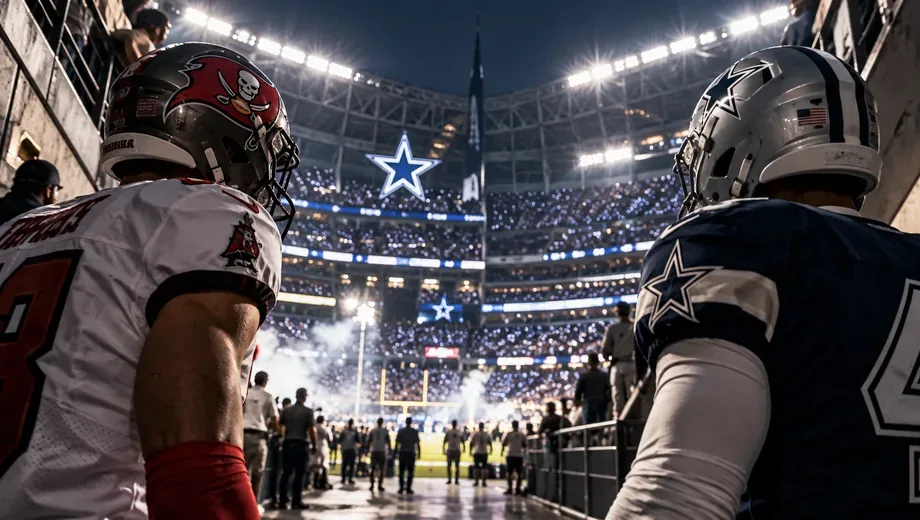
Tampa Bay Buccaneers visits the Dallas Cowboys on 2026-10-08 at AT&T Stadium. This OddsBay Week 5 analysis is built around short week, pass protection, quarterback decision-making and explosive-play control. The purpose is not to predict from reputation, nor to stretch a routine preview with generic betting language. It is to identify the football questions that can be checked, updated and connected to market information without inventing evidence.
Four days changes the definition of preparation
Tampa Bay and Dallas do not get a normal NFL workweek before this Thursday game. Both clubs play on October 4 and return four days later, which compresses recovery, installation and personnel decisions into the same window. Dallas comes home after its Week 4 trip to Houston, while Tampa Bay must turn from a home game against Green Bay into a road trip to Arlington. That difference is context, not a built-in edge. The evidence that matters is how much each team can actually practice, which players are limited, and whether either staff has to narrow its menu because physical recovery and mental installation are competing for time.
A short week also changes what “new” means. A concept that looks attractive on film may not be useful if it requires communication the unit cannot rep enough before Thursday. Familiar calls, protections and personnel groupings can gain value because the players already own the details. That makes this matchup unusually sensitive to continuity along the offensive line and at positions that participate in protection. The final injury report matters not merely as a list of names, but as an indication of how much continuity each offense can preserve.
Dallas can make the short week visible through pressure
The Cowboys’ defensive opportunity is to force Tampa Bay to solve protection problems before the Buccaneers have had a full week to rehearse the answers. That does not mean blitzing on every important down. Movement, simulated pressure and late presentation can create communication stress without sacrificing coverage numbers. The important question is whether Tampa Bay can identify the picture quickly enough to keep the quarterback’s first read and checkdown structure intact.
For Tampa Bay, avoiding obvious passing situations becomes especially valuable. A clean first-down gain preserves the run, play-action and quick game; a sack, penalty or tackle for loss gives Dallas permission to attack a narrower menu. The matchup should therefore be read through the sequence of downs. Pressure on third-and-long may be the visible result, but the more important defensive win may have happened one snap earlier when Dallas created the long-yardage situation.
Tampa Bay’s answer has to begin before third down
The Buccaneers do not need to neutralize every Dallas pressure look to keep control of the game. They need enough early-down efficiency to stop the Cowboys from dictating when and how the ball must be thrown. Screens, quick throws, play-action and a credible run threat can all change the rusher’s timing, but only if Tampa Bay avoids repeatedly playing from behind the sticks.
Personnel availability can reshape that answer. If a starting lineman or a protection-relevant back or tight end is limited, the staff may have to protect one matchup at the expense of another route or formation. That is why Thursday injury information belongs directly inside the tactical story. The question is not simply who is “in” or “out”; it is what the available combination allows Tampa Bay to call without exposing the quarterback.
Dallas’ offense has its own compressed-week problem
The short week is not a one-sided burden. Dallas also has to recover from Week 4, evaluate its own injuries and install a plan against Tampa Bay with limited field time. The Cowboys’ cleanest offensive path is to avoid creating a game in which every important possession depends on a difficult conversion. Staying efficient on early downs can keep the full formation and motion menu available and reduce the number of snaps on which Tampa Bay can attack an obvious pass.
That makes negative plays unusually expensive. A holding penalty or protection error can erase the value of several efficient snaps, and a compressed week gives an offense fewer practice repetitions to repair communication problems that surfaced four days earlier. The Week 4 tape should therefore be refreshed before publication for workload, sacks, pressures, penalties and any late-game injuries that could alter Thursday’s personnel plan.
The red zone is where a simplified game plan gets tested
Between the 20s, an offense can create space with formation and route depth. Near the goal line, that space disappears and defenses can play tendencies more aggressively. If either staff has reduced its call sheet for the short week, red-zone possessions can expose the limitation. A team that moves the ball but repeatedly settles for field goals leaves the opponent close enough to survive a weaker overall drive profile.
For Dallas, finishing possessions would let the defense play with a more favorable score state and attack Tampa Bay’s protection. For the Buccaneers, touchdowns can prevent the Cowboys from turning the second half into a pass-rush game. Red-zone execution is therefore connected to the central short-week thesis rather than being a generic statistic appended to the preview.
What must be refreshed after Week 4
This article has a deliberately narrow evidence window because both teams play immediately before the matchup. The final editorial pass should examine official practice participation, game-status designations, the Week 4 snap load of players carrying injuries, and any transaction that changes line or skill-position depth. If the evidence remains uncertain, the article should preserve that uncertainty rather than promote a projection to a confirmation.
Any market observation added to the package also needs an observation time and like-for-like comparison. A Thursday price can move quickly as availability becomes clearer. OddsBay should describe the observed change without claiming an injury, betting action or other event caused it unless direct evidence supports that explanation.
The question Thursday night has to answer
Buccaneers-Cowboys is ultimately a test of which team can preserve more of its normal football on an abnormal calendar. If Tampa Bay keeps the down structure manageable and its protection communication intact, Dallas loses some of the leverage a short week can create. If the Cowboys manufacture early negative plays, the Buccaneers may be forced into the exact obvious situations that are hardest to repair with limited preparation.
Dallas faces the mirror image on offense: can it play cleanly enough that Tampa Bay never gets to turn a compressed installation week into confusion? The final answer belongs in the interaction between available personnel, protection and red-zone finishing. “Thursday night” is the setting. Which team builds a Thursday-proof plan is the actual story.
The pre-Week 5 baseline makes Tampa’s urgency concrete
Tampa Bay entered Week 4 at 0-3 after losses to Cincinnati, Cleveland and Minnesota. Through those three games, the Buccaneers had 838 offensive yards, converted 14 of 43 third downs and allowed 13 sacks. Those numbers do not decide the Dallas game, and Week 4 against Green Bay still has to be incorporated after it is final, but they sharpen the short-week thesis: Tampa cannot afford for protection problems or stalled third downs to become harder to correct on four days of preparation. The offense has already been operating with little margin.
Dallas entered Week 4 at 1-2 before its road game at Houston. That means both teams reach the Sunday-to-Thursday transition with an immediate need to learn from Week 4 rather than install a completely new identity. For the Buccaneers, the first three weeks make protection a verified concern rather than a generic Thursday-night talking point. For Dallas, the useful question after Houston is whether its defense created the kind of early-down disruption that can be carried into a compressed plan against Tampa Bay.
Quarterback availability changes the entire protection conversation
Tampa Bay’s quarterback situation must be refreshed after the Packers game rather than assumed. NFL coverage entering Week 4 identified rookie Jalon Daniels as the starter against Green Bay, while Baker Mayfield’s status was a current storyline. That is exactly the kind of time-sensitive fact that cannot be frozen into a Week 5 preview before the Week 4 game is complete. If the same quarterback starts in Dallas, the protection menu and communication burden can be analyzed from the Green Bay tape. If the starter changes, the article’s central question remains valid but the answers may change materially.
A different quarterback can alter launch point, processing rhythm, scramble threat and how much protection help the offense needs. On a full week, a staff can devote practice time to tailoring those details. On a Thursday turnaround, there is less room to rebuild the plan. The final version should therefore treat quarterback confirmation as a structural input, not a footnote.
Dallas’ home setting matters because the calendar already favors continuity
AT&T Stadium removes weather uncertainty from the matchup, which keeps the analytical focus on communication, recovery and execution. Dallas also returns from Houston rather than making another road trip, while Tampa Bay travels from Florida after its Sunday home game. The distinction should not be inflated into a prediction, but it does mean Dallas can conduct the short turnaround in its normal facility and then play at home.
That logistical continuity becomes meaningful only if Dallas converts it into cleaner operation. False starts, missed protection exchanges or substitution problems would erase the practical benefit. Tampa Bay, conversely, can neutralize much of the travel story by getting through the first quarter without procedural mistakes and by keeping the quarterback out of repeated long-yardage downs.