
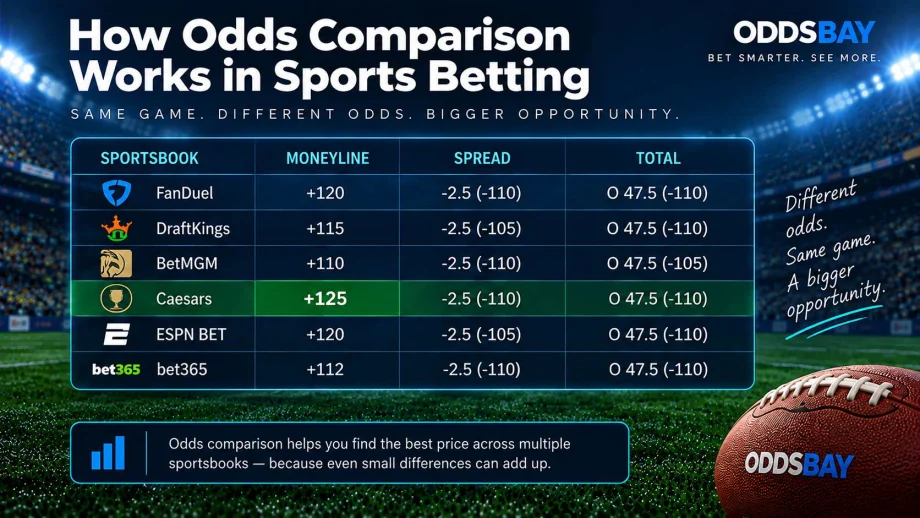
Odds comparison is the process of placing multiple sportsbook quotes for the same market side by side so you can see how their prices differ. It sounds straightforward, but useful comparison requires more than finding the largest number on a screen.
You need to confirm that the books are quoting the same event, market, selection, line and settlement conditions. Once those elements match, price comparison becomes a powerful way to understand what the market is offering.
Why sportsbooks can show different odds
Sportsbooks operate independently. Their prices can reflect different models, trading decisions, risk exposure and customer activity. They may also update at different times.
As a result, one sportsbook might offer +125 while another shows +115 on the same moneyline selection. On a spread, one might offer -2.5 at -110 while another offers -3 at +100. Those are not necessarily equivalent offers.
Start by matching the exact market
Before comparing prices, verify that you are looking at the same market. A full-game moneyline should not be compared with a first-half moneyline. A regulation-only hockey market may settle differently from a market that includes overtime.
Market labels can look similar while the underlying rules differ. Good comparison starts with market identity, not price.
Compare the line and the price together
For moneylines, the quoted odds are usually the main number to compare. For spreads and totals, there are two components: the line itself and the price attached to it.
For example, -2.5 at -115 and -3 at +100 represent different tradeoffs. The second quote offers a better payout price but requires the favorite to cover a larger spread. There is no meaningful comparison if you ignore one of those dimensions.
What counts as a better price?
When every other condition is identical, a higher positive price is better for the bettor, while a negative price closer to zero generally requires less risk for the same target profit. But once the underlying spread or total changes, the comparison becomes more complex.
This is why odds comparison should not be reduced to a single green highlight without context. The market number and price must be interpreted together.
Comparison and implied probability
Converting prices to implied probability can make differences easier to understand. A shift from +110 to +125 is not merely a change in notation; it represents a different implied percentage and a different potential return.
Understanding sportsbook margin also helps explain why prices vary and why comparison matters.
Odds comparison versus line shopping
The terms overlap, but they emphasize slightly different ideas. Odds comparison is the analytical act of viewing multiple quotes together. Line shopping is the bettor behavior of checking those alternatives before accepting a line.
In practice, the two concepts work together: comparison supplies the information; line shopping uses it.
What OddsBay can add
A comparison product can organize observed sportsbook quotes so users do not have to treat each operator as an isolated market. The value is not in declaring that one sportsbook is universally “best.” It is in showing the prices that were actually observed and allowing the user to compare them.
Any live comparison should distinguish recorded observation from interpretation and should never substitute invented prices when source data is unavailable.
A practical comparison checklist
Confirm the event. Confirm the market. Confirm the selection. Check whether the spread or total number matches. Compare the attached odds. Review settlement rules when relevant. Then consider whether the difference is large enough to matter for the bet you are evaluating.
For the broader mechanics of sports wagering, see How to Bet on Sports.
Key takeaway
Odds comparison is useful because sportsbooks can quote the same market differently. The strongest comparison is not simply “which number is biggest?” It is a like-for-like evaluation of the market, line, price and rules.