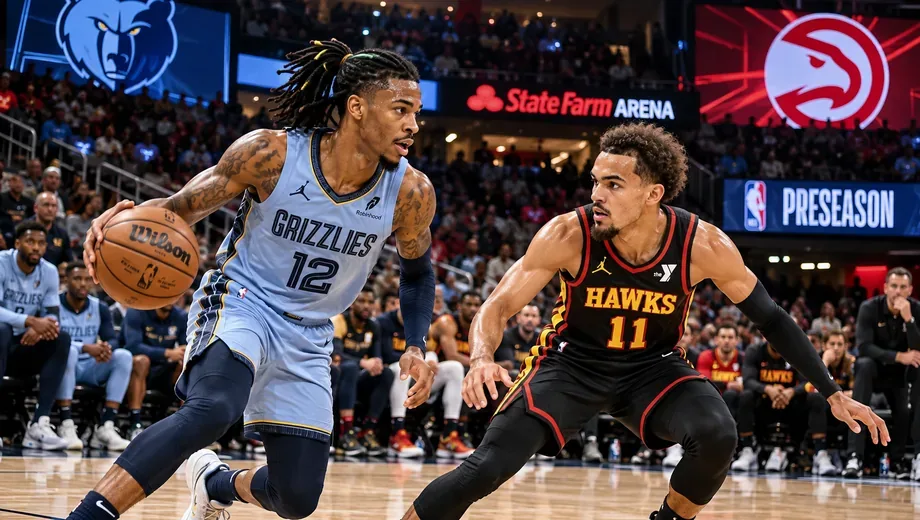
Memphis visits Atlanta on October 5 for a preseason opener that matters less for the final score than for the first public look at two very different roster-building projects. Memphis has moved into a post-Ja Morant, post-Jaren Jackson Jr. phase and added No. 3 pick Cameron Boozer, Jerami Grant, Isaiah Stewart and D’Angelo Russell around a young core that includes Cedric Coward and Zach Edey. Atlanta enters from a 46-win season with an unusually deep perimeter group and new defensive options in Luguentz Dort and rookie Kingston Flemings. That contrast makes the rotation sheet unusually informative: Memphis is defining responsibilities, while Atlanta is deciding how to distribute minutes across an already credible structure.
Memphis has more than a starting-five decision
The Grizzlies are not merely choosing which five players open the game. They are deciding where creation lives after Morant's departure and how Boozer fits beside Edey, Coward and veteran newcomers. Russell can organize pick-and-roll possessions, Grant can absorb difficult wing possessions, and Boozer's value grows if his passing and decision-making connect those pieces. The first substitution can therefore say more than the opening lineup. If Memphis keeps one organizer on the floor with younger groups, that points toward a staggered hierarchy; if several creators share the floor, the staff may be testing a more distributed offense.
Atlanta's depth creates a different experiment
Atlanta already has a strong reference point. Jalen Johnson, CJ McCollum, Nickeil Alexander-Walker, Dyson Daniels and Onyeka Okongwu formed a productive group last season, and the Hawks have since added Dort plus another young guard in Flemings. Quin Snyder can use preseason minutes to decide whether Dort's point-of-attack defense belongs with the starters or becomes a weapon that changes reserve units. The answer affects more than defense: every extra non-primary scorer in a lineup changes where Johnson and McCollum must create advantages.
Boozer's touches will reveal more than his point total
Boozer arrives with the profile of a forward who can score, pass and process the floor. His first NBA preseason possessions are most useful when they show where Memphis places him. Elbow touches would invite passing reads; screening for Russell would test his ability to roll or pop; possessions initiated by Boozer would signal a larger developmental burden. A 16-point night built on transition finishes would tell a different story from eight points accompanied by repeated half-court creation responsibilities.
The ball-handler hierarchy is Memphis' clearest tell
Without Morant, Memphis must decide who starts possessions and who finishes them. Russell is the obvious veteran organizer, but Coward and Boozer can reduce the need for one guard to dominate every touch. Watch what happens after a defensive rebound: does the nearest capable handler push, or does the group search for Russell? That choice determines whether Memphis can play with pace while still keeping enough structure to get Edey deep catches and Grant favorable wing matchups.
Atlanta can pressure that hierarchy immediately
The Hawks' perimeter personnel makes this a difficult first test. Daniels, Alexander-Walker and Dort can apply pressure at different points of a possession without asking Johnson to carry the hardest guard assignment. If Memphis struggles simply to enter offense, that may expose a genuine ball-security or spacing problem. If the Grizzlies consistently create a second side against that pressure, the mechanism matters more than whether the resulting three goes in.
Edey changes the geometry of every Memphis unit
Edey's size gives Memphis a natural interior reference point, but it also forces choices around pace and spacing. Playing him with another big can strengthen the glass while shrinking driving lanes; surrounding him with mobile forwards can make his screening and rim gravity more valuable. Atlanta's Okongwu can pull him into decisions away from the rim, so Memphis' coverage and recovery responsibilities will be worth tracking whenever those centers share the floor.
What can survive beyond one preseason night
The durable findings are role decisions that repeat across several stints: who initiates after makes and misses, which players are paired with Boozer, whether Atlanta uses Dort with its established core, and how each team protects spacing when it gets bigger. Shooting percentages and late-game reserve results can swing wildly. Rotation order, recurring pairings and assigned responsibilities are more likely to reveal what the coaches are actually building.
Coward and Boozer can separate initiation from advantage creation
Memphis does not have to replace Morant with a single imitation. Cedric Coward and Cameron Boozer give the Grizzlies two larger connectors who can move a possession forward without monopolizing it. That matters against Atlanta because Daniels, Dort and Alexander-Walker can make a conventional point-guard entry uncomfortable. If Memphis can enter through a wing, hit Edey at the elbow or use Boozer as a short-roll passer, Russell can receive the ball after the defense has already shifted. The sequence would distribute creation by function: one player gets the offense organized, another bends the coverage, and a third attacks the resulting gap.
The opposite outcome would be revealing too. If every difficult possession ends with Russell walking the ball into a high screen because the younger forwards cannot reliably connect actions, Memphis will know how much structure it still needs. That is why turnover type matters. A risky pass from a rookie attempting the correct read is different from a possession that never creates a passing window at all.
Atlanta can use Dort without sacrificing Daniels’ playmaking value
Dort’s arrival gives Snyder a choice that few teams can make: Atlanta can place one elite pressure defender on the primary creator while keeping Daniels available to disrupt the next action. Against Memphis, that could mean Dort fighting over Russell’s screen while Daniels shades toward Coward or digs at an Edey catch. The arrangement would let the Hawks test a more aggressive defensive chain without forcing Johnson to spend every possession wrestling with a lead ball handler.
Offensively, however, the same grouping has to preserve enough room for Johnson and McCollum. Memphis can respond by helping from the least threatening perimeter spot and asking Atlanta to prove that its defensive-heavy combinations can punish the rotation. The preseason value is in seeing whether Snyder solves that spacing problem through cutting, screening and quick decisions rather than simply accepting a cramped floor.
Edey versus Okongwu tests two incompatible center jobs
Edey is most imposing when the game becomes physical and vertical: deep seals, hard screens, offensive rebounding position and rim protection. Okongwu is valuable precisely because he can make a traditional center defend movement. If Atlanta brings Okongwu into handoffs or short rolls, Edey has to choose between containing the ball and protecting the rim. Memphis’ weak-side rotations then become part of the center matchup even when Edey never leaves the paint.
At the other end, Atlanta must decide how much help Edey’s size deserves. Early double-teams would create passing tests for Memphis’ new forwards; single coverage would test whether the Grizzlies can consistently earn deep position. Either response produces more useful evidence than Edey’s raw rebound total because it shows which advantage the opponent believes it must remove first.
The first and second substitutions can expose the real hierarchy
Opening lineups often reflect ceremony, health management or a coach’s desire to give veterans familiar roles. The next ten minutes are harder to fake. If Boozer exits early and returns to lead a reserve group, Memphis is giving him developmental creation responsibility. If Russell stays attached to Edey, the staff may be prioritizing a veteran-big partnership. Atlanta can make similar statements by staggering Johnson, McCollum, Daniels and Dort.
Those patterns should be read over multiple stints rather than one substitution. Foul trouble, a minor knock or an experimental quarter can distort the order. But recurring pairings—especially who closes a first-half rotation and who begins the second quarter—can reveal which combinations the staffs want to see under more realistic game pressure.
Pace only matters if Memphis can keep its spacing organized
A younger Memphis roster has every reason to run, particularly after live-ball turnovers. Yet speed without lane discipline can turn athleticism into congestion. Coward and Grant need to occupy different levels of the floor, Boozer must know when to fill the middle and when to trail, and Edey cannot arrive so late that he blocks a driving lane already in use. Atlanta’s transition defense will test those habits because its long perimeter defenders can recover into passing lanes even after the first line is beaten.
If Memphis repeatedly produces an early paint touch and then a clean second-side shot, that is a meaningful offensive signal regardless of shooting percentage. It would show that the new hierarchy can generate advantage before the defense is set and still maintain enough organization to exploit the next rotation.
For broader context on evaluating NBA markets, see the OddsBay NBA Game Intelligence page and the sports betting guide.
The cleanest takeaway is responsibility under pressure
Memphis and Atlanta are at different stages, which is exactly why the matchup can be informative. The Grizzlies need to discover who can carry specific jobs after major personnel change; the Hawks can test how new defensive pieces sharpen an established core. The most transferable evidence will appear when the first option is denied. If Boozer, Coward or Russell can produce the next action against Atlanta pressure, Memphis has a workable chain. If Dort and Daniels can disrupt that chain without damaging Atlanta spacing at the other end, the Hawks have found a way to add defense without narrowing their offense.
 NBA Preseason Betting: Why the Score Can Matter Less Than the Rotation