
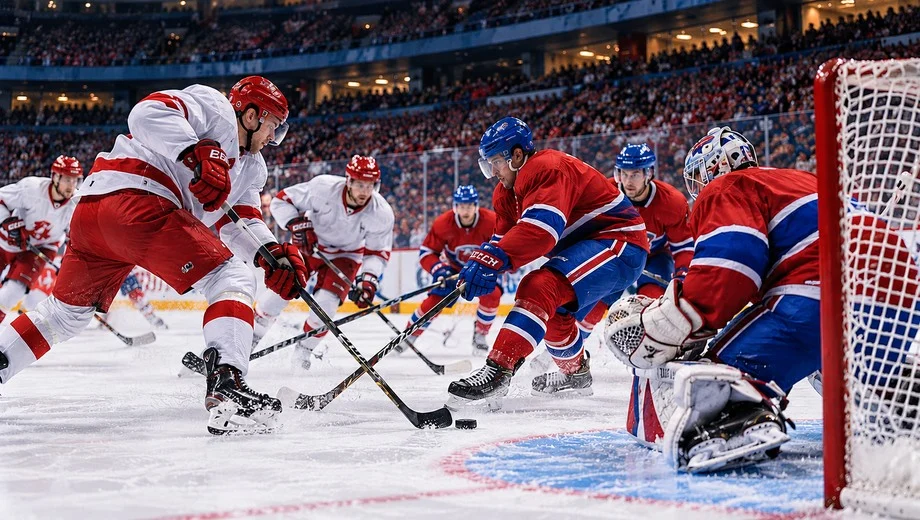
Hurricanes at Canadiens: What Montreal Changed After the Playoff Turn
Montreal's question is no longer whether it can skate with Carolina
The useful way into this home opener is not the banner, the building or even the phrase “playoff rematch.” It is the sequence Montreal lived through last spring. The Canadiens showed they could hurt Carolina: they won the first game of the Eastern Conference Final 6-2 after sweeping the three regular-season meetings. Then the series changed. Carolina won four straight, including the final two by 4-0 and 6-1. That progression matters because it separates capability from repeatability. Montreal had answers early; Carolina found better answers later. October 6 asks whether Montreal’s offseason work changed the parts of the matchup that became unsustainable over a seven-game series.
The roster now gives Montreal different ways to reach dangerous ice
Montreal does not return with the same set of tools. Chris Kreider has opened on Nick Suzuki’s wing with Cole Caufield, giving that line a direct net-front and rush-finishing presence. Phillip Danault is back in the middle of the lineup, which gives Martin St-Louis another experienced center for difficult matchups. Noah Dobson beside Mike Matheson changes the first pass and the amount of offense Montreal can create from its defense. Lane Hutson remains a second-pair driver rather than the only defenseman expected to turn retrievals into attack. Those additions matter specifically against Carolina because clean possession after a recovery is often more valuable than the recovery itself.
Carolina still makes every possession earn its next five seconds
The Hurricanes do not need to win every forecheck to control a game. Their advantage appears when one Montreal touch becomes two hurried touches and the Canadiens lose the chance to attack with numbers. Sebastian Aho, Andrei Svechnikov and Carolina’s layers behind the puck can turn an ordinary dump-in into a long defensive shift. Montreal’s response cannot simply be “exit cleaner.” It needs multiple exit routes: a center arriving underneath pressure, a defenseman willing to hold the puck for an extra beat, and weak-side support that is available before Carolina closes the wall. Dobson and Hutson can change the geometry, but only if the forwards give them somewhere useful to send the puck.
The missing pieces change the matchup at both ends
Freshness matters more than reputation in early October. Montreal is without Kaiden Guhle as he recovers from offseason adductor surgery, removing a mobile defender who can absorb hard defensive minutes. Carolina opened the season without Seth Jarvis because of a shoulder injury. Those absences do not cancel each other out; they alter different parts of the game. Montreal loses a defender who can help survive pressure and defend speed. Carolina loses a forward who can finish, retrieve and move through several roles. The better question is which team can replace the missing function rather than which missing name is larger.
Montreal should attack the rematch instead of trying to survive it
The Canadiens’ best periods in this matchup are likely to come when they force Carolina to defend movement before the Hurricanes can establish their own pressure game. Suzuki and Caufield can create off the rush, Kreider can occupy the interior, and Demidov gives the second unit another puck carrier capable of turning a neutral-zone touch into controlled offense. That does not require reckless hockey. It requires Montreal to recognize when Carolina’s forwards are above the puck and when a defenseman has stepped into space. The home team needs enough ambition to make Carolina turn, recover and defend its own goal line.
The crease matters, but it should not swallow the article
Goaltending will be important because Carolina can create clusters of chances rather than isolated shots. Montreal has Samuel Montembeault and Jakub Dobes available, while Carolina’s early rotation has included Brandon Bussi and Pyotr Kochetkov. The responsible pregame read is to wait for the actual starter rather than turn a projection into a fact. More important, evaluate what the starter is being asked to stop. A goalie seeing first shots from distance is living a different game from one handling lateral passes, screens and rebounds after a failed clear. The quality of Montreal’s defensive possessions will determine how large the goaltending burden becomes.
What the playoff film can still teach us
History is useful here because the teams met often enough to reveal adjustments, but it cannot be imported as a prediction. Montreal’s early success proved Carolina was not invulnerable. Carolina’s four-game response proved that Montreal’s first solution did not survive counter-adjustment. Personnel has changed, the season is new and neither club is operating at playoff rhythm. The transferable lesson is narrower: Montreal must create a second action after Carolina disrupts the first one. If the first breakout lane closes, there must be another. If the first rush dies, there must be support arriving behind it. That is a hockey problem, not a psychological one.
OddsBay read: price the new evidence, not the rematch label
A playoff rematch will attract a story before it attracts a number. That is precisely why the hockey needs to be defined first. A current price should be compared only after the starting goalies, final availability and line combinations are known. Montreal’s new personnel may justify a different assessment from May; Carolina’s championship pedigree may justify respect; neither statement creates a bet by itself. The most useful information on October 6 will be whether Montreal can move through Carolina’s pressure without surrendering the puck in layers, and whether its new interior presence turns possession into chances. If those answers are unclear, waiting is a valid conclusion.
A line-by-line matchup map
Suzuki’s line should be judged by more than scoring. If Kreider can occupy a defenseman at the top of the crease, Caufield may receive the extra half-step he needs to find a shooting lane. Danault’s line can take some of the defensive burden that otherwise falls on Suzuki, which could free Montreal’s first unit for more offensive starts. Demidov’s group gives the Canadiens a second possession line that can challenge Carolina’s depth rather than waiting for the top unit to create everything. Carolina counters with Aho’s intelligence, Staal’s difficult minutes and enough wing pressure to test every Montreal pair. The contest is therefore distributed across the lineup: Montreal’s improvement has to appear after the first line leaves the ice.
The defense pairings create a second chessboard
Matheson and Dobson can move a forecheck laterally before trying to beat it vertically. Hutson and Carrier can create a different problem by using Hutson’s feet to change the angle of the first pass. Without Guhle, however, Montreal has less margin if those aggressive touches fail. Carolina’s defense is comfortable stepping into space when its forwards have already forced a predictable outlet. Montreal must know when to attack that pressure and when to accept a simple glass-and-out reset. The goal is not a perfect breakout percentage; it is preventing one failed attempt from becoming two or three consecutive Carolina possessions.
What a Montreal improvement would actually look like
A better Montreal performance should be visible before the score confirms it. Look for more controlled exits after Carolina’s first forechecker arrives, fewer emergency reversals that strand the weak side, and more possessions in which a Canadiens forward receives the puck with his feet moving through the middle. In the offensive zone, look for Kreider or another forward forcing Carolina’s defense to protect the crease while a second attacker becomes available above the circles. Those details would indicate that the offseason changes are solving hockey problems rather than merely adding recognizable names. If Montreal spends the night surviving along the walls, the rematch will feel much more familiar.
What Carolina can test immediately
Carolina should make the new pieces communicate under stress. A hard rim behind Dobson followed by pressure on the reverse can test whether the new pairings read the same exit. A quick counter after a Montreal defenseman joins the rush can test the coverage behind him. Long offensive shifts can expose which Canadiens center is trusted for the next defensive-zone faceoff. None of those ideas require Carolina to reinvent itself. The champion’s advantage is that it already knows which kinds of pressure travel from game to game. Montreal’s challenge is demonstrating that its new solutions travel too.
A useful checklist for the final pregame update
The final information window should answer a small number of concrete questions. Is Guhle still unavailable? Is Jarvis still out? Which goaltenders are confirmed? Did either coach alter the top-six combinations after the weekend games? Are special-teams units using the same personnel seen in the most recent practices? Those answers should update the analysis without replacing it. A goalie confirmation can change the expected finishing environment, but it does not change whether Montreal has enough support on exits. A winger returning can deepen a line, but it does not erase the need to manage Carolina’s second wave.
The game can pivot on Montreal's response to the first failed exit
One sequence may reveal more than an early shot count. Suppose Montreal wins a defensive-zone puck, Carolina closes the first lane and the Canadiens fail to clear. The important action is what happens next. Does Montreal keep its shape, recover a second puck and exit through another side, or does the failed attempt become a ninety-second Carolina cycle? That second response was where the playoff matchup became increasingly difficult. New personnel should give Montreal more escape routes, but those routes only matter if five players recognize them together. A successful second exit would be a small but meaningful sign that the Canadiens are solving the matchup at the level where it previously broke down.
The reader's takeaway before puck drop
This is not a game that needs a dramatic prediction to be interesting. Montreal has credible reasons to believe it is better equipped than it was in May, while Carolina has credible reasons to trust a championship structure that already survived Montreal’s best first adjustment. The useful pregame stance is to watch whether the Canadiens’ additions change possession quality rather than simply counting their touches. Kreider’s interior work, Danault’s deployment and Dobson’s first pass should connect into a team-level answer. If they do, the rematch is genuinely new. If they appear as isolated upgrades inside the same old pressure problem, Carolina will have forced Montreal back onto familiar ground.