
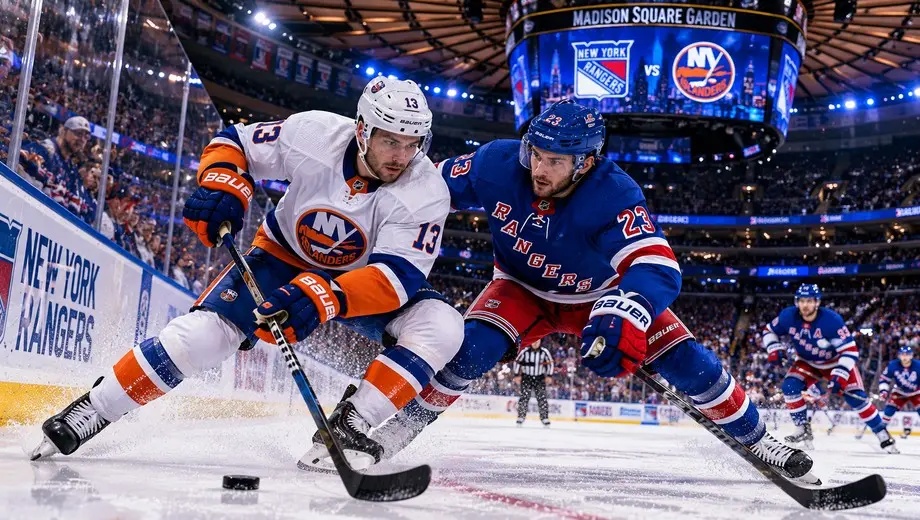
Islanders at Rangers: Does Last Season’s Sweep Still Explain This Rivalry?
Last season's sweep is a clue, not the plot
The Islanders arrive at Madison Square Garden carrying a result that is impossible to ignore and easy to misuse. They won the first three meetings of the 2025-26 season by a combined 12-2 before completing the season-series sweep. That tells us the Rangers repeatedly failed to turn possession into enough dangerous offense against this opponent. It does not tell us that the same matchup will automatically reproduce itself. Both rosters have changed, the Islanders are opening this season without Mathew Barzal, and the Rangers have rebuilt meaningful portions of their forward group and defense. The job is to identify which causes of the sweep survived the summer.
Barzal's absence changes how the Islanders distribute creation
The opening Islanders roster places more responsibility on Bo Horvat, Brayden Schenn, Cal Ritchie, Jean-Gabriel Pageau and the wings around them. Barzal is on injured non-roster because of a knee injury, removing the club’s most improvisational puck carrier. Pete DeBoer has already adjusted combinations. That can make the Islanders more direct, but it can also make them easier to map if too much creation is forced through predictable routes. Against a Rangers team with Adam Fox and several new defenders capable of moving the puck, New York cannot assume last season’s territorial patterns will simply return.
The Rangers changed the middle of the roster, not just the decoration
Pavel Dorofeyev, Oliver Bjorkstrand and Eeli Tolvanen give the Rangers additional shooting and forechecking options. Sean Durzi and Marcus Pettersson change the defense behind Adam Fox and Vladislav Gavrikov. Those additions matter because the previous meetings often left the Rangers needing a perfect individual play after the Islanders had already shaped the possession. A deeper group can create offense earlier in the sequence: a cleaner retrieval, a better first pass, a second wave arriving with speed. If the Rangers can make the Islanders defend before their five-man shape is settled, the old scores become less informative.
Sorokin is still the matchup's hardest reset button
Ilya Sorokin remains the player most capable of making a good Rangers period look ordinary on the scoreboard. He is not merely a reason to expect saves; his presence changes the standard for shot quality. New York needs traffic, lateral movement and second opportunities rather than a high count of visible perimeter shots. The Islanders can survive stretches without the puck if Sorokin sees releases cleanly and defenders remove rebounds. Conversely, if the Rangers create east-west movement before the shot, they force the Islanders’ structure and their goalie to solve a more demanding problem.
Madison Square Garden gives the Rangers choices
Home ice matters here less as emotion than as deployment. The Rangers can decide which line sees Horvat, where Fox starts offensive-zone shifts and how often a favorable matchup is protected after a whistle. That is useful against an Islanders team reorganizing without Barzal. It also puts responsibility on the Rangers’ staff: if the new depth is real, the bench should be able to use it to create different kinds of possessions rather than chase one preferred matchup all night. A rivalry crowd can amplify momentum, but the controllable advantage is lineup choice.
Special teams may reveal change faster than five-on-five totals
The Islanders’ power play was one of the obvious areas to watch entering the season, and Barzal’s absence changes its puck-distribution map. The Rangers’ new personnel also changes their penalty-kill and power-play options. Early percentages will be noisy, so the better indicators are entries, retrievals and whether either unit can force the penalty kill to turn its shape. A single goal can swing a rivalry game, but the process tells us more about whether the offseason actually changed a recurring weakness.
The first ten minutes can tell us whether the sweep still belongs in the conversation
If the Islanders immediately slow the Rangers through the neutral zone, keep shots outside and make Sorokin’s work predictable, the old matchup logic still has life. If the Rangers exit quickly, attack before the Islanders set their layers and generate second touches around the crease, the sweep becomes background rather than blueprint. This is why the article should not be built around revenge. Revenge is not measurable. The speed and location of the first several possessions are.
OddsBay read: do not pay twice for a famous result
The sweep will be part of the public conversation, just as the rivalry itself will be. A current market can already reflect both. OddsBay’s useful role is to compare the actual available prices after final goalie and lineup confirmation, not to turn last season’s scoreline into a recommendation. The strongest evidence will come from whether the Rangers’ new personnel changes the way they enter and sustain the offensive zone, and whether the Islanders can replace Barzal’s creation without becoming one-dimensional. If the price assumes the old matchup is unchanged while the hockey says otherwise, that difference deserves attention.
The Islanders' new forward map has to create without a cheat code
Barzal often gives a possession an escape hatch: a controlled entry that should not exist, a curl that buys time, or a pass through a seam that forces the defense to rotate. Without him, the Islanders need creation to come from accumulation. Horvat can drive the middle, Palmieri can finish, Schenn can create heavy possessions and Ritchie can add skill, but the group must connect those strengths. If the puck moves from one isolated battle to another, the Rangers can defend the game in pieces. If the Islanders connect low support to a second wave, they can reproduce some of last season’s territorial control without reproducing Barzal himself.
Matthew Schaefer changes the Islanders' transition ceiling
The young defenseman gives the Islanders another way to move from defending to attacking. His skating can turn a retrieval into a carry rather than a forced pass, which matters against a Rangers forecheck that wants to close predictable lanes. The risk is obvious: an aggressive young defenseman can also leave space behind him if a carry dies in traffic. New York’s forwards need to read those moments and fill above the puck. If Schaefer can transport cleanly while the support remains disciplined, the Islanders become harder to pin than the stereotype of a purely low-event team suggests.
The Rangers need offense before Sorokin is set
Once Sorokin is square and the Islanders have five players inside their preferred defensive picture, the Rangers are asking for elite finishing. Their better route is to create before that picture exists. Fox can start that process with the first pass; Durzi can add another puck-moving option; the new wings can attack off the catch rather than settling every possession. A quick second pass through the neutral zone may matter more than a spectacular move at the blue line. The Rangers’ offseason should be visible in the number of attacks that reach the circles before the Islanders have all five defenders facing the puck.
The rivalry can become emotional without becoming analytically useful
Hits after whistles, a loud building and an early scrum can change the temperature without changing the matchup. The useful question is whether emotion creates penalties, rushed changes or lost coverage. The Islanders can benefit if the Rangers turn the game into individual confrontations because Sorokin and a compact defensive group are comfortable waiting for mistakes. The Rangers benefit if intensity accelerates their feet without accelerating their decisions. Rivalry energy is real; its hockey consequence has to be observed rather than assumed.
What would make last season's evidence obsolete
Three things would quickly reduce the value of the sweep. First, the Rangers consistently exit their zone with possession instead of feeding the Islanders’ pressure. Second, the Islanders struggle to replace Barzal’s controlled entries and become dependent on dump-ins. Third, New York’s new defensive personnel turns more recoveries into immediate counterattacks. If none of those changes appear, last season’s pattern deserves more weight. This is a better framework than simply asking whether the Rangers are “motivated” to avenge four losses.
A tied game will tell us more than an early lead
The most revealing version of this rivalry may be a 1-1 game in the second period. In that state, neither club can hide behind score effects. The Islanders have to decide whether to keep attacking without Barzal or settle into protection; the Rangers have to decide whether their new depth can create patiently without forcing the puck into Sorokin’s structure. Watch who owns the neutral zone when there is no scoreboard reason to gamble. If the Rangers can produce controlled entries in a neutral game state, that is stronger evidence of change than a rush chance created while trailing. If the Islanders can still dictate where possessions begin, the sweep’s underlying logic remains relevant.
The reader's takeaway before the rivalry resumes
Last season’s four wins belong in the analysis because they establish a problem the Rangers failed to solve. They do not deserve veto power over new evidence. Barzal’s absence materially changes the Islanders; the Rangers’ additions materially change the opponent. Sorokin remains a constant, but even an elite goalie can be made to solve a different game. The cleanest pregame framework is therefore comparative: identify what produced the old advantage, identify which personnel supported it, then watch whether those same conditions exist on October 6. That approach respects history without becoming trapped by it.