
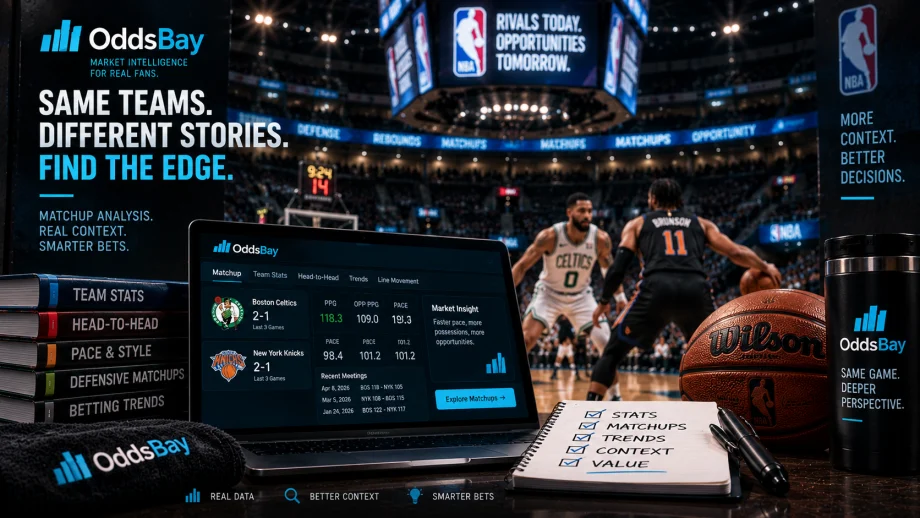
OddsBay NBA Market Intelligence examines nba matchup analysis: why the same teams can create a different betting story as a distinct part of the basketball market. This article focuses on a new Batch #2 angle and uses schedule, statistical, matchup or decision-process context without repeating Batch #1’s core lessons on basic line movement, starting-lineup mechanics, sportsbook disagreement, causation or star-status props.
Same teams does not mean same game
Two teams can meet several times and produce very different environments. Personnel changes, rest, venue, rotation decisions, pace and recent tactical adjustments can alter the matchup. Head-to-head history is context, not a template that the next game must follow.
The editorial test is whether the factor can be verified and whether it changes the reader’s understanding of the game or the available price. If it cannot be verified, it should remain a question rather than become a claim.
Start with style, not the last score
A previous final score is easy to remember but often too blunt. How did each team create shots? Who controlled the glass? Was the game played fast or slow? Were important players missing? The answers help explain why a rematch may not resemble the first meeting.
A useful OddsBay workflow places the basketball fact beside the market observation while preserving both timestamps. This makes later review possible and prevents a current price from being confused with an earlier offer.
Related reading: How to Bet on Sports · Why NBA Starting Lineups Matter.
Matchups are about interactions
Team statistics become more useful when paired. A strong offensive rebounding team facing a weak defensive rebounding opponent creates a specific interaction. A high-volume three-point offense facing a defense that limits attempts creates another. The article should identify those intersections rather than listing unrelated rankings.
Book-level data matters because an apparent consensus can hide meaningful differences. The writer should compare equivalent markets and avoid mixing alternate lines, periods or stale observations.
Venue can change context
Home and away splits may reflect travel, routine, opponent mix and many other factors. They should be described, not mythologized. If a rematch changes venue, OddsBay can note the difference while checking whether the market has priced the new environment differently.
Historical statistics should be identified by their time window. Season-long performance, the last ten games and a single prior meeting describe different populations and should never be presented as interchangeable evidence.
Related reading: Why NBA Starting Lineups Matter · Reading NBA Line Movement.
Personnel can rewrite the matchup
A player who missed the previous meeting may return; a starter may be absent; a bench role may have expanded. These changes can alter who guards whom, who creates offense and how minutes are distributed. Verified availability therefore belongs beside matchup statistics.
The strongest internal connection is to the NBA hub, where readers can move from explanation to current game intelligence. Supporting education articles should deepen the concept rather than duplicate the same paragraph in several posts.
Head-to-head needs sample-size discipline
One or two meetings are not enough to establish a law about two teams. The previous games can still reveal tactical ideas, but writers should avoid language such as ‘always dominates’ based on a tiny sample. Season-level and recent-form context can keep the comparison grounded.
No illustrative number should be written as though OddsBay observed it live. When a real case study is unavailable, the article can explain the method without manufacturing a spread, total, player prop, sportsbook offer or proprietary score.
Related reading: Reading NBA Line Movement · NBA Odds & Game Intelligence.
Market context completes the picture
Matchup analysis becomes betting analysis only when connected to actual prices. OddsBay can compare the current spread, total and moneyline across sportsbooks and use Line Archive to see how those offers evolved. The matchup explains basketball context; the market shows what bettors can actually compare.
As OddsBay accumulates real observations, this framework can become a case-study template. The future article can insert actual timestamps, book-level differences and source-verified context while retaining the same analytical discipline.
Build a matchup file before writing
A repeatable file should include schedule, venue, rest, availability, projected or confirmed starters, team efficiency, pace, rebounding, turnover tendencies, shooting profile, prior meetings and current book-level prices. The writer can then choose the factors that genuinely distinguish this game.
The reader’s decision remains separate from the analysis. OddsBay can improve comparison, provenance and context, but the evidence should be presented so the reader can decide what matters rather than being told that one factor guarantees an outcome.
Related reading: NBA Odds & Game Intelligence · Inside an NBA Line Move.
How this fits the OddsBay evidence model
SportsGameOdds remains the sportsbook-market source for book-level prices and markets. SportsDataIO can contribute structured NBA injuries, lineups and statistical context. ESPN can serve as a supplemental, non-contractual source for schedules, game status, teams, injuries, statistics, leaders and game context. OddsBay’s proprietary value is the layer built from its own observations: Line Archive, Best Price, Steam Score™ and other market-intelligence products when real data supports them.
Those layers should never be silently blended. An ESPN identifier is not automatically a SportsGameOdds or OddsBay identifier, and a display name is not sufficient to create canonical identity. Controlled mapping protects both the product and the article. When a source is unavailable or identities cannot be verified, the content should degrade gracefully instead of inventing a connection.
What to verify before publication
Before an editor publishes a current example based on this framework, verify the event identity, market type, selection, period, sportsbook, observation time and source of every contextual fact. Check that internal links resolve, that a historical price is labeled historical, and that a current claim is still current. Confirm that any reference to Best Price or Steam Score™ comes from actual OddsBay evidence rather than an illustrative design element in the hero image.
This verification step is what turns a strong evergreen article into a safe foundation for future live case studies. The method can remain stable while the observations change. That allows OddsBay to build a connected NBA editorial library without forcing every article to repeat the same explanation of how a line moves.
Editorial application for NBA matchup analysis
A future live example should begin with a clearly identified game and a real observation from OddsBay, then add only the contextual facts relevant to this article’s subject. The writer should explain the time window, compare equivalent sportsbook markets and identify what changed since the earlier observation. If the evidence does not support a directional conclusion, the article should say so. This keeps the focus on NBA matchup analysis while preserving the distinction between basketball analysis and sportsbook-market evidence.
Editorial application for NBA matchup analysis
A future live example should begin with a clearly identified game and a real observation from OddsBay, then add only the contextual facts relevant to this article’s subject. The writer should explain the time window, compare equivalent sportsbook markets and identify what changed since the earlier observation. If the evidence does not support a directional conclusion, the article should say so. This keeps the focus on NBA matchup analysis while preserving the distinction between basketball analysis and sportsbook-market evidence.
Editorial application for NBA matchup analysis
A future live example should begin with a clearly identified game and a real observation from OddsBay, then add only the contextual facts relevant to this article’s subject. The writer should explain the time window, compare equivalent sportsbook markets and identify what changed since the earlier observation. If the evidence does not support a directional conclusion, the article should say so. This keeps the focus on NBA matchup analysis while preserving the distinction between basketball analysis and sportsbook-market evidence.
Editorial application for NBA matchup analysis
A future live example should begin with a clearly identified game and a real observation from OddsBay, then add only the contextual facts relevant to this article’s subject. The writer should explain the time window, compare equivalent sportsbook markets and identify what changed since the earlier observation. If the evidence does not support a directional conclusion, the article should say so. This keeps the focus on NBA matchup analysis while preserving the distinction between basketball analysis and sportsbook-market evidence.
Editorial application for NBA matchup analysis
A future live example should begin with a clearly identified game and a real observation from OddsBay, then add only the contextual facts relevant to this article’s subject. The writer should explain the time window, compare equivalent sportsbook markets and identify what changed since the earlier observation. If the evidence does not support a directional conclusion, the article should say so. This keeps the focus on NBA matchup analysis while preserving the distinction between basketball analysis and sportsbook-market evidence.
Editorial application for NBA matchup analysis
A future live example should begin with a clearly identified game and a real observation from OddsBay, then add only the contextual facts relevant to this article’s subject. The writer should explain the time window, compare equivalent sportsbook markets and identify what changed since the earlier observation. If the evidence does not support a directional conclusion, the article should say so. This keeps the focus on NBA matchup analysis while preserving the distinction between basketball analysis and sportsbook-market evidence.