
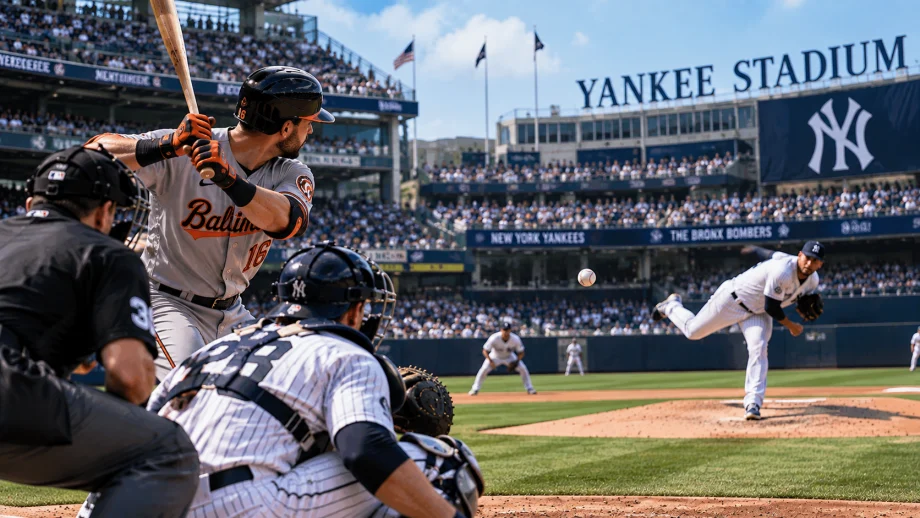
Baltimore Orioles at New York Yankees closes the regular season on September 27. The scheduled first pitch is 3:20 PM ET at Yankee Stadium. This preview focuses on how a high-profile market can reward discipline when reputation, lineup decisions and postseason context are all reflected in the number.
The betting question is the price, not the headline
Game 162 naturally attracts stronger narratives than an ordinary regular-season date. There is finality, scoreboard watching, possible roster management and the knowledge that some clubs are preparing for October while others are closing the season. None of that changes the central betting problem: a matchup is not automatically attractive because its story is interesting. The useful question is whether the available price properly compensates for the uncertainty that remains.
For Baltimore Orioles at New York Yankees, the scheduled identity is straightforward: the game is set for 2026-09-27 at 3:20 PM ET at Yankee Stadium. What may be less straightforward by first pitch is the exact personnel context. Final-day baseball can produce late lineup changes, abbreviated pitching plans, aggressive bullpen decisions and different incentives for players or clubs. A bettor should therefore separate what is known from what is merely expected and avoid paying for a narrative before the operational details are confirmed.
That approach is especially relevant to this matchup because the core angle is how a high-profile market can reward discipline when reputation, lineup decisions and postseason context are all reflected in the number. An early opinion can still be useful, but an opinion and a wager are not the same thing. The number offered by the market determines whether the underlying baseball view has enough margin to justify action.
Start with confirmed personnel
Starting pitching receives the most attention in baseball markets, but a listed or projected starter is only the beginning of the handicap. Workload expectations matter. A pitcher expected to work six innings creates a different bullpen path from one who may be used briefly. On the final day, even a familiar starter can have an unfamiliar assignment.
The same discipline applies to lineups. A projected order can help frame platoon balance, strikeout risk, power and on-base potential, but the confirmed lineup is the actionable version. If a key hitter rests, if a club gives younger players at-bats, or if a manager changes the defensive alignment, the run environment can move in ways that are not captured by a generic season-long team rating.
This is why bettors should revisit the matchup after official lineups and pitching plans become clearer. Waiting has a cost because the market may move, but betting early has a different cost: accepting information risk. There is no universal answer. The decision depends on whether the early price contains enough value to justify that uncertainty.
Bullpen context can change quickly
Relief pitching is one of the easiest areas to oversimplify. Season-long bullpen ERA or strikeout rate describes a group over time; it does not tell us exactly who is likely to pitch today. Recent workload, multi-inning appearances, back-to-back usage and managerial priorities can reshape the available relief tree.
That distinction becomes more important late in September. A team may protect a high-leverage arm, audition another reliever, or manage innings differently from a typical midseason game. Those possibilities should not be assumed in advance, but they are reasons to verify recent usage before treating the bullpen as a static unit.
For live betting, bullpen availability can also change the meaning of an early score. A one-run deficit against a fully available late-inning group is different from the same deficit when the preferred relievers are unlikely to appear. The scoreboard alone does not tell the whole story; the remaining pitching resources matter.
Moneyline, run line and total answer different questions
The three primary baseball markets should not be treated as interchangeable expressions of the same opinion. A moneyline asks whether the probability of winning is better than the implied probability in the price. A run line adds margin of victory and changes the distribution being priced. A total asks about combined scoring and can be sensitive to different variables altogether.
A bettor who likes the stronger side does not automatically have to lay a run line. Likewise, concern about a starting pitcher does not automatically make an over attractive if the opposing offense is weakened or the bullpens are positioned well. Each market needs its own case.
Price comparison matters here. Even small differences between sportsbooks can materially change long-run results, particularly on favorites and derivative markets. OddsBay’s broader sportsbook-comparison framework is useful for that reason: the goal is not merely to identify a side, but to identify the best available version of the wager. Readers who want the mechanics can review the OddsBay sports betting guide and the MLB Odds & Game Intelligence hub.
Do not turn standings context into a certainty
Standings and postseason positioning can affect decision-making, but motivation is not a measurable substitute for probability. A team with something at stake can still lose. A club with little left to gain can still play well. Professional players also have individual incentives that do not appear neatly in a standings table.
The better use of standings context is operational. Ask whether it could affect who starts, how long a pitcher works, when a manager goes to the bullpen, whether regulars receive full games, and how aggressively the bench is used. Those are concrete pathways through which context can influence the matchup.
Even then, the effect must be evaluated through the price. If the market has already adjusted heavily for an obvious motivational story, the popular side can become less attractive rather than more attractive. Context is information; value is the relationship between information and price.
Park and environment still belong in the handicap
Venue matters because baseball is unusually sensitive to geometry and environment. Outfield dimensions, foul territory, roof status, temperature, wind and air density can influence the distribution of outcomes. But those factors should be used carefully rather than converted into automatic over-or-under rules.
At Yankee Stadium, bettors should confirm the game-day environment close enough to first pitch for the information to be meaningful. Indoor or retractable-roof settings can reduce some weather uncertainty, while open-air parks can introduce more variability. The relevant question is not whether weather exists, but whether the conditions are meaningfully different from what the market appears to expect.
Park effects also interact with hitter profiles. Pull power, opposite-field contact and batted-ball shape can make the same venue more helpful to one lineup than another. That is a deeper question than simply labeling a stadium hitter-friendly or pitcher-friendly.
A practical pregame checklist
Before committing to a wager, verify the starting pitchers or announced pitching plan, both confirmed lineups, recent bullpen workload, meaningful injury or availability news, venue conditions and the current price across books. If one of those inputs changes, reassess rather than defending an earlier opinion.
Then translate the baseball view into a price threshold. Instead of saying “I like New York Yankees,” a more disciplined process says the home side is attractive only at a certain number or better. The same applies to Baltimore Orioles, the run line and the total. A threshold makes it easier to pass when the market moves away from the value.
Passing is a valid betting decision. Game 162 can create pressure to participate because every matchup feels consequential. The bettor does not receive extra value for action. If the information remains incomplete or the price is already efficient, preserving bankroll is preferable to forcing a position.
What to watch after first pitch
The first innings can reveal whether the pregame assumptions were accurate. Pitch velocity, command, swing decisions and defensive positioning may confirm or challenge the original handicap. That does not mean reacting to every hit or out. Small samples are noisy, and a hard-hit ball caught at the wall can be more informative than a softly hit single.
For live markets, focus on changes in the underlying state: an unexpected pitching limit, an injury, a lineup substitution, a reliever warming earlier than expected or a meaningful shift in the run environment. Those developments can change probability. The fact that a team happens to trail by one run does not, by itself, create value.
OddsBay’s long-term Intelligence model is designed around preserving observations with timestamps rather than pretending every piece of information was known from the beginning. For the reader, the practical version is simple: use the freshest verified information available and remember when it became known.
Final outlook
The most useful way to approach Baltimore Orioles at New York Yankees is to resist the urge to make Game 162 more certain than it is. The matchup has a known place and time, but the betting environment can keep changing until lineups, pitching plans and market prices settle.
That makes patience a legitimate edge. Build the baseball opinion first, identify what would invalidate it, compare prices and act only if the market offers enough compensation for the remaining uncertainty. If the number is gone, let it go.
The objective is not to predict every event in a baseball game. It is to make decisions at prices that are better than the probabilities you assign. On a final day full of emotion and moving parts, that distinction matters more than ever.
Evidence slots to verify before betting
This preview intentionally avoids inventing a starter, lineup, injury designation, sportsbook price, opening line, closing line, Steam Score™, Best Price or Line Archive observation that has not been verified. The final handicap should populate those evidence slots only from authoritative or approved sources and preserve the observation time. A missing observation is not permission to estimate one.
The most important evidence slots for this game are: confirmed starting pitcher or announced pitching plan for each club; confirmed batting order; relevant scratches; recent bullpen workload; roof or weather status when applicable; current moneyline, run line and total by operator; and the timestamp attached to each observation. If those inputs remain unresolved, the correct response is to reduce confidence or pass, not to fill the gap with a convenient assumption.
Market movement also needs a reference point. A price seen at one sportsbook at one moment does not establish a universal opener, consensus move or steam event. Comparing multiple operators can reveal disagreement, but the observation should remain tied to the book and time at which it was actually seen. That discipline is what allows later analysis to distinguish a real market change from a stale or isolated quote.