
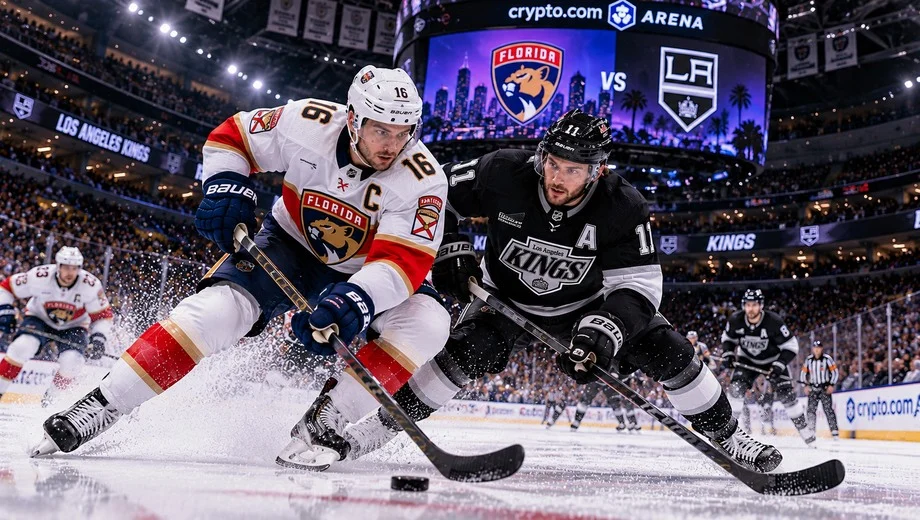
Panthers at Kings: Florida’s Barkov Problem Meets a New Los Angeles Era
Florida reaches Los Angeles with a roster problem bigger than jet lag
The Panthers’ fourth stop of an opening road trip would already be a useful test of execution. Aleksander Barkov’s move to long-term injured reserve makes it something more. Florida is not simply managing miles from Carolina through San Jose and Anaheim to Los Angeles; it is reorganizing the center of its lineup and leadership structure while games are already counting. That changes the question. Travel can reduce margin for error, but the more important issue is how Florida redistributes Barkov’s defensive assignments, faceoff work, puck support and late-game responsibility. The Kings’ home opener is a difficult place to learn those answers in real time.
Barkov's absence changes where Florida can afford risk
Barkov allows Florida to play aggressively because so many difficult possessions can end on his stick. Without him, the Panthers have to decide which centers absorb defensive-zone starts and which lines are protected for offense. Brady Tkachuk adds a major physical and scoring presence to a group that still has Matthew Tkachuk and other established attackers, but he does not replace Barkov’s exact function. The Panthers can remain dangerous while becoming different. That distinction matters against Los Angeles because an overaggressive forecheck is more expensive when the next layer behind it is being reorganized.
Los Angeles is opening a new era, not merely a new home schedule
The Kings’ 60th-anniversary home opener comes after a meaningful identity change. Anze Kopitar has retired, Peter Laviolette is behind the bench and Artemi Panarin is part of the new offensive core. Those are not cosmetic changes. Kopitar had been the reference point for matchup minutes and two-way responsibility for years. Panarin changes how Los Angeles can create from possession, while Laviolette has his own preferences for pace and pressure. The home opener therefore offers an early look at how much of the old Kings structure remains and where the team is deliberately becoming something else.
The trip matters only if it changes specific actions
“Fatigue” is too vague to explain hockey. Florida’s schedule becomes relevant if defensemen arrive a half-step late to retrievals, if forwards stop underneath the puck instead of supporting it, or if a long second period change produces repeated trapped shifts. Those are observable consequences. The Panthers have played championship hockey recently enough to understand travel management; they should not be assumed tired because a map looks long. Los Angeles has to create the kind of game that makes the trip matter—quick counters, repeated races to retrievals and enough pace to force Florida’s reorganized lines into uncomfortable changes.
Panarin gives the Kings a different way to punish pressure
Florida wants opponents making decisions under contact and time pressure. Panarin is valuable precisely because he can turn a pressured possession into a delayed, creative one. If Los Angeles exits with control, he can slow the next action long enough for support to arrive rather than treating every transition as a race. That creates a fascinating tension: Florida wants to compress time; Panarin can manufacture it. The Kings do not need to abandon direct hockey, but they now have a player who can change the rhythm of a possession after the first wave has been survived.
The home opener can become a test of Florida's center depth
Los Angeles should make Florida’s replacement centers defend through the middle. Controlled entries, low-to-high movement followed by a return pass inside, and offensive-zone rotations can force communication between players assuming new responsibilities. Florida will try to reverse that pressure by spending time in the Kings’ end and making Los Angeles retrieve under contact. The matchup is therefore less about which team is “physical” and more about who dictates where the centers have to work. Barkov’s absence becomes visible when Florida must defend repeated interior actions, not simply when his name is missing from the lineup card.
Goaltending should be evaluated inside the new environments
Both clubs have enough offensive talent to make the starting-goalie confirmation relevant, but a goalie name cannot solve the structural questions. The Kings allowed eight goals in their opener at Colorado, an ugly number that should be investigated rather than projected forward. Was the problem rush defense, coverage, rebound control or game state? Florida’s road games likewise need to be read for chance quality rather than raw totals. The pregame update should confirm the starters; the analysis should then ask whether each defense is giving its goalie a repeatable picture.
OddsBay read: the schedule is public, the consequences are not
Every sportsbook knows Florida has traveled. Every sportsbook knows Barkov is on LTIR. The edge, if there is one, comes from interpreting how those facts alter the hockey rather than merely repeating them. Watch Florida’s support under the puck, center usage and ability to sustain pressure without exposing the middle. Watch whether Los Angeles can turn controlled exits into attacks before Florida resets. Then compare current prices with the information actually available. The home-opener atmosphere and the road itinerary are context; the meaningful evidence is what they do to execution.
Florida's center rotation is the first tactical document to read
The line combinations around the middle will reveal how the Panthers intend to replace Barkov’s workload. One center may take the hardest defensive assignments while another receives more offensive-zone starts. Wingers may be asked to collapse lower in the zone to help exits, changing how quickly Florida can counter. These are not minor coaching details; they determine whether the Panthers can preserve their familiar aggression without exposing the center lane. The first several defensive-zone faceoffs should be informative because they show who the staff trusts when it cannot choose an easy situation.
Brady and Matthew Tkachuk can make the game uncomfortable in a different way
Florida’s identity does not disappear with Barkov. The Tkachuk brothers can create a game built on net-front pressure, puck protection and emotional friction. That can be especially useful in a road home-opener environment where Los Angeles wants to turn ceremony into early momentum. The Panthers should be careful, however, not to confuse confrontation with control. Drawing a defender into a battle is useful if a teammate receives the next puck; taking an unnecessary penalty is not. Florida’s physical edge works best when it creates possession rather than merely noise.
Los Angeles has to prove the opener in Colorado was information, not identity
Allowing eight goals to Colorado creates an immediate narrative about the Kings’ defense, but one game is too small to define a system. The useful response is diagnostic. Did Los Angeles lose track of trailers? Were gaps too large through neutral ice? Did the defense surrender the middle after the first save? Laviolette now has a second road game before the home opener to adjust. By October 6, the question will be whether the same breakdowns are repeating. Repetition is evidence; one chaotic opener is only a warning.
A new Kings attack can force Florida to defend laterally
Panarin’s arrival is most dangerous when Los Angeles creates multiple passing layers rather than asking him to beat a set defense alone. A low possession that pulls a Florida defender below the dots can open a seam above; a delayed entry can allow a defenseman to join after the first wave. Those actions matter against a Panthers group changing center responsibilities because they force communication across the width of the ice. Florida will try to prevent that by pressuring the puck early and making the Kings play along the boards.
What would make the travel angle real
Watch the final ten minutes of periods rather than the opening ceremony. If Florida’s changes become shorter, if weak-side support arrives late, if defensemen stop holding the offensive blue line because they fear the counter, or if the Panthers repeatedly ice the puck under moderate pressure, the trip may be affecting execution. If Florida is still winning races and sustaining third efforts, the itinerary is just a story on paper. Travel should earn its place in the analysis through visible consequences.
The second period is where both stories can collide
The long change can turn Florida’s travel question and Barkov’s absence into the same tactical problem. A Panthers line that stays on the ice too long may be unable to change after a turnover, leaving a replacement center and tired wingers to defend Panarin or another skilled Kings group through transition. Los Angeles should try to create those sequences deliberately by keeping pucks alive above the offensive blue line and attacking before Florida can reset. Florida’s answer is disciplined shift length and possession choices that do not strand three forwards below the puck. That is a more precise way to evaluate road wear than waiting for a late goal and labeling it fatigue after the fact.
The reader's takeaway before the Kings open at home
Florida remains dangerous enough to win without Barkov, and Los Angeles remains unsettled enough that a home-opener ceremony cannot be treated as an advantage by itself. The matchup is compelling because both teams are solving identity questions simultaneously. Panthers must decide how much of their familiar pressure game survives a major absence. Kings must decide what parts of their old two-way structure remain after Kopitar and how Panarin changes the attack. The better team on October 6 may simply be the one whose new responsibilities are clearer. That is why the first twenty minutes should be read for organization rather than emotion.