
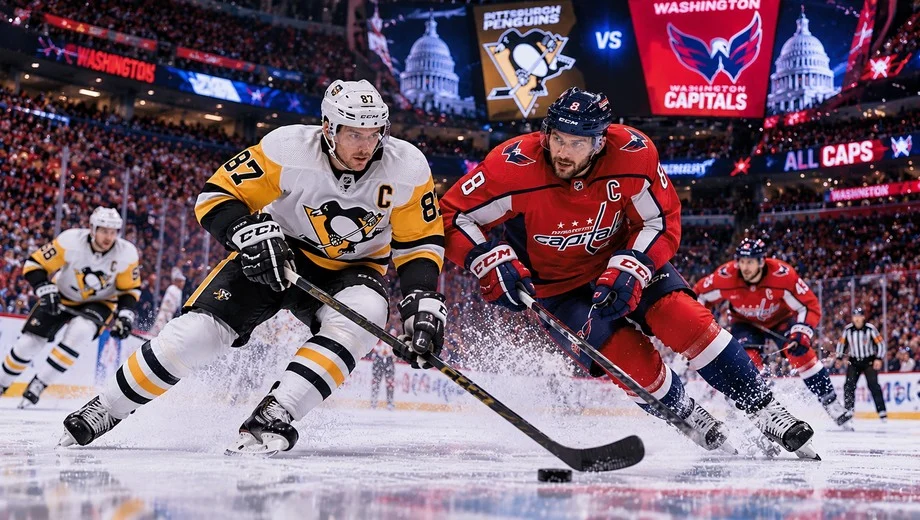
Penguins at Capitals: Meeting 101 Is About More Than Crosby and Ovechkin
Meeting 101 matters because the rivalry has outlived several versions of both teams
Sidney Crosby and Alex Ovechkin can reach their 101st head-to-head meeting when Pittsburgh visits Washington’s home opener. The number is remarkable, but it should not become a substitute for analysis. These players have competed through different coaches, different supporting casts and different competitive cycles. The useful question is not whether the rivalry still “means something.” It plainly does. The useful question is which habits created over two decades remain relevant when so many of the players around them have changed. History gives this game depth; the current rosters decide how it is played.
Washington changed the cast around Ovechkin aggressively
The Capitals’ offseason work brought in players including Alex Tuch, Jordan Kyrou and Boone Jenner, reshaping the support available around Ovechkin. That gives Washington more ways to attack than simply waiting for its captain’s finishing. Tuch can bring size and directness, Kyrou can add speed and one-on-one creation, and Jenner can absorb difficult interior work. The challenge is integration. A roster can become more talented on paper while needing time to learn spacing, timing and who owns which decisions under pressure. The home opener provides an early stress test against an opponent that knows Washington’s building and its stars extremely well.
Pittsburgh is trying to contend without pretending time stopped
The Penguins still begin with Crosby and Evgeni Malkin, but the roster around them is in motion. Nick Robertson, Egor Chinakhov, Tommy Novak, Hendrix Lapierre and other younger or newer pieces are being asked to create useful minutes around the veteran core. Injuries to Bryan Rust and others have complicated the opening picture. That means Pittsburgh cannot treat this as another chapter written by the same old cast. Crosby can still control possessions and Malkin can still break a game open, but the Penguins’ ceiling depends on whether the next group can carry shifts rather than merely survive until the stars return.
The rivalry's most important change is where the difficult minutes go
For years, a Pittsburgh-Washington preview could begin by mapping Crosby and Ovechkin and then radiating outward. Now the interesting decisions may occur on the second and third lines. Which Washington unit gets the hardest defensive assignment? Can Pittsburgh’s newer forwards exploit a favorable matchup after Crosby draws attention? Does Jenner’s presence allow Washington to move another center into a more offensive role? Those deployment questions reveal whether roster change is functional. A famous top-line duel can dominate television coverage while a quieter matchup determines which team spends the night chasing the puck.
Ovechkin and Crosby still bend defensive choices
Age does not erase the way elite players alter the geometry around them. Ovechkin’s shooting threat still demands attention before the puck reaches him; Crosby’s work below the goal line and ability to find support still forces defenders to decide between pressure and containment. The difference is that neither team should be evaluated as though every possession runs through those stars. The new supporting casts must punish the attention they receive. If Washington’s additions create clean secondary attacks, or Pittsburgh’s younger forwards turn Crosby-created space into sustained offense, the rivalry’s old center can produce a very modern game.
Recent scores need lineup corrections before they become evidence
Washington won last season’s series 2-1-0 and swept an April home-and-home. One of those games is a warning against lazy head-to-head analysis because Pittsburgh rested or lacked several major regulars. A score without the lineup is incomplete evidence. October’s game has its own availability questions, including Pittsburgh injuries and early-season combinations that can change quickly. The proper use of history is to identify recurring situations—how each club handles the other’s stars, where transition chances originate, how special teams alter momentum—not to average old scores and call it a forecast.
The home opener adds urgency, not a mathematical advantage
Washington’s building will be loud and the Ovechkin-Crosby framing will make the night feel larger than an ordinary October game. That can sharpen execution, but atmosphere is not a model. The tangible home advantage is deployment, familiarity and the chance for Washington to choose matchups after stoppages. Pittsburgh’s response should be to make those choices uncomfortable by getting useful shifts from lines beyond Crosby’s. If the Penguins’ depth can force Washington to spend its best checking resources in several places, the home bench loses some of its control.
OddsBay read: nostalgia is context, not a price
A market can easily overproduce narratives around famous players because everyone recognizes them. OddsBay should do the opposite: compare current prices only after current information is established. Confirm the goalies, Pittsburgh’s injured forwards and Washington’s actual combinations. Then ask whether the supporting casts are changing the expected share of dangerous possessions. Meeting 101 deserves celebration, but the wager—if any—is on the 2026 versions of these teams, not on a composite memory of the previous hundred meetings.
Washington's additions should be judged by what they free Ovechkin from doing
The best version of the Capitals’ offseason is not one in which every new player feeds Ovechkin. It is one in which opponents cannot load every important defensive choice toward him. If Kyrou can carry through the middle, if Tuch can win direct possessions and if Jenner can own difficult interior shifts, Ovechkin can arrive as the finishing threat rather than the beginning and end of the attack. That changes Pittsburgh’s coverage. A defenseman who cheats toward the familiar shooting lane may leave a newer option with space. The supporting cast becomes valuable when it makes the old solution to Ovechkin incomplete.
Pittsburgh's young minutes have to survive Washington's weight
The Penguins’ newer forwards will see a different challenge from an open early-season game. Washington can make shifts heavy along the wall and around the net. Young or newly assembled lines need to exit those shifts without relying on Crosby to repair them. That means winning enough first touches, presenting short outlets and resisting the temptation to force a stretch pass every time pressure arrives. If Pittsburgh’s depth can turn defensive work into controlled possession, the veterans receive better offensive situations. If not, Crosby and Malkin spend too much energy starting from their own end.
Karlsson and Letang can still change the pace from behind
Pittsburgh’s veteran defense gives it a route to attack Washington before the Capitals’ heavier forwards settle into position. Erik Karlsson and Kris Letang can both turn a recovery into offense with one decision. The danger is that aggressive activation can also expose the Penguins if the puck is lost above the circles. Against a Washington roster with more speed in the supporting cast, those choices carry a different cost than they did in older versions of the rivalry. Pittsburgh needs selective aggression: enough to prevent Washington from setting its forecheck, not so much that every miss becomes an odd-man rush.
Special teams are where old stars and new support can intersect
Ovechkin’s power-play gravity remains obvious, but the surrounding puck movement determines whether a penalty kill can simply lean toward him. Washington’s new personnel may create different entry and retrieval options. Pittsburgh’s power play likewise has elite veteran decision-makers but must show that the group around them can recover loose pucks and extend possessions. Early percentages are less useful than whether each unit can establish the zone and force a second rotation. A rivalry with this much familiarity can be decided by the one sequence that looks different from the film everyone already knows.
What meeting 101 should teach us by the second intermission
By forty minutes, the game should reveal whether the rivalry is being carried by the stars or redefined by the supporting casts. Count which lines generate sustained offensive-zone shifts. Notice whether Washington’s new forwards are creating entries without Ovechkin. Watch whether Pittsburgh’s depth can get the puck north after defensive starts. If the answer to those questions is yes, meeting 101 will feel like a continuation and a transition at the same time. If every important moment still requires Crosby or Ovechkin, the organizations may have changed more on paper than on the ice.
A one-goal game would expose the real hierarchy
If this is a one-goal game late, the coaches’ choices will show which parts of the roster they truly trust. Does Washington shorten the bench toward Ovechkin and its established veterans, or do Tuch, Kyrou and Jenner keep receiving important shifts? Does Pittsburgh lean almost entirely on Crosby and Malkin, or can a newer line take a defensive-zone draw and move the puck out? Late-game usage is more revealing than preseason promises because the cost of a mistake is immediate. The rivalry’s next phase will feel credible when the new supporting casts are trusted with the same moments that once belonged almost exclusively to the famous names.
The reader's takeaway before meeting 101
Crosby and Ovechkin are the reason this game carries historical weight, but they are not the reason the analysis should stop. Their longevity creates a rare control group: we know how profoundly each can shape a game, so changes around them become easier to see. Washington has invested in a new supporting cast; Pittsburgh is trying to renew the roster without abandoning contention. October 7 is therefore a useful snapshot of two different approaches to aging greatness. The result will count as one game. The way responsibility is distributed may tell us much more about where each organization is headed.