
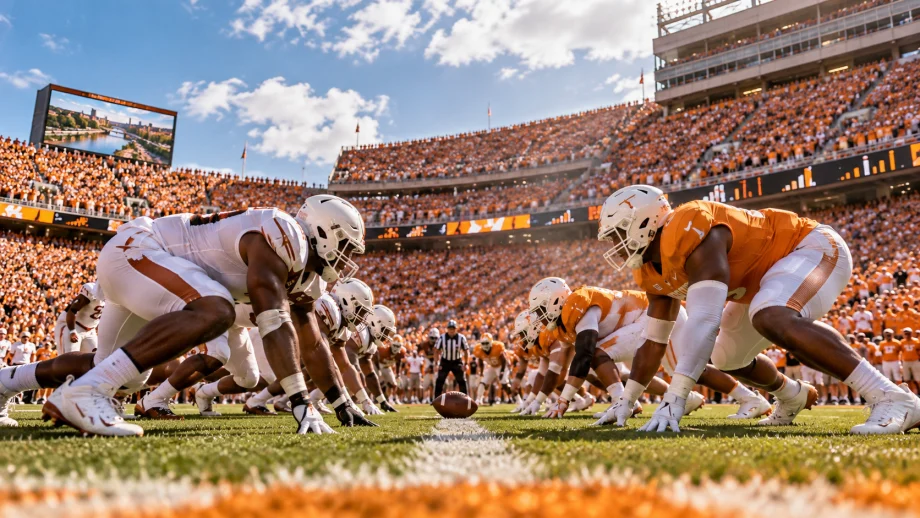
Published market snapshot: September 21, 2026. Texas vs. Tennessee Week 4 Betting Preview: Odds, Matchup and Early Pick combines a current Week 4 price with matchup analysis and a price-sensitive early lean. Because this is a live-week article, every line quoted below should be treated as a dated observation rather than a promise that the same number will be available later.
The Week 4 setup
No. 1 Texas at No. 14 Tennessee is one of the games that gives Week 4 its shape. Texas at Tennessee is scheduled for Saturday, September 26, 2026, noon ET at Neyland Stadium, Knoxville. Texas enters 3-0 and Tennessee 3-0; this is Tennessee’s SEC opener and Texas’ first SEC game of the season. That context matters, but the purpose of this preview is not to turn rankings or atmosphere into a prediction by themselves. The betting question is whether the available price properly reflects the matchup and the uncertainty around it.
Odds snapshot and why the timestamp matters
The market used for this preview is a September 21 snapshot: Texas -3.5, total 56.5. Texas 1.55 / Tennessee 2.50 at BetMGM snapshot. Those numbers are not permanent facts. College football prices can change quickly as limits increase, injury information becomes clearer and sportsbooks react to market action. OddsBay readers should compare the current board before betting rather than assume a number quoted days earlier is still available. This is especially important when a spread sits near a common football margin.
What the spread is really asking
A point spread compresses a complicated matchup into a tradable threshold. In Texas at Tennessee, the bettor is not merely deciding which roster is better. The question is whether the favorite can clear the posted margin often enough to justify the price, or whether the underdog can keep the game inside that number. Home field, quarterback efficiency, explosive plays, third-down performance, red-zone finishing, special teams and turnover variance can all affect that answer.
Rankings are context, not the price
The ranking attached to each team is useful for describing the national stakes, but rankings and betting markets answer different questions. Polls order teams. Sportsbooks price a specific game. A lower-ranked team can be favored, and a highly ranked team can be an underdog, without either system being ‘wrong.’ Bettors should resist anchoring to the number beside a school name and instead examine what the spread implies about this particular venue and matchup.
Quarterback and skill-position lens
Quarterback play deserves attention because college offenses can change dramatically with decision-making, mobility, protection and the ability to create explosive passes. But a preview should not reduce the game to one player. Receivers must separate, the offensive line must handle pressure, backs must keep the offense on schedule, and coaches must create answers when the first plan fails. Player statistics are most useful when they explain how an offense functions, not when they are copied into a list without matchup context.
Line-of-scrimmage questions
Many high-profile games are decided by whether an offense can avoid obvious passing downs. Early-down success changes the entire playbook. If the offense repeatedly faces second-and-long or third-and-long, the defense can disguise pressure and coverage more aggressively. Conversely, efficient rushing and short completions can force the defense to defend the full width of the field. That battle also affects total possessions and therefore the relevance of the game total.
Explosiveness versus consistency
College football creates enormous swings because one missed tackle or coverage bust can produce a touchdown. A team can lose the efficiency battle and still cover if it creates enough explosive plays. The opposite is also true: a favorite can control most snaps but fail to create separation on the scoreboard. When evaluating this matchup, bettors should ask whether each offense needs a long sequence of successful plays or can change the game with one snap.
Third down, red zone and hidden leverage
Third-down percentage and red-zone results are highly visible, but small early-season samples can be noisy. The better question is how those results were created. Was a team repeatedly facing manageable third downs, or converting low-probability situations? Did red-zone touchdowns come from sustainable offensive execution or short fields created by turnovers? Sustainable process matters more than a raw percentage when projecting forward.
Special teams can move both field position and the spread
Special teams is easy to ignore until it decides a bet. Punt distance, return ability, kickoff coverage, field-goal range and the reliability of the snap-hold-kick operation can create hidden points. In a game priced within one or two possessions, one short field can change the entire script. Injury news involving a returner or coverage player can therefore matter beyond ordinary offensive depth.
How to read injuries without inventing causation
Availability news should be handled chronologically. Confirm the player’s status, identify when the information became public, then observe whether the market changed during the same period. Do not claim the injury caused the move unless there is direct evidence. Multiple things can happen at once: respected wagers, weather updates, lineup information and normal sportsbook risk management. OddsBay’s standard is to separate the observed move from the explanation.
Market disagreement is useful information
If one sportsbook posts a different spread or price from another, that disagreement is not a nuisance—it is part of the market. A bettor laying -3.5 at one book may find -3 elsewhere; an underdog bettor may find +3.5 instead of +3. The difference can materially change long-run results. This is why price comparison is central to OddsBay rather than an afterthought.
The total tells a second story
The total can reveal a different view of the matchup than the spread. A relatively high total increases the number of scoring paths and can make larger spreads easier to overcome; a lower total can make each possession more valuable and each point of spread more significant. Bettors should evaluate pace, explosive-play potential, red-zone finishing and game-state incentives instead of assuming an ‘over team’ or ‘under team’ identity is permanent.
Game script: favorite case
The strongest case for the favorite begins with control. If the favorite wins early downs, protects the quarterback and avoids turnovers, it can force the underdog to chase the game. That creates more predictable passing situations and additional opportunities for sacks, takeaways and short fields. For a favorite to cover, merely leading is not enough; it usually needs to create margin and then avoid giving that margin back through conservative late-game possessions or preventable explosive plays.
Game script: underdog case
The underdog case starts with keeping the game structurally uncomfortable. Long possessions, field-position wins, a few explosive plays and red-zone resistance can prevent the favorite from creating separation. An underdog does not need to dominate every efficiency category to cover. It needs enough high-leverage wins to remain within the number. That is why a half-point around a common margin can be more valuable than it looks.
OddsBay early pick
At the cited snapshot, the early OddsBay lean is **Texas -3.5**. The reasoning is price-sensitive: Texas has the stronger early-season market position, but the number is short enough that Neyland Stadium and Tennessee’s unbeaten start remain meaningful counterweights. This is not a guarantee and it is not a recommendation to chase the same side at any number. If the spread moves materially, the handicap changes with it. The responsible approach is to define the acceptable price before kickoff and pass if the market no longer offers it.
What could change the pick
The most important pregame checks are quarterback and offensive-line availability, skill-position injuries, weather, late depth-chart changes and the actual sportsbook price. A significant change in any of those inputs can invalidate an early lean. The article should therefore be treated as a dated market analysis, not a static prediction that remains correct regardless of new information.
How to shop the game on OddsBay
Start with the OddsBay College Football Odds & Game Intelligence page and compare the spread, moneyline and total across available sportsbooks. Note the timestamp and juice, not just the headline spread. A -3 at -120 and a -3.5 at -105 are different propositions. If you need a refresher on how spreads, totals and moneylines work, the OddsBay sports betting guide provides the foundation before you evaluate the game-specific market.
Source and evidence note
This preview was assembled from currently published Week 4 schedule, market and team information. Primary references for the factual snapshot include BetMGM current board; CBS Sports Week 4 odds; Sports Illustrated matchup preview. Odds are snapshots and should be rechecked. Rankings are identified as contemporary Week 4 references rather than timeless team attributes. No proprietary OddsBay Steam Score™, Best Price observation or internal line-history claim is fabricated here.
Bottom line
Texas at Tennessee offers exactly the kind of matchup where disciplined price comparison matters more than a loud prediction. The early lean is Texas -3.5, but the useful takeaway is the process: verify availability, compare sportsbooks, understand what the spread is asking, and know which price makes the position attractive. A good bet is not simply a side; it is a side at a defensible number.
Week 4 betting FAQ
Should I bet the opening line or wait?
There is no universal answer. Betting early can capture a number before information moves it, but it also means accepting more uncertainty about injuries, weather and depth charts. Waiting provides more information but may sacrifice the best price. The decision should depend on why you believe the current number is valuable.
Is moneyline safer than the spread?
A moneyline removes the margin requirement but charges for that protection through the price. ‘Safer’ is not the same as better value. Compare the implied cost of the moneyline with the spread and consider how often your matchup thesis expects a close game.
Do head-to-head records matter?
They can provide historical context, but college rosters and coaching staffs change rapidly. Older meetings should not be treated as if the same players and tactical environment still exist. Recent, structurally comparable games deserve more weight than distant series history.
What is the biggest mistake in a weekly betting preview?
Treating a narrative as evidence. Rivalry, revenge, rankings and atmosphere can be relevant context, but they do not replace verified availability, matchup mechanics and the actual price. The market number is part of the analysis, not decoration.
Why the number matters more than the team name
A weekly pick should always be expressed with a number attached. Saying ‘I like the favorite’ is incomplete because -2.5, -3.5 and -6.5 can represent meaningfully different bets. The same applies to underdogs. If a bettor’s thesis is that the game stays within one score, +7.5 has a different risk profile from +6.5. Price discipline prevents a good matchup read from becoming a poor wager.
Recheck the board before publication
Because this package is being prepared several days before kickoff, editors should treat the quoted line as a documented early-week snapshot. If OddsBay’s live board shows a materially different number at publication time, the article can still preserve the historical snapshot while clearly labeling the newer market. That turns change into useful information instead of a correction problem.
Responsible interpretation
A pick is an analytical conclusion under uncertainty, not a promise. Stake sizing, jurisdictional rules and personal financial circumstances sit outside the matchup model. Readers should never interpret confidence in a football thesis as certainty about a single outcome. The best editorial standard is transparent about what is known, what is inferred and what could still change.