
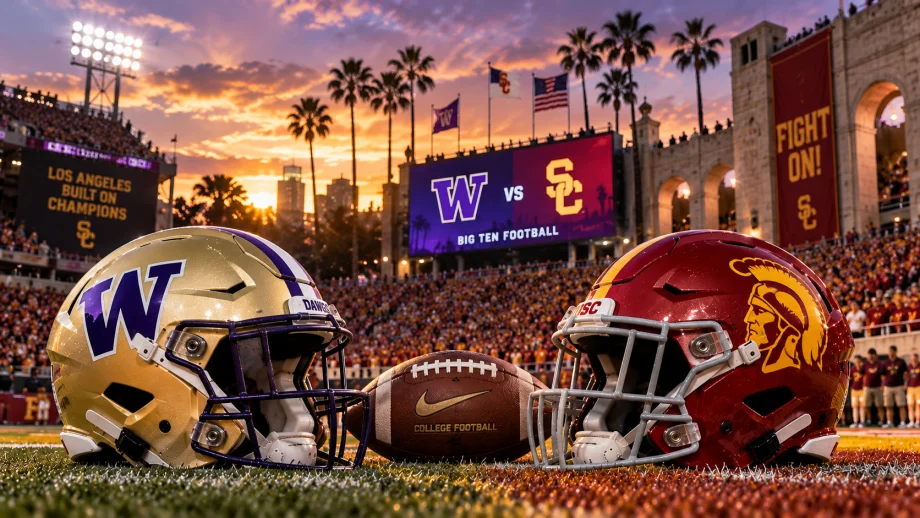
OddsBay NCAAF preview: Washington visits USC on October 3, 2026. This analysis is intentionally price-sensitive: live odds, injuries and late market movement should be verified again before publication and kickoff.
Game identity and what is already known
This article is built around a fixed editorial identity: Washington at USC on 2026-10-03, in Big Ten play at Los Angeles Memorial Coliseum, Los Angeles, California. The currently published kickoff is 4:30 PM PT and the listed television window is NBC. If the kickoff is still TBA, that uncertainty is intentional and should remain unresolved until the school or conference publishes a time. OddsBay does not infer a missing kickoff or manufacture an event identifier. The canonical OddsBay event relationship is resolved separately by the engine and, once resolved, should persist even if the schedule later changes.
Current snapshot before the final game-week update
USC was 4-0 through September 19 with wins over San José State, Fresno State, Louisiana and Rutgers. Washington opened with a 24-10 Apple Cup win over Washington State and had additional September games before this matchup. USC also hosts Oregon on September 26, making the final pregame market highly dependent on one more major data point. That timing matters because this is a forward-looking betting preview, not a claim that the market or injury report is frozen today. The final handicap should absorb the September 26 results, availability news and any verified market movement before publication or a later update.
The central betting question
The most useful way to approach Washington at USC is through pace, scoring expectations, travel, home-field pricing and Big Ten West Coast context. That keeps the analysis centered on price rather than reputation. A strong team can still be an unattractive bet at an inflated number, while an imperfect team can become playable when the market builds enough compensation into the spread or moneyline. The goal is therefore not to declare which roster is ‘better’ in the abstract. It is to identify the assumptions embedded in the eventual price and decide which assumptions deserve the most scrutiny.
How to read the spread
When a spread becomes widely available, start by separating matchup opinion from number quality. Ask what must happen for USC to cover at home and what must happen for Washington to create separation on the road. Then compare those paths with the actual spread. Moving from -3 to -4 is not merely one point; it crosses a key football margin. Moving from -6.5 to -7 changes the price of a common touchdown result. OddsBay’s sports betting guide explains why the number you bet can matter as much as the side you prefer.
Total: possessions before points
Totals should begin with possession expectations rather than recent final scores. Estimate how often each offense is likely to snap the ball, how frequently either team can create short fields, whether explosive plays are required to sustain scoring, and how game state could alter tempo. A favorite protecting a second-half lead may compress possessions; an underdog forced into obvious passing situations may increase both explosive-play and turnover probability. Those mechanisms matter more than simply averaging each team’s points scored and points allowed.
Home field without mythology
The venue matters, but home field should not become a vague narrative. At Los Angeles Memorial Coliseum, Los Angeles, California, the practical questions are communication, cadence, substitution, travel routine and how the visiting offense handles high-leverage downs. Home advantage is already reflected to some degree in the market, so bettors should avoid counting it twice. The useful question is whether this particular matchup creates an unusual home-field interaction that the generic price may not capture.
Quarterback and passing-game checklist
Quarterback evaluation should focus on the situations most likely to decide the bet: third-and-medium, pressure responses, red-zone decisions, explosive throws and protection communication. Raw passing yards can be misleading when pace, opponent strength or game script changes. Before betting, verify the current starter, any meaningful injury designation and whether the offensive line is intact. If a quarterback change occurs, do not simply transfer the previous offensive assumptions to the replacement; revisit pace, sack risk, designed-run usage and turnover exposure.
Run game and down-to-down leverage
The rushing matchup matters because efficient early-down runs can keep the full playbook available and reduce obvious passing situations. But rushing analysis should go beyond yards per carry. Watch success rate concepts: staying ahead of the chains, avoiding negative plays, creating manageable third downs and converting short yardage. If one defense can consistently win first down without extra bodies, it may preserve coverage flexibility. If it cannot, the offense can create play-action and explosive opportunities that affect both spread and total.
Explosives, field position and hidden volatility
College football margins can change quickly through explosive plays, special teams and turnovers. Those events are real parts of the matchup, but they are also volatile. A bettor should distinguish repeatable advantages from outcomes that may regress. Field-position edges can be especially important in games expected to be tight or lower scoring because one short field can represent a large share of the expected scoring. Punters, return units and fourth-down decisions deserve attention when the spread makes every possession valuable.
Injuries: verify, timestamp, do not guess
Availability information is one of the fastest-changing inputs in a weekly college football market. OddsBay should treat an injury as actionable only when the status is supported by a credible report and the timing is clear. Do not convert an absence into a precise point value without evidence. Instead, identify the role that changes: pass protection, coverage, run fits, explosive-play creation or depth. Recheck the report close to publication and again near kickoff if the article remains prominently surfaced by OddsBay Intelligence.
Market movement: chronology before causation
If the line moves, record what moved, when it moved and which verified information was available at the time. Do not automatically claim that an injury, weather forecast or betting action ’caused’ the move. Multiple books can adjust at different times and for different reasons. A useful market note is chronological and testable: an earlier number, a later number, the observation time and the relevant public information. Causal language requires stronger evidence than simple timing.
What would make the favorite attractive
A favorite case should be conditional. For Washington or USC, depending on the eventual market, the attractive path usually requires reliable early-down efficiency, protection against negative plays and enough defensive resistance to avoid a backdoor cover. Price is the final filter. A side that looks appealing at -2.5 can be materially less attractive at -4.5. Rather than publishing a permanent ‘best bet’ detached from price, this preview defines the football conditions that would justify favorite exposure if the number remains favorable.
What would make the underdog attractive
The underdog case becomes stronger when it has a credible way to shorten the game, generate explosive plays, win field position or force the favorite into long drives. Underdog value is not synonymous with predicting an outright upset. A team can lose and still cover comfortably. The most important question is whether the available points compensate for the matchup disadvantages. If the market moves through a key number, the underdog thesis should be reevaluated rather than repeated mechanically.
Timing the bet
There is no universal rule that early is better or late is better. Early betting can capture a favorable opener before the market adjusts, but it also accepts more uncertainty about injuries, weather and lineup information. Waiting reduces some uncertainty but can sacrifice the best number. The decision should be tied to what information you expect to arrive and how likely that information is to move the market. If your edge depends on a player status, waiting may be rational; if it depends on a clearly mispriced key number, earlier action may be preferable.
OddsBay Intelligence lifecycle
This game belongs in the OddsBay college football odds and game intelligence workflow as an upcoming-event editorial object. The article can receive greater homepage priority as kickoff approaches, but that temporary priority should expire when the game goes live. The article itself remains published and useful afterward. Editorial analysis and live game facts have different jobs: the article explains the matchup and betting framework, while the OddsBay engine owns the canonical event, current schedule and live market state.
Pre-bet checklist
Before placing a wager, verify the current spread, moneyline and total at the sportsbook you actually use; compare multiple books when possible; confirm kickoff time and venue; review quarterback and offensive-line availability; check meaningful defensive absences; review weather if it can affect passing or kicking; identify whether the price crossed a key number; and record the time of your observation. If any core input is unresolved, reduce confidence rather than filling the gap with an assumption.
Bottom line
The value of Washington at USC will ultimately be determined by the relationship between matchup and price. The framework here emphasizes pace, scoring expectations, travel, home-field pricing and Big Ten West Coast context while leaving volatile information—live odds, late injuries and market movement—to be verified closer to kickoff. That separation is deliberate. A durable preview should explain what matters even as the number changes, while OddsBay’s live systems provide the current facts. Revisit the market after both teams complete their preceding games and treat any final pick as price-dependent, timestamped analysis rather than a permanent claim.