
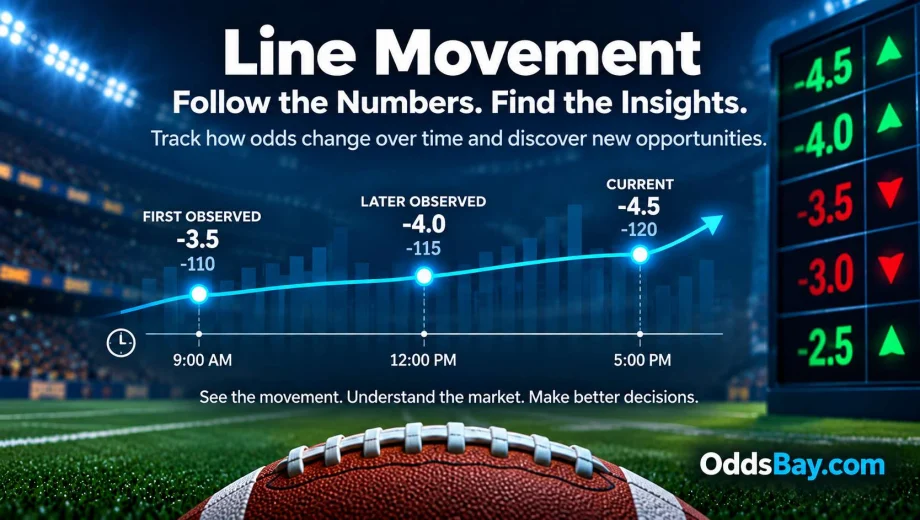
Line movement is the change in a betting market from one observed state to another. The line may change, the attached price may change, or both may change. Describing that change accurately sounds simple, but it requires clear timestamps, comparable market definitions and disciplined language about what the data does—and does not—prove.
This guide is the bridge between OddsBay’s evergreen betting education and its developing market-intelligence layer. It explains the concepts without turning movement into a prediction or assigning motives that the observations cannot establish.
What can move?
In a point spread, a line might be observed at -2.5 and later at -3. In a total, 47.5 might later become 48. A moneyline might move from -120 to -135. Sometimes the main number remains unchanged while its price changes—for example, -3 at -105 becoming -3 at -115.
These should not be collapsed into one vague label. OddsBay’s evidence architecture can preserve the market, selection, line, price and observation time so later analysis knows exactly what changed.
First Observed is not automatically the opening line
First Observed is a provenance statement: it is the earliest qualifying observation OddsBay has for the defined market in the applicable dataset. An official opening line is a different claim. Unless OddsBay has evidence establishing the true opening quote, it should not rename its earliest observation “the opener.”
This distinction matters because monitoring can begin after a sportsbook first posts a market, feeds can have coverage gaps and different books can originate markets at different times.
Line movement versus price movement
Consider a spread. Moving from -2.5 to -3 changes the handicap. Moving from -3 at -105 to -3 at -115 changes the price while preserving the handicap. Both are useful observations, but they answer different questions. A future Market Movement Fact should be able to represent line delta and price delta independently.
The same distinction connects directly to point spreads and totals. Moneylines usually express movement directly through price, as explained in the moneyline guide.
Movement needs a path, not just two endpoints
First and current observations tell you net change. They do not necessarily describe the path. A market could move from -2.5 to -3.5 directly, or travel through -3, return to -2.5 and later reach -3.5. Those paths have the same endpoints but different histories.
This is why historical observations matter. A richer intelligence layer can eventually summarize timing, magnitude, breadth, velocity and persistence while retaining the underlying provenance.
Breadth, velocity and persistence
One sportsbook changing a quote and many sportsbooks changing comparable quotes are different observations. A change occurring over minutes and the same-sized change developing over hours also have different temporal characteristics. A quote that immediately reverses differs from one that persists.
These dimensions can become structured intelligence only when the methodology, sample and provenance support them. They should not be retrofitted as narrative guesses.
Movement does not prove motive
A line change by itself does not prove “sharp money,” public betting, an injury, a sportsbook opinion or any other cause. Those explanations may sometimes be supported by additional evidence, but the movement alone establishes only that the recorded market state changed.
That is central to OddsBay’s market-integrity approach: record what can be observed, calculate what can be derived transparently, and keep interpretation separate from unsupported attribution.
From education to OddsBay intelligence
Sport-specific surfaces such as NFL Intelligence, college football, NBA, MLB and NHL provide natural places to connect these concepts to observed markets when relevant data exists.
A future OddsBay Market Story™ can assemble structured evidence into a readable sequence, but the evidence should remain traceable to observations. The story is a presentation layer over facts, not permission to invent a cause.
Line-movement checklist
- Define the event, market, period and selection.
- Record line and price separately.
- Attach observation timestamps.
- Call the earliest OddsBay observation First Observed unless an official opener is established.
- Preserve intermediate history when analyzing path.
- Distinguish magnitude, breadth, velocity and persistence.
- Do not infer motive from movement alone.
Line Movement FAQ
Is the first line OddsBay records the sportsbook’s opening line?
Not necessarily. OddsBay calls it First Observed unless evidence independently establishes that the quote was the official opener.
Does a fast move prove professional betting activity?
No. Speed is an observable characteristic of movement; motive requires additional evidence. OddsBay can record velocity without assigning an unsupported cause.
Why preserve intermediate observations?
Endpoints show net change, while intermediate observations reveal the path. Two markets can begin and end at the same values while taking materially different routes.
The main idea
Line movement is evidence of change over time. The useful question is not merely “did it move?” but “what changed, when, across which comparable observations, and what can the recorded evidence actually support?” That framework gives OddsBay a clean foundation for future Market Intelligence without asking the editorial layer to pretend it already knows more than the data can prove.