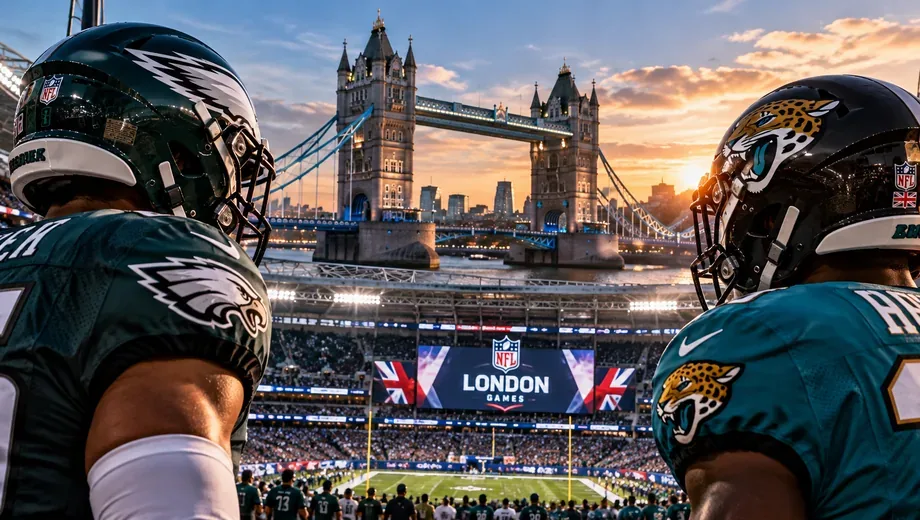
Philadelphia Eagles visits the Jacksonville Jaguars on 2026-10-11 at Tottenham Hotspur Stadium. This OddsBay Week 5 analysis is built around international travel, offensive rhythm, line play and neutral-event context. The purpose is not to predict from reputation, nor to stretch a routine preview with generic betting language. It is to identify the football questions that can be checked, updated and connected to market information without inventing evidence.
London changes the week before it changes the game
The NFL lists Eagles-Jaguars at Tottenham Hotspur Stadium for 2:30 p.m. local time, which is 9:30 a.m. Eastern. That creates a different sequence of sleep, meals, meetings and pregame preparation from a normal U.S. Sunday. It does not establish that either team will be sluggish. The analytical value comes from documented travel and from how cleanly the teams operate once the game begins.
Jacksonville’s London familiarity should be used carefully
The Jaguars have substantial experience playing in London, and Philadelphia and Jacksonville previously met there in 2018. Familiarity can remove some logistical novelty, but it does not transfer old results to a current roster. The useful edge would have to appear in present-day preparation, communication or execution.
Philadelphia can make the travel story disappear in the trenches
If the Eagles protect cleanly and create manageable early downs, the venue quickly becomes background. Stable line play allows the offense to use its normal timing and prevents Jacksonville from turning an unusual week into a football advantage. The Jaguars need disruption that changes down-and-distance, not merely a London narrative.
Jacksonville needs field position to amplify its familiarity
A team comfortable with the event can still lose control if it gives away possessions or repeatedly starts drives in poor territory. Jacksonville’s special-teams execution and turnover avoidance can make the opening quarter easier to manage. Short fields would also force Philadelphia to defend before it can settle into a normal rhythm.
The early local kickoff makes the opening quarter diagnostic
Because the Eastern body clock reads morning at kickoff, the first quarter deserves attention for cadence, substitution, tackling and communication. Those are observable signs of operational sharpness. They are more defensible than predicting fatigue without evidence.
Quarterback comfort will be created by the lines
The quarterback discussion should begin with the pocket each offense provides. Interior disruption can shorten the throwing platform and force earlier decisions; edge pressure can alter launch points. If either line controls the rush with four, the defense gains flexibility behind it and the quarterback sees fewer simple answers.
Explosive plays can erase a careful international plan
Travel preparation can be excellent and still become irrelevant after a busted coverage or missed tackle. Both teams need to distinguish controlled aggression from reckless pursuit. Preventing a short completion from turning into a long gain is particularly important while the defenses are settling into the unusual schedule.
The London question is who reaches ordinary football first
Philadelphia wants its normal offensive rhythm to make geography irrelevant. Jacksonville wants its familiarity, field position and disruption to keep the Eagles from reaching that state. The most revealing answer may arrive early: which club turns the unusual routine into clean, ordinary football before the other one does?
The schedule gives Philadelphia a normal week but an abnormal clock
Philadelphia entered Week 4 at 2-1 and played the Rams at home on October 4. Jacksonville also entered Sunday at 2-1 but played at Cincinnati. Both clubs therefore have a conventional seven-day interval before London; this is not a short-rest story. The unusual part is what happens after the normal recovery window: travel, time-zone adjustment and a 9:30 a.m. Eastern kickoff at Tottenham Hotspur Stadium.
That distinction matters. It prevents the preview from lazily treating every international game as a fatigue game. The teams have a full week between contests. The better question is how they use it. Philadelphia has to transition from a home game to transatlantic travel. Jacksonville transitions from Cincinnati and then into a setting the organization knows well. Verified travel timing, when available, can deepen that comparison; until then, the schedule itself supports only the conclusion that the clock and routine are unusual, not that one team is automatically disadvantaged.
Jacksonville arrives with evidence that its defense can change possessions
Jacksonville’s 35-6 Week 3 win over New England showed a team capable of creating separation rather than merely surviving close games. In Week 4 at Cincinnati, the Jaguars again produced impact defensive moments before halftime, including a Jourdan Lewis interception return and a Danny Striggow sack. Those are current examples of the kind of disruption Philadelphia must prevent from becoming the story in London.
The Eagles’ Week 4 game supplied its own live personnel warning: Saquon Barkley left against the Rams with an apparent hamstring injury, while DeVonta Smith and Zack Baun had already been ruled out for that game. None of those Week 4 statuses should be projected automatically to October 11. They do, however, make Philadelphia’s Week 5 availability refresh essential. The London thesis becomes much more football-specific if the Eagles travel with changes at running back, receiver or linebacker.
The Jaguars’ second London game changes the strategic context
Jacksonville is scheduled to remain in the London window for another game against Houston on October 18 before its Week 7 bye. Eagles-Jaguars is therefore not an isolated overseas event for the Jaguars; it begins a two-game London sequence. Philadelphia, by contrast, returns to host Carolina the following week. That scheduling asymmetry is real, but its Week 5 competitive effect should still be demonstrated rather than assumed.
For Jacksonville, organizational familiarity can reduce uncertainty around facilities, transportation and routine. For Philadelphia, the task is to make those background advantages irrelevant through line play and possession quality. If the Eagles protect the quarterback and avoid giving Jacksonville short fields, the game can look like ordinary NFL football quickly. If the Jaguars create takeaways or negative plays early, the unfamiliar routine becomes harder for Philadelphia to compartmentalize.
The offensive-line battle determines whether London remains a headline
The most useful way to connect venue and football is through operation at the line of scrimmage. Philadelphia wants a clean cadence and protection structure that allows the offense to use its full menu. Jacksonville wants to force communication under stress and create long-yardage situations. The Jaguars’ Week 4 pressure flashes provide a current reason to watch that conflict rather than relying on a generic statement about travel.
On the other side, Philadelphia’s defense needs to prevent Jacksonville from turning manageable throws and runs into a comfortable rhythm. If the Jaguars can stay out of obvious passing downs, the Eagles lose some ability to dictate the rush. The game becomes less about which team “handles London” and more about which line allows its offense to remain on schedule.
The personnel refresh will matter more than an old London score
These teams met in London in 2018, but that result belongs to different rosters and a different competitive moment. Its main value is historical confirmation that the matchup has occupied this stage before. It should not be used as predictive evidence for 2026. Current availability and current line play are far more relevant.
The final editorial refresh should therefore prioritize Philadelphia’s Week 4 injuries, Jacksonville’s Week 4 health, any practice limitations after travel and the confirmed active roster. If Barkley, Smith, Baun or any other important player carries a designation into the week, the article should explain how the role affects the matchup rather than merely repeat the label. That is the difference between useful London context and decorative international-game storytelling.
 Buccaneers at Cowboys Week 5: The Short-Week Problems That Matter Most
 Falcons at Saints Week 4 Betting Preview: Monday Night Football Market Checklist
 Lions at Panthers Week 4 Betting Preview: Sunday Night Football Intelligence