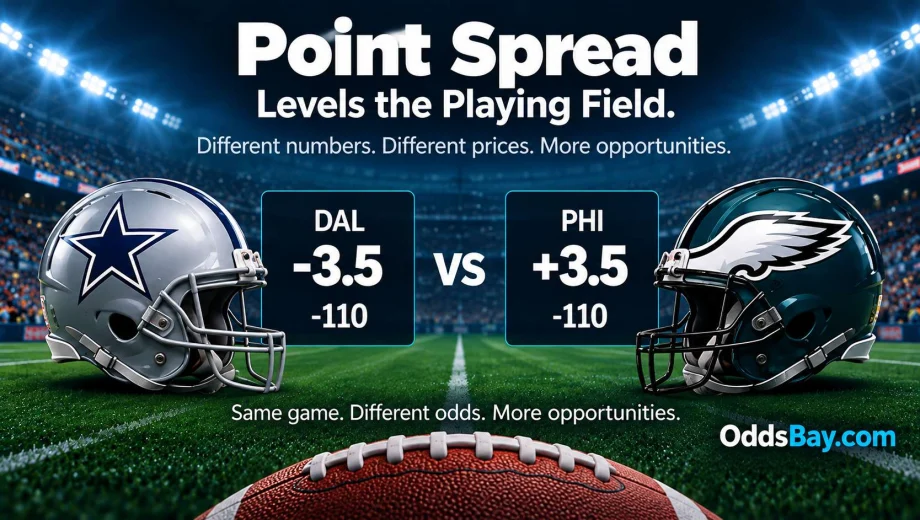
Point spread betting changes the question from “who wins?” to “how does the result compare with a handicap?” A favorite may need to win by more than a stated number, while an underdog can remain successful against the spread even if it loses the game outright.
That makes the spread a two-part quote: the line and the price. Understanding both is essential. For the broader betting workflow, see How to Bet on Sports.
Reading a point spread
If Team A is -3.5 and Team B is +3.5, the numbers describe opposite sides of the same handicap. A wager on Team A -3.5 generally needs Team A to win by at least four points. A wager on Team B +3.5 generally succeeds if Team B wins outright or loses by three points or fewer, subject to the market’s settlement rules.
The half-point matters because it removes the possibility of landing exactly on the spread. A line of -3 behaves differently from -3.5 because an exact three-point margin can create a push at -3 when the rules return the stake.
The price attached to the spread
A spread is not complete without its price. Team A -3.5 at -105 is economically different from Team A -3.5 at -115 even though the handicap is identical. Conversely, Team A -3 at -120 and Team A -3.5 at +100 differ in both line and price. Comparing spread markets therefore requires looking at both dimensions.
If American price notation is unfamiliar, read How American Odds Work.
What are key numbers?
Some scoring margins occur more frequently than others because of a sport’s scoring structure. Those margins are commonly called key numbers. Their practical importance depends on the sport and market. Crossing a frequently occurring margin can be more meaningful than moving the same numerical distance elsewhere.
The concept should not be treated as universal across every sport. Football scoring, for example, creates different margin patterns from basketball. When discussing a key number, the relevant sport and historical distribution matter.
Spread movement
A spread can move from one observed value to another, and its attached price can move even when the spread itself does not. A market might be observed at -2.5 and later at -3, or remain -3 while the price changes. These are different forms of movement and should be recorded separately.
OddsBay’s evidence model uses First Observed for the earliest qualifying observation in its own data rather than casually calling that quote an official opener. See What Is Line Movement? for the distinction between observed change and explanations for why a market moved.
Comparing spread offers
When comparing sportsbooks, first check whether the line is the same. If it is, the price can be compared directly. If the lines differ, the bettor is comparing a tradeoff between handicap and price. A seemingly better price can come with a less favorable spread, so looking only at one column can be misleading.
Sport-specific context also matters. OddsBay’s NFL, college football and NBA surfaces provide natural destinations when those sports are relevant to the discussion.
Spread checklist
- Identify favorite and underdog correctly.
- Read the handicap and attached price together.
- Know whether an integer spread can produce a push.
- Compare the same line before comparing price alone.
- Account for sport-specific scoring structure when discussing key numbers.
- Separate observed movement from claims about its cause.
Point Spread FAQ
What happens if the final margin equals the spread?
When the market uses a whole-number spread, an exact match can result in a push under standard settlement rules. Half-point spreads remove that exact tie with the posted number.
Is -3.5 at -105 always better than -3 at -120?
There is no universal answer because both the handicap and price differ. The first quote costs less but requires covering an additional half point. The comparison must preserve both dimensions.
Why does OddsBay separate line movement from price movement?
Because a handicap can remain unchanged while its price moves, or the handicap itself can change. Recording them separately preserves what actually happened.
The main idea
A point spread is not just “minus versus plus.” It is a handicap priced by the market. Good comparison therefore asks two questions at once: what line am I getting, and what am I paying for it?