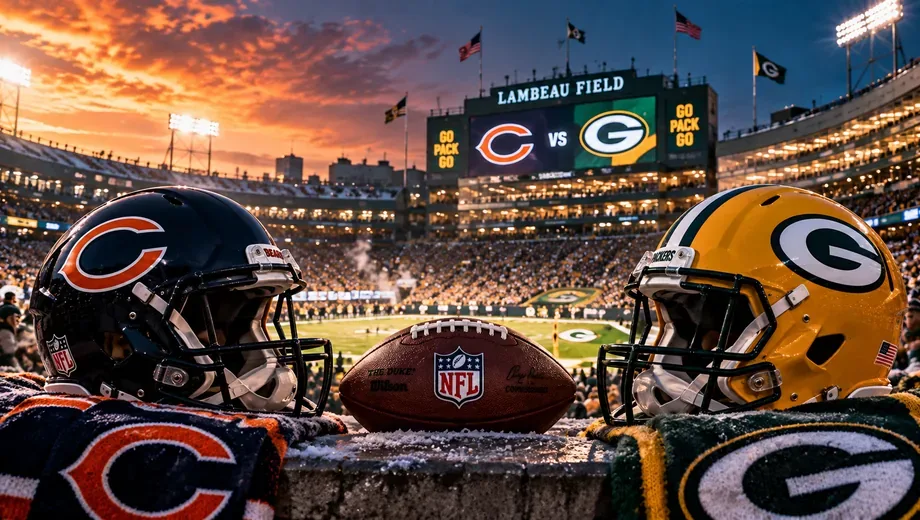
Chicago Bears visits the Green Bay Packers on 2026-10-11 at Lambeau Field. This OddsBay Week 5 analysis is built around rivalry context, quarterback pressure, possession efficiency and Lambeau execution. The purpose is not to predict from reputation, nor to stretch a routine preview with generic betting language. It is to identify the football questions that can be checked, updated and connected to market information without inventing evidence.
The rivalry matters only after the current matchup is understood
Bears-Packers carries more history than this preview needs to recite. The useful question is which mechanisms from recent meetings still exist with current personnel and coaching. Pressure, protection and explosive-play prevention can remain relevant concepts; an old final score cannot tell us how this Week 5 game will be played.
Chicago’s real protection problem begins on first down
Sacks are the loudest protection failure, but a hurried incompletion on first down can be almost as damaging to the structure of a series. Chicago needs to reach second down with the run, play-action and dropback game all credible. Repeated second-and-long situations let Green Bay narrow the possibilities before the obvious passing down even arrives.
Green Bay can turn Lambeau noise into a tactical tool
Crowd noise has football value when it complicates cadence, checks and protection communication. The Packers can magnify that value by creating early negative plays. If Chicago remains ahead of the chains, the offense has more freedom to vary tempo and formation and the environment becomes less powerful.
Possession quality is more useful than possession time
A long Green Bay drive matters when it produces points, changes field position or forces Chicago’s defense to sustain a heavy workload. Holding the ball without finishing does not create the same advantage. Chicago can survive fewer minutes of possession if its own drives produce better scoring value.
Green Bay’s rush must finish the down without losing structure
Pressure that sends the quarterback out of the pocket can still become a defensive loss if coverage leverage collapses or a scramble creates a first down. The Packers need rush and coverage to work together. Chicago, in turn, can punish an undisciplined rush if the quarterback has a clear escape and receivers adjust.
Chicago needs explosives without becoming dependent on them
A long gain can change the rivalry instantly, but an offense that requires one every drive becomes fragile. The Bears need enough ordinary efficiency to keep Green Bay from sitting on obvious concepts. Explosives are most dangerous when they grow out of a functioning down-to-down offense rather than replacing one.
Lambeau conditions belong in the article only when they become evidence
Weather can matter in Green Bay, but a forecast should be checked close enough to publication to be useful. The article should not write a weather story days in advance. If wind, precipitation or temperature becomes materially relevant, it can be integrated into passing, kicking and ball-security analysis with an observation time.
The rivalry hinge is Chicago’s down structure
If the Bears repeatedly face third-and-long, Green Bay can attack with greater certainty and the crowd becomes harder to manage. If Chicago protects first down and reaches manageable situations, the offense keeps more of its formation and play-call flexibility. That is the specific unresolved question beneath the rivalry branding.
The Week 4 quarterback context makes Chicago’s protection story immediate
Chicago entered Week 4 at 2-1, but NFL coverage indicated Tyson Bagent was likely to start against the Jets. That means the quarterback situation must be rechecked before projecting anything about the trip to Green Bay. If Chicago changes starters for Week 5, the protection and early-down thesis becomes even more important because cadence, launch point and pressure answers may change with the quarterback.
The Bears’ Week 4 offense showed a willingness to lean on the run and attack fourth down early, with Kyle Monangai scoring on a fourth-down rush and D’Andre Swift producing a 13-yard fourth-down run. Those live examples matter because a credible run game is one way Chicago can keep Green Bay from treating every critical snap as an obvious pass. The final Week 4 result and quarterback status still need to be incorporated before publication.
Green Bay’s first three games show why early downs matter
The Packers entered Week 4 at 1-2 after a 20-17 win over the Jets and losses to Minnesota and Atlanta, including a 35-14 defeat to the Falcons on Thursday night. That small sample is not enough to define the season, but it shows that Green Bay has already played from very different game states. Against Chicago, the Packers want to create the version of the game in which their defense can anticipate pass rather than react to the full menu.
That begins with first down. If Green Bay forces Chicago into second-and-long, Lambeau noise and pass-rush timing gain practical value. If the Bears consistently reach second-and-medium, they can keep the defense uncertain with run, play-action and movement. The rivalry angle is therefore subordinate to a very current tactical question: which team controls the shape of the next down?
Chicago’s run game can be a protection tool without becoming predictable
Running the ball is not automatically an answer to pressure. If Green Bay can stop the run with light boxes or create penetration before the back reaches the line, Chicago simply trades one bad down for another. The Bears need a run game that forces the Packers to respect multiple gaps and formations while still preserving play-action and perimeter answers.
The Week 4 fourth-down rushing examples are useful because they show Chicago trusting the ground game in leverage situations. Week 5 asks whether that trust can survive on the road. If it can, the Bears can make the Packers defend more than the quarterback. If it cannot, Green Bay can narrow the game and let the crowd become part of the communication problem.
Green Bay’s home edge is conditional, not mystical
Lambeau Field matters because noise can complicate cadence and checks, especially when the visiting offense is already in an obvious passing situation. It does not make every Packers pressure successful. Chicago can reduce the environmental effect by staying on schedule, using clear communication mechanics and avoiding penalties that turn manageable series into long-yardage problems.
Weather should remain a late-week evidence slot rather than an early narrative. Conditions in Green Bay can matter for kicking, ball security and deep passing, but only a sufficiently fresh forecast deserves space in the article. Until then, the stable venue fact is the crowd and the road communication burden, not a speculative weather advantage.
Possession has to be connected to finishing
The Packers can own the ball and still leave Chicago in the game if long drives end in field goals. The Bears can lose the time-of-possession column and still be efficient if their possessions generate touchdowns or favorable field position. That is why possession quality is more useful here than raw minutes.
Red-zone performance after Week 4 should be refreshed for both teams. It can reveal whether either offense is converting sustained movement into touchdowns. In a divisional game where both defenses know the opponent’s broad tendencies, small-space execution can expose whether motion and formation are creating real leverage or simply moving defenders without producing an advantage.
The history that matters is tactical continuity
Bears-Packers history is too large to summarize usefully in a Week 5 preview. Recent meetings should be included only if the current coaches, quarterbacks or core concepts make the comparison relevant. A pressure tendency that remains in the defense can be informative; an old score produced by different personnel is mostly trivia.
The article should therefore resist the temptation to use rivalry history as easy depth. The current quarterback status, Chicago’s ability to run on leverage downs, Green Bay’s capacity to create early negative plays and the final injury reports tell us more about October 11 than a catalog of past meetings.
 Eagles at Jaguars in London: Travel, Tempo and the Matchup Beneath the Event
 Buccaneers at Cowboys Week 5: The Short-Week Problems That Matter Most
 Falcons at Saints Week 4 Betting Preview: Monday Night Football Market Checklist