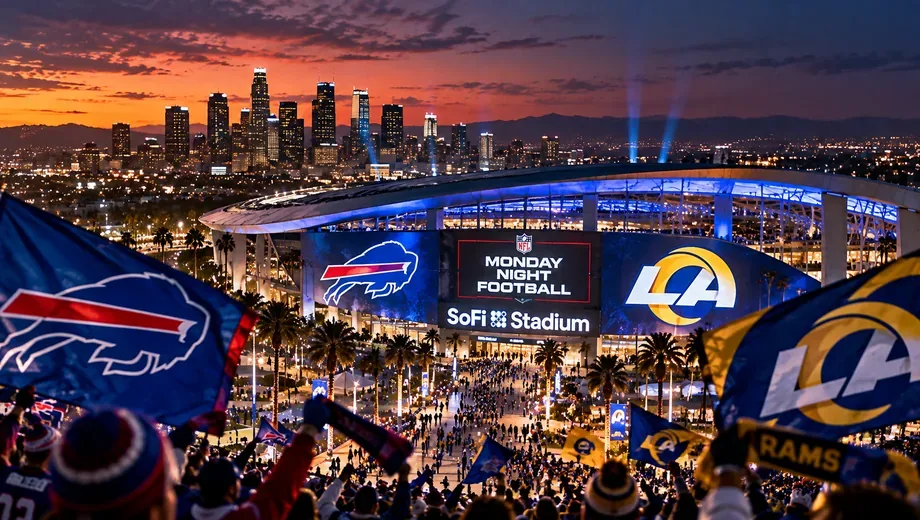
Buffalo Bills visits the Los Angeles Rams on 2026-10-12 at SoFi Stadium. This OddsBay Week 5 analysis is built around quarterback stress, protection answers, explosive plays and Monday-night game shape. The purpose is not to predict from reputation, nor to stretch a routine preview with generic betting language. It is to identify the football questions that can be checked, updated and connected to market information without inventing evidence.
The Rams can stress Buffalo without sending an extra rusher
Quarterback stress is not synonymous with blitzing. Los Angeles can show one coverage picture before the snap and rotate after it, asking Buffalo to confirm leverage while the play is already moving. That type of stress rewards processing and route discipline as much as pure protection.
Buffalo’s answer changes when the problem is numbers
When Los Angeles does add a rusher, the offense has a different equation. The quarterback may need to identify the unblocked threat, find a quick outlet or use movement to escape the pressure point. Treating disguise and numbers pressure as the same problem would hide the most interesting part of this matchup.
The Rams’ rush has to respect creation outside the pocket
A pass rusher can win his individual matchup and still lose the down if the angle opens a clean escape lane. Los Angeles needs edge discipline and interior push to reduce the quarterback’s space. Buffalo wants the opposite: a crease that turns a broken protection into an extended play.
Extended plays force the secondary to win twice
Once the original route timing breaks, coverage becomes a second contest. Defenders have to plaster receivers as they improvise, and the quarterback has to decide whether the new opportunity is worth the risk. Buffalo’s ability to create after the first structure fails can erase what looked like a Rams defensive win.
Buffalo’s defense creates its own processing test
The quarterback problem exists on both sides. If Buffalo changes the picture after the snap, the Rams need protection and route spacing that give their quarterback enough time to reach the correct answer. A clean pre-snap read can become wrong immediately after rotation.
Red-zone disguise has less space but more consequence
Near the goal line, defenses cannot hide behind as much grass. Disguise must be paired with leverage and communication because one missed assignment can become six points. For both offenses, the ability to recognize and attack a small-space mismatch may matter more than total yardage accumulated between the 20s.
SoFi removes weather from the main equation
The controlled stadium environment eliminates the wind and precipitation uncertainty that can dominate an outdoor preview. That does not make the venue neutral. Crowd composition, communication and surface familiarity can still affect execution, but they should be described specifically rather than folded into a generic home-field claim.
Monday creates a longer information window
Because this is the Monday night game, injury designations and weekend developments have more time to become clear. The editorial advantage is accuracy: the article can be refreshed later than the Sunday previews. The extra day should never be used to turn a projection into a confirmation before authoritative information exists.
The decisive question arrives after the first answer fails
The most revealing snaps may be the ones that survive the initial design. Can Buffalo create when protection bends? Can the Rams maintain coverage through the extension? Can Los Angeles’ offense solve Buffalo’s post-snap changes after the original read disappears? Monday night belongs to the team that handles that second reaction without turning improvisation into recklessness.
The records create different kinds of quarterback pressure
Buffalo entered Week 4 at 3-0 and first in the AFC East. Los Angeles entered at 1-2 before traveling to Philadelphia. Those records do not tell us which quarterback will play better on October 12, but they shape the cost of mistakes. Buffalo has been operating from an unbeaten start; the Rams entered Sunday needing to stabilize after a 26-30 loss at Denver in Week 3.
The Week 4 games must still be completed and absorbed before this Monday preview is final. Buffalo hosts New England; Los Angeles plays at Philadelphia. Because the Week 5 game is Monday night, the editorial desk gets an extra day to evaluate how each quarterback handled pressure, how the offensive lines finished the game and whether any injuries alter the protection structure.
Buffalo’s problem-solving starts with identifying the Rams’ question
A defense does not have to blitz to force a difficult decision. The Rams can create uncertainty by presenting one shell and rotating after the snap, changing leverage after the quarterback has already built a pre-snap answer. Buffalo’s quarterback then has to confirm the picture without holding the ball long enough for the rush to win.
When Los Angeles adds a rusher, the problem changes. The offense may have to account for an unblocked defender, speed up the throw or create an escape lane. The important analytical distinction is whether Buffalo is being stressed by numbers, by disguise or by both. A quarterback can be excellent against one and less efficient against the other.
Los Angeles has to rush with the quarterback’s second play in mind
Against a quarterback capable of extending the down, winning the first phase of the rush is not enough. An edge defender who flies past the pocket can create the escape lane that turns pressure into a scramble or off-platform completion. Interior push can be especially valuable because it reduces the quarterback’s ability to step up while disciplined edges close the exits.
That is why raw sack totals would be an incomplete way to evaluate this matchup. The Rams need pressures that preserve rush integrity. Buffalo wants to force Los Angeles into the opposite choice: rush conservatively and allow the pocket to live, or attack aggressively and risk creating space outside structure.
The Rams’ offense faces Buffalo’s disguise from the other direction
Quarterback processing is not a one-team story. Buffalo can also change the post-snap picture and ask the Rams to solve leverage after the ball is snapped. The Rams’ protection must buy enough time for that confirmation, while route spacing needs to give the quarterback answers against both man and zone looks.
The difficulty is compounded when down-and-distance becomes predictable. On third-and-long, Buffalo can present pressure and coverage with greater freedom because the run threat is reduced. Los Angeles can protect its quarterback by being efficient earlier in the series, making this a problem-solving matchup that begins before the obvious passing down.
Current Rams availability already makes the refresh meaningful
NFL reporting entering Week 4 said Puka Nacua would play against Philadelphia while Aaron Donald was out for that matchup. Those statuses are Week 4 facts, not automatic Week 5 designations. They illustrate why the Monday game needs a fresh personnel check. Nacua’s availability affects how Los Angeles can attack coverage and create answers for its quarterback; defensive-front availability affects how the Rams can contain Buffalo’s creation.
The final version should update both teams’ official practice participation and game-status designations. If a player moves from limited to full, questionable to active, or active to unavailable, the analysis should change only where the role changes the tactical problem. The label alone is not analysis.
SoFi changes the variables but does not erase environment
The indoor setting removes wind and rain from the central passing equation, which is useful in a quarterback-focused preview. It allows the article to concentrate on processing, protection and coverage rather than speculative weather. But communication still matters. Crowd composition and offensive cadence can affect the ease of making checks at the line.
Buffalo also travels across the country for the game. With a Monday kickoff, the team has a normal-plus preparation window rather than a short week. That makes travel a secondary factor unless verified scheduling details or player comments make it more relevant. The matchup should not invent a fatigue story simply because the distance is large.
Explosive plays are the reward for solving the first problem
Both offenses can turn a correct read into more than a modest gain if the coverage structure is stressed. Against disguise, the quarterback’s first job is to find the correct leverage; the second is to deliver accurately enough for the receiver to create after the catch or win downfield. Against pressure, the offense can sometimes turn the defense’s aggression into an explosive if the ball reaches the vacated space.
The defenses therefore need more than a clever first picture. They need tackling and coverage discipline after the quarterback finds an answer. This is where extended plays become especially dangerous: once the original coverage landmarks dissolve, receivers and defenders enter an improvisational phase in which one lost assignment can change the game.
The Monday-night answer should compare difficulty, not reputation
The article’s central question is which quarterback is being asked to solve the more difficult set of problems. That cannot be answered by reputation or a generic ranking. It requires the final Week 4 tape, current protection personnel, the Rams’ pressure and disguise choices, Buffalo’s coverage presentation and the health of the receiving groups.
If Buffalo’s quarterback faces a Rams front capable of compressing the pocket without sacrificing coverage, his problem may be more difficult than the record suggests. If Los Angeles is forced into obvious passing downs against a Buffalo defense that can disguise without exposing itself, the Rams quarterback may carry the heavier cognitive burden. The evidence should decide which side of that comparison survives the final refresh.
 Antonio Brown, Bruce Arians Dispute Resurfaces After Video Reports
 49ers at Seahawks Week 5: Noise, Space and the NFC West Stress Test
 Bears at Packers Week 5: A Rivalry Preview Built on Pressure and Possession