Home-field advantage is real in college football: loud stadiums, familiar surroundings, no travel, and sometimes altitude or weather the visitors are not used to. Conference realignment has added a new layer, with teams now flying across the country, sometimes across three time zones, for regular conference games. The betting question is not whether these factors exist, but whether the price already accounts for them.
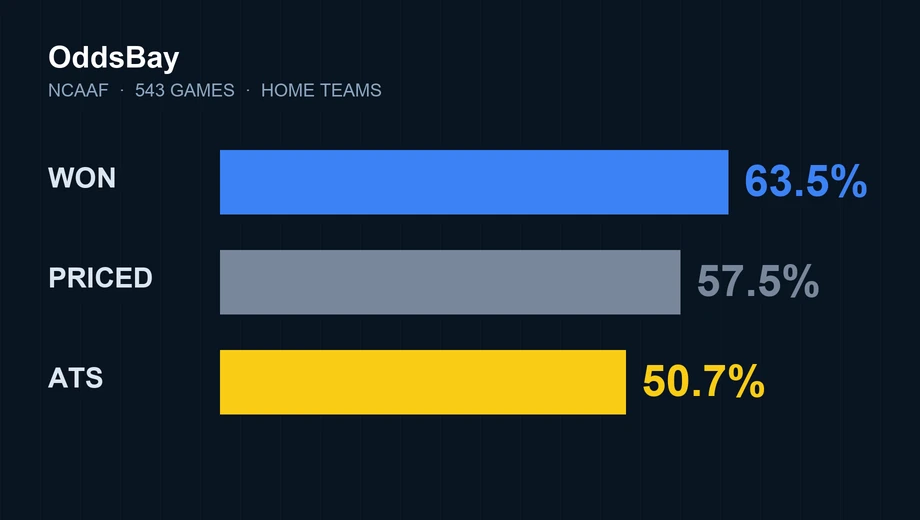
OddsBay’s records of 543 finished college football games with closing lines, from September to October 12, 2026, give a clear answer for this sample: home teams won often, and the market priced that almost exactly.
What the data shows
| Result | |
|---|---|
| Home teams won | 63.5% (345 of 543) |
| Closing moneylines gave home teams, on average | 57.5% (467 games with moneylines) |
| Home teams actually won in those games | 58.0% |
| Home teams covered the closing spread | 50.7% (274 covers, 266 losses, 3 pushes) |
| Average home margin vs average closing line | 8.9 points vs 8.4 points |
Home teams won almost two games in three, partly because stronger programs host many of their weaker opponents. But closing prices predicted their win rate within half a percentage point, and against the spread the home side was a coin flip. Home field mattered; the market had already charged for it. (A few neutral-site games are listed with one team as “home”, which this sample does not separate.)
What makes up home-field advantage
- Crowd noise. It can disrupt the visiting offense’s communication, causing false starts and wasted timeouts, especially in the largest stadiums.
- Travel and routine. The home team sleeps in its own beds and keeps its routine.
- Officiating and momentum. Often cited, harder to measure.
- Environment. Altitude, heat, cold or a night kickoff the visitors rarely play in.
Not every home field is equal. Some stadiums are famously difficult; small stadiums or sparse crowds offer less. Treat “home field is worth three points” as a rough average, not a rule.
Realignment and long-distance travel
Recent conference realignment means more regular-season games between schools that are very far apart. That adds:
- Time-zone changes. A team from the West Coast playing an early kickoff in the East plays at what feels like breakfast time.
- Longer trips more often, which cut into preparation and recovery time.
- Unfamiliar environments for players and staff who have rarely played there.
These are real effects, but they are also well publicized, so sportsbooks and bettors watch them closely. As with home field in general, the question is whether a specific trip is priced correctly.
How to use home-field and travel information
- Start from the price. Convert the moneyline or spread to implied probability. The home edge is already in it.
- Ask whether this venue is typical. A very difficult stadium, a night game, extreme weather or a long trip across time zones can justify a different view than the average.
- Check the kickoff time and travel. Early starts for teams crossing several time zones are the situation most often discussed.
- Look at line movement. If the line has already moved toward the home team, much of the story may be priced. Our guide to line movement explains how to read that.
- Get the best number. Half points matter, especially around 3 and 7; our guide to college football key numbers shows how often those margins come up. Compare lines in the OddsBay Price Finder.
Common mistakes
- Betting home teams because they win a lot. They do, but the prices reflect it: in this sample they covered 50.7% of the time.
- Applying one number to every stadium. Home-field advantage varies by venue and situation.
- Overrating a single bad road trip. One poor performance after travel is a small sample.
Betting responsibly
Home-field and travel factors are already priced most of the time, and most bettors lose money over time. Set stakes in advance (our guide to bankroll management shows how) and treat betting as entertainment. If gambling stops being fun, help is available: in the United States, the National Problem Gambling Helpline is available 24/7 by calling or texting 1-800-MY-RESET.
Key takeaways
- In 543 college games recorded by OddsBay, home teams won 63.5% of the time.
- Closing moneylines priced home teams at 57.5% on average; they won 58.0% of those games.
- Against the closing spread, home teams covered 50.7%, essentially a coin flip.
- Realignment adds more long trips and time-zone changes, which are real but closely watched factors.
- Judge each venue and trip on its specifics, starting from the price.
Frequently asked questions
How much is home-field advantage worth in college football?
It varies by stadium and situation. In OddsBay’s sample, home teams won 63.5% of games, but closing prices already reflected nearly all of it.
Do home teams cover the spread more often?
Not in this sample: home teams covered 50.7% of the time against the closing line.
Does cross-country travel matter?
It can, especially with early kickoffs across several time zones, but markets watch it closely.