Implied probability is the win rate a betting price represents. Every set of odds can be turned into a percentage, and that percentage tells you how often a bet has to win just to break even. If you understand this one conversion, odds stop being strange notation and become something you can compare, question and shop.
Here is the short version. A price of +150 implies 40%. A price of −150 implies 60%. The rest of this guide explains how to get those numbers, why the two sides of a game add up to more than 100%, how to strip out the sportsbook’s margin, and how to use all of it with real prices OddsBay recorded across 44 sportsbooks.
How to calculate implied probability
There is one formula for positive American odds and one for negative odds.
- Positive odds: 100 ÷ (odds + 100). For +150: 100 ÷ 250 = 40%.
- Negative odds: odds ÷ (odds + 100), using the number without its minus sign. For −150: 150 ÷ 250 = 60%.
The logic is the same in both cases: implied probability is what you risk divided by the total you get back when the bet wins. At +150 you risk $100 to get back $250 (your $100 plus $150 profit), so 100 ÷ 250. At −150 you risk $150 to get back $250, so 150 ÷ 250.
If you use decimal odds, it is even simpler: implied probability = 1 ÷ decimal odds. Decimal 2.50 is 1 ÷ 2.50 = 40%. Fractional odds work the same way once converted; our guide to fractional odds shows how.
Common prices at a glance
| American odds | Decimal odds | Implied probability |
|---|---|---|
| −300 | 1.33 | 75.00% |
| −200 | 1.50 | 66.67% |
| −150 | 1.67 | 60.00% |
| −120 | 1.83 | 54.55% |
| −110 | 1.91 | 52.38% |
| +100 | 2.00 | 50.00% |
| +120 | 2.20 | 45.45% |
| +150 | 2.50 | 40.00% |
| +200 | 3.00 | 33.33% |
| +300 | 4.00 | 25.00% |
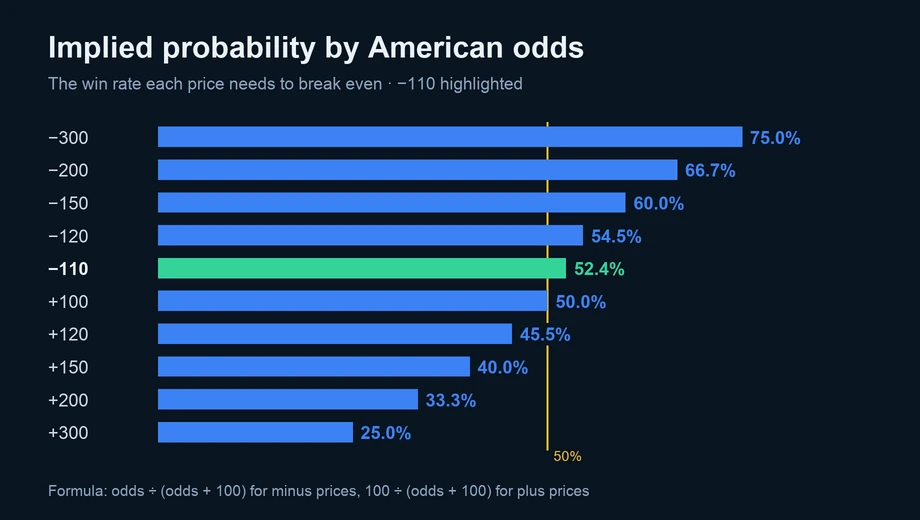
Two patterns are worth remembering. The bigger the minus number, the higher the implied probability. The bigger the plus number, the lower it gets. And +100 sits exactly at 50%: an even-money bet has to win half the time to break even.
What implied probability is, and what it is not
Implied probability is a translation of the price. It is not a forecast, and it is not the sportsbook’s honest opinion of how likely something is.
Think of it as the break-even bar. A bet at −110 needs to win 52.38% of the time for you to come out level over many bets. If your bets at that price win less often than that, you lose money; if they win more often, you make money. The percentage describes the price, not the game.
That distinction matters because the price includes something besides probability: the sportsbook’s margin. To see it, you have to look at both sides of the market at once.
A real example: Cowboys at Packers
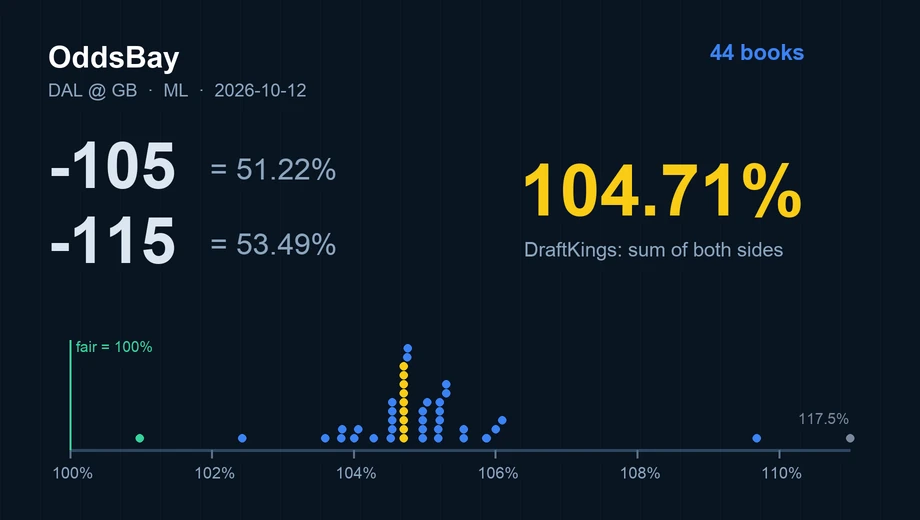
On October 12, 2026 at 16:14 UTC, OddsBay recorded moneyline prices from 44 sportsbooks for the Dallas Cowboys at the Green Bay Packers on Sunday Night Football (October 18). Prices move, so treat these as a snapshot rather than current odds.
At DraftKings, the prices were:
| Team | Price | Implied probability |
|---|---|---|
| Dallas Cowboys | −105 | 51.22% |
| Green Bay Packers | −115 | 53.49% |
| Total | 104.71% |
One of the two teams will win, so the true probabilities must add up to exactly 100%. These add up to 104.71%. The extra 4.71 percentage points are not a mistake. They are the sportsbook’s margin, built into the prices.
Why the two sides add up to more than 100%
The amount above 100% is called the overround. It is how a sportsbook makes money regardless of who wins: both sides are priced slightly worse than fair, so the book collects more from losing bets than it pays to winning ones over time. That margin is usually called the vig or juice, and our guide to what the vig is covers it in detail.
A quick way to turn the overround into the book’s expected share of the money is 1 − (1 ÷ total). For DraftKings here, 1 − (1 ÷ 1.0471) = about 4.5%. If bets were split so that the book paid out the same whichever team won, it would keep roughly 4.5 cents of every dollar wagered on this game.
The overround is not the same everywhere. Across the 44 sportsbooks in this snapshot:
- The lowest total was 100.98% at Novig (Dallas +100, Green Bay −104), an exchange-style platform where prices come from other users rather than from a bookmaker’s own margin.
- The median sportsbook sat at 104.73%.
- Among regular sportsbooks, the highest was 109.68% at LeoVegas (Dallas −118, Green Bay −125).
A bettor at the high end pays roughly twice the margin of one at the median, on the same game. That is one reason line shopping matters so much.
Removing the vig: the fair probability
If you want an estimate of what the market actually thinks, remove the margin. The simplest method is to divide each side’s implied probability by the total:
- Dallas: 51.22% ÷ 104.71% = 48.92%
- Green Bay: 53.49% ÷ 104.71% = 51.08%
Now the two sides add up to 100%, and you have the no-vig, or “fair”, probabilities: according to DraftKings’ prices, Green Bay is a slight favorite at about 51%.
This proportional method assumes the margin is spread evenly across both sides. In practice books often load more margin onto one side, especially the underdog in lopsided games, and analysts use more refined methods for that. For a close game like this one, the simple version is a reasonable estimate. It is still an estimate built from one book’s prices, not the truth about the game.
Books do not even agree on the favorite
Implied probability becomes most useful when you compare books. In this snapshot, sportsbooks did not just disagree on the size of the margin. Some made Dallas the favorite and others made Green Bay the favorite:
| Sportsbook | Dallas | Green Bay | Total |
|---|---|---|---|
| Novig | +100 (50.00%) | −104 (50.98%) | 100.98% |
| DraftKings | −105 (51.22%) | −115 (53.49%) | 104.71% |
| BetMGM | −120 (54.55%) | +100 (50.00%) | 104.55% |
| BetAnything | +100 (50.00%) | −120 (54.55%) | 104.55% |
| Betsson | −125 (55.56%) | +101 (49.75%) | 105.31% |
BetMGM and BetAnything posted mirror images of each other. A Green Bay bettor could have taken +100 at BetMGM or +101 at Betsson, or −120 at BetAnything, for exactly the same outcome. In implied-probability terms that is the difference between needing to win 49.75% of the time and needing to win 54.55% of the time. You can see the full spread for any game in the OddsBay Price Finder.
Using implied probability to judge a bet
Implied probability is the price. Your own estimate is your opinion. Comparing the two is the core of judging whether a bet is worth making.
Suppose you believe Green Bay wins this game 54% of the time. Here is what a $100 bet is worth on average at three prices from the snapshot, using expected value = (your probability × profit if it wins) − (chance it loses × stake):
| Green Bay price | Implied probability | Profit if it wins | Expected value per $100 |
|---|---|---|---|
| −125 (LeoVegas) | 55.56% | $80.00 | −$2.80 |
| −115 (DraftKings) | 53.49% | $86.96 | +$0.96 |
| +101 (Betsson) | 49.75% | $101.00 | +$8.54 |
Same team, same opinion, three different answers. At −125 the bar (55.56%) is above your 54%, so the bet is expected to lose money. At −115 it is barely positive. At +101 the bar is more than four points below your estimate. The quality of a bet depends on the price you get as much as on the pick.
Two cautions. First, this only works if your 54% is a good estimate, and most people’s estimates are less accurate than they think. Second, expected value describes the long run. Any single bet still wins or loses outright.
Many experienced bettors also track how their prices compare with the final price before the game, the closing line. If the market regularly moves toward the side you took, your estimates were probably good.
Common mistakes
- Reading implied probability as a prediction. It is the break-even rate of a price, with the sportsbook’s margin built in.
- Forgetting the margin. Converting only one side of a market hides the vig. Convert both sides and check the total.
- Comparing different markets. A full-game moneyline, a first-half moneyline and a regulation-only hockey moneyline are different bets with different probabilities.
- Treating no-vig numbers as certain. A fair probability built from one sportsbook is still one book’s view. Several sharp books together give a better estimate.
- Ignoring the price once you like a side. As the table above shows, the same opinion can be a good or a bad bet depending on where you place it.
Implied probability does not remove risk
Knowing the math helps you avoid paying too much for a bet. It does not make any bet more likely to win, and it does not turn sports betting into a reliable income. Most bettors lose money over time. Decide in advance what you can afford to spend (our guide to bankroll management shows how), and treat betting as entertainment. If gambling stops being fun, help is available: in the United States, the National Problem Gambling Helpline is available 24/7 by calling or texting 1-800-MY-RESET.
Key takeaways
- Implied probability is the break-even win rate of a price: 100 ÷ (odds + 100) for positive odds, odds ÷ (odds + 100) for negative odds, or 1 ÷ decimal odds.
- Both sides of a market add up to more than 100%. The excess is the sportsbook’s margin; on Cowboys at Packers it ranged from 0.98 points at an exchange to 9.68 points at the most expensive regular sportsbook.
- Dividing each side by the total removes the margin and gives an estimate of the fair probability.
- Books can disagree on which team is the favorite, so comparing prices changes the bar a bet has to clear.
- A bet is only worth making when your honest estimate is higher than the implied probability of the price you can get.
Frequently asked questions
What does −110 mean in implied probability?
−110 implies 52.38%: 110 ÷ 210. A bet at −110 has to win a little more than 52 times in 100 to break even.
Why do implied probabilities add up to more than 100%?
Because each side is priced slightly below fair value. The amount over 100% is the sportsbook’s margin, also called the overround or vig.
Is the favorite always the team with the higher implied probability?
At a single sportsbook, yes. Across sportsbooks, not necessarily: in the Cowboys at Packers snapshot, some books priced Dallas as the favorite and others priced Green Bay.
How do I calculate implied probability from decimal odds?
Divide 1 by the decimal odds. Decimal 1.91 is 1 ÷ 1.91 = 52.4%, the same as −110 in American odds.