The vig is the fee a sportsbook builds into its odds. You never see it on your bet slip, but you pay it on every bet, win or lose, through slightly worse prices than a fair coin flip would get. It is also called the juice, and it is the main reason most bettors lose money over time.
The numbers are easy to work out once you know where to look. A standard bet at −110 on both sides carries a vig of 4.55%. When OddsBay compared about 1,000 NFL markets at once, the typical sportsbook charged almost exactly that, but the range ran from under 1% at the cheapest books to over 8% at the most expensive. This guide explains how to calculate the vig, what it costs you, and how to pay less of it.
Where the vig hides
Imagine a game that is a true coin flip. Fair odds on each side would be +100: bet $100, win $100. Sportsbooks rarely offer that. Instead, they list both sides at −110: you risk $110 to win $100.
If one bettor puts $110 on each side, the book takes in $220. Whichever team wins, it pays back $210 (the winner’s $110 stake plus $100 profit) and keeps $10. That $10 out of $220 is the vig: about 4.55% of the money wagered.
The book does not need to predict the winner to earn it. It only needs the prices on both sides to be a little worse than fair, which is why the vig is sometimes described as the price of placing a bet.
How to calculate the vig
You can calculate the vig of any two-sided market in three steps.
- Convert each price to implied probability. For negative odds: odds ÷ (odds + 100). For positive odds: 100 ÷ (odds + 100). Our guide to implied probability explains the formulas in detail.
- Add the two together. In a fair market they would add up to exactly 100%. The total above 100% is called the overround.
- Turn the total into the vig: vig = 1 − (1 ÷ total).
For −110 on both sides: each side implies 110 ÷ 210 = 52.38%. Together that is 104.76%. The vig is 1 − (1 ÷ 1.0476) = 4.55%.
You will sometimes see the vig quoted as 4.76%, simply the overround minus 100. Both numbers describe the same prices. The 4.55% figure is the more useful one, because it is the share of the money wagered that the book expects to keep, so this guide uses it throughout.
Common prices and their vig
| Prices (both sides) | Combined implied probability | Vig |
|---|---|---|
| −102 / −102 | 100.99% | 0.98% |
| −105 / −105 | 102.44% | 2.38% |
| −108 / −108 | 103.85% | 3.70% |
| −120 / +100 | 104.55% | 4.35% |
| −115 / −105 | 104.71% | 4.50% |
| −110 / −110 | 104.76% | 4.55% |
Notice that −115/−105 costs almost the same as −110/−110. The book has simply moved more of the vig onto one side. That is common: in the NFL data below, −115/−105 was the most frequent spread price, ahead of the classic −110/−110.
Vig, juice, hold and overround
- Vig (short for vigorish) and juice mean the same thing: the margin built into the odds.
- Overround is the total of the implied probabilities, such as 104.76%.
- Hold is the share of money wagered a sportsbook keeps. The theoretical hold of a single market is the 4.55% figure above. A book’s actual hold over a month also depends on how the money was split and which side won, so it can be higher or lower.
What the vig actually costs you
The vig raises the bar your bets have to clear. At −110 you need to win 52.38% of your bets just to break even. At −105 the bar drops to 51.22%.
It also has a direct cost. If your bets are exactly as likely to win as to lose, every $100 you bet at −110 is worth −$4.55 on average, the vig itself. At −105 that falls to −$2.38. Over a season of 100 bets of $100, that is an expected cost of $455 at −110 against $238 at −105, for the same picks.
For a bettor who is slightly better than the market, that difference can decide whether the year ends in profit or loss. Our guide to line shopping shows a 52–48 record turning from a loss into a profit just by moving from −110 to −105.
How much vig sportsbooks charge: OddsBay data
On October 13, 2026 at 16:18 UTC, OddsBay recorded prices for all 13 NFL games of the following weekend. Counting every sportsbook that offered both sides of the same market at the same line, that came to about 1,000 markets. Prices move constantly, so treat this as a snapshot.
| Market | Markets compared | Median vig | Lowest | Highest |
|---|---|---|---|---|
| Moneyline | 374 | 4.50% | 0.21% | 9.53% |
| Point spread | 307 | 4.55% | 0.43% | 8.45% |
| Total (over/under) | 317 | 4.55% | 0.47% | 8.83% |
The typical book charged the classic −110 margin on all three main markets. The spread between books was much wider than between market types. Among the 25 sportsbooks that priced at least 20 of these markets:
| Sportsbook | Median vig | Type |
|---|---|---|
| Novig | 0.96% | Exchange-style |
| Matchbook | 2.83% | Betting exchange |
| LowVig | 3.43% | Reduced-juice sportsbook |
| BetMGM | 4.13% | Sportsbook |
| DraftKings | 4.42% | Sportsbook |
| BetOnline | 4.50% | Sportsbook |
| Betsson | 5.04% | Sportsbook |
| LeoVegas | 8.11% | Sportsbook |
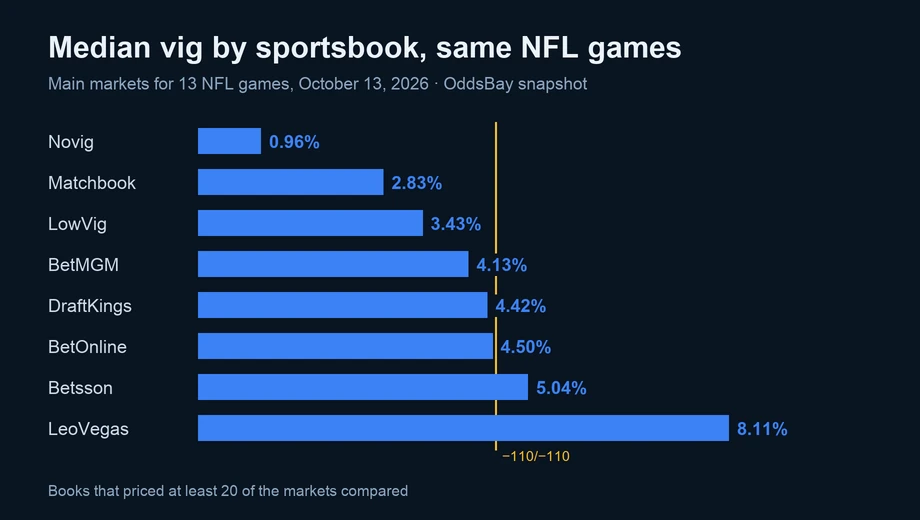
Exchanges such as Matchbook usually charge a commission on winnings instead of building most of their margin into the price, so their listed vig understates the total cost a little. Availability also depends on where you live; only use operators licensed in your jurisdiction. You can see how every book compares on price in the OddsBay sportsbook rankings.
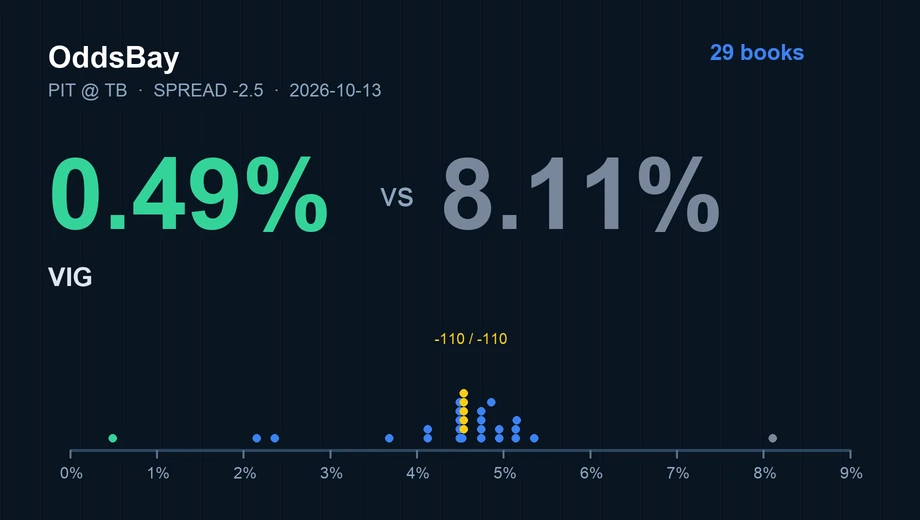
One game, 29 different prices
Here is the point spread for the Pittsburgh Steelers at the Tampa Bay Buccaneers (Steelers −2.5) from the same snapshot. Every book below offered exactly the same bet, at the same line:
| Sportsbook | Steelers −2.5 | Buccaneers +2.5 | Vig |
|---|---|---|---|
| Novig | −102 | +100 | 0.49% |
| LowVig | −102 | −108 | 2.36% |
| BetMGM | −108 | −110 | 4.13% |
| DraftKings | −110 | −110 | 4.55% |
| BetRivers | −109 | −112 | 4.75% |
| LeoVegas | −125 | −114 | 8.11% |
A Steelers bettor at LeoVegas risked $125 to win $100. At LowVig or Novig, the same bet cost $102.
Parlays multiply the vig
Every leg of a parlay carries its own vig, and the parlay compounds them. Take legs that are each a true 50/50, priced at −110:
| Legs | Parlay pays | Fair payout | Vig |
|---|---|---|---|
| 1 (straight bet) | +91 | +100 | 4.55% |
| 2 | +264 | +300 | 8.88% |
| 3 | +596 | +700 | 13.03% |
| 4 | +1228 | +1500 | 16.98% |
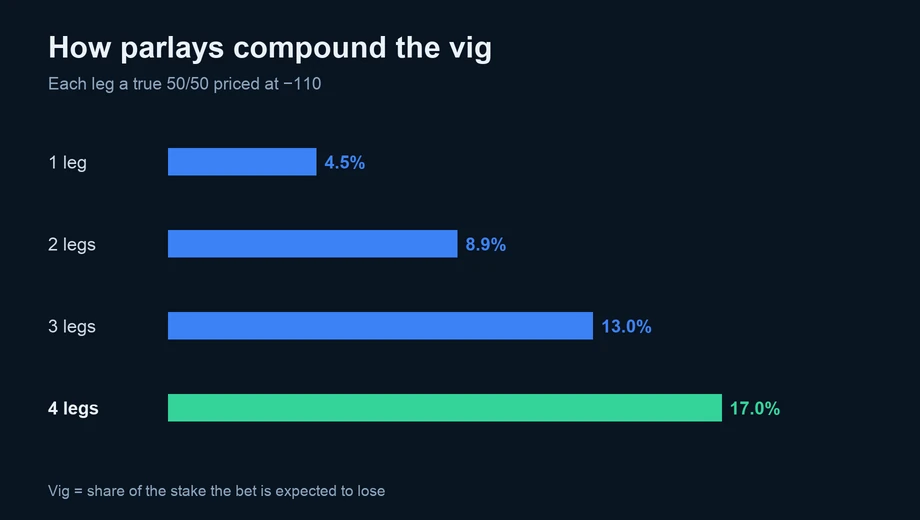
A four-leg parlay at standard prices costs nearly four times the vig of a single bet. Parlays with fixed payout tables and same-game parlays are often priced with even larger margins.
How to pay less vig
- Compare prices before every bet. In the 13-game snapshot, taking the best available price on each side of a spread cut the median vig from 4.55% to about 1.2%. The OddsBay Price Finder shows those best prices side by side.
- Look for reduced-juice prices. Some books post −105 or −108 instead of −110 as standard. On the same picks, −105 roughly halves the vig.
- Consider exchanges where they are legal. Their prices come from other bettors, so the margin is usually lower, although the commission has to be counted.
- Be careful with high-margin bets. Parlays, futures and player props usually carry more vig than spreads, totals and moneylines.
- Know which markets you are betting. Our guides to point spreads and totals explain how lines and prices work together, so you compare like with like.
Removing the vig: fair odds
Because the vig is built into both sides, you can strip it out to estimate fair odds. Divide each side’s implied probability by the total. At −110/−110, each side’s 52.38% divided by 104.76% gives 50%: an even game. Our implied probability guide works through a full example, and many bettors use no-vig prices from the lowest-margin books as a benchmark when judging their own bets against the closing line.
The vig is why betting is hard
Paying less vig is one of the few things every bettor can control. It does not make any bet more likely to win, and even at low margins most bettors lose money over time. Decide in advance how much you can afford to spend, never bet money you need, and treat betting as entertainment. If gambling stops being fun, help is available: in the United States, the National Problem Gambling Helpline is available 24/7 by calling or texting 1-800-MY-RESET.
Key takeaways
- The vig is the sportsbook’s margin, built into the odds rather than charged as a separate fee.
- To calculate it, add the implied probabilities of both sides and use vig = 1 − (1 ÷ total). At −110/−110 it is 4.55%.
- Across about 1,000 NFL markets, the typical book charged about 4.5%, but individual books ranged from under 1% to over 8%.
- Parlays compound the vig: about 8.9% for two legs at −110 and about 17% for four.
- Comparing prices across books cut the typical spread vig from 4.55% to about 1.2% in our snapshot.
Frequently asked questions
What does −110 mean for the vig?
You risk $110 to win $100. When both sides are −110, the market’s vig is 4.55% and you need to win 52.38% of the time to break even.
Is the vig the same at every sportsbook?
No. In OddsBay’s NFL snapshot, the median vig by book ranged from 0.96% to 8.11%, on identical games.
Do I pay the vig if my bet wins?
Yes. You pay it through the price: a winning −110 bet pays $90.91 per $100 risked instead of the $100 a fair price would pay.
Which bets have the lowest vig?
Main-market spreads, totals and moneylines on popular games usually carry the lowest margins. Parlays, futures and props usually carry more.