Line shopping means comparing the price of the same bet at several sportsbooks and taking the best one. It is the simplest habit in sports betting that reliably improves your results, because it does not require you to predict anything better. You make the same pick you were going to make, and you get paid more when it wins.
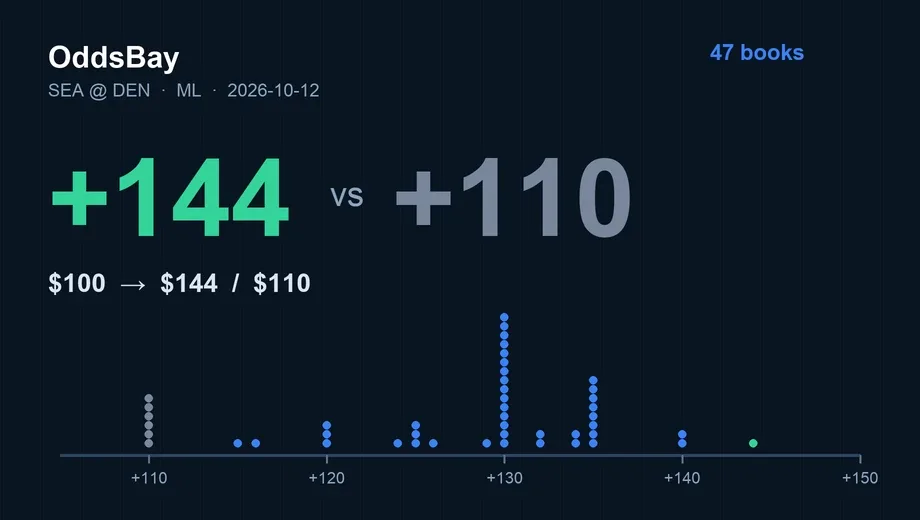
Here is how big the gap can be. Before the Seattle Seahawks visited the Denver Broncos on Thursday Night Football in October 2026, OddsBay recorded moneyline prices from 47 sportsbooks in a single snapshot. The best price on Denver was +144. The worst was +110. On a $100 bet, that is $144 of profit at one book and $110 at another, for exactly the same outcome.
This guide explains why those gaps exist, how to measure what they are worth, and a simple routine for shopping every bet.
What line shopping actually is
Every bet has two parts you can compare: the line and the price.
- The line is the condition the bet has to meet: Seahawks −2.5, over 42.5 points, and so on.
- The price is what you are paid if it wins, shown as American odds such as −110 or +144.
Line shopping is comparing both across sportsbooks before you bet. Sometimes the line is the same everywhere and only the price differs (−110 at one book, −104 at another). Sometimes the price is similar but the line differs (Seahawks −3 at one book, −2.5 at another). Either way you are looking for the version of the bet that is most favourable to you.
It is not a betting system and it does not tell you who will win. It is the same discipline as checking prices before buying anything else: the product is identical, so the only question is where it is cheapest.
Why sportsbooks post different prices
It is natural to assume that sportsbooks simply copy each other. They do not, and there are good reasons why.
Books set prices; they do not just balance bets. The economist Steven Levitt studied bookmaker behaviour using betting data from the NFL and found that sportsbooks set prices and take positions, rather than adjusting odds only to balance the money on each side. If each book is making its own judgement, their prices will not always agree.
Different customers, different exposure. A sportsbook whose customers mostly bet on the home favourite may shade that side to manage its risk, while another book with different customers has no reason to.
Different margins. Every sportsbook builds a margin into its prices, often called the vig or juice. Some books run tighter margins than others, which shows up as better prices on both sides of a market. Our guide to what the vig is explains how that margin is calculated.
Different speeds. When news breaks, such as an injury, a weather change or a lineup announcement, some books move their numbers within seconds and others take longer. For a while, prices can sit at very different levels.
Different business models. Traditional sportsbooks set their own odds. Betting exchanges let customers bet against each other and charge a commission instead, which often produces prices close to fair value. Mixing both kinds into one comparison is part of why the spread between best and worst can be so wide.
A real example: Seahawks at Broncos
These are moneyline prices OddsBay recorded across 47 sportsbooks on October 12, 2026 at 16:13 UTC, for Seattle at Denver on October 15. Prices move constantly, so treat these as a snapshot rather than current odds.
| Moneyline | Best price | Worst price | Profit on $100 (best vs worst) |
|---|---|---|---|
| Seattle Seahawks | −133 (Coral) | −167 (BetVictor) | $75.19 vs $59.88 |
| Denver Broncos | +144 (Novig) | +110 (Neds) | $144.00 vs $110.00 |
Look at Seattle from the other direction. To win $100 on the Seahawks you would have needed to risk $133 at the best book, but $167 at the worst. That is $34 more at risk for the same $100 payout.
Not every sportsbook in that list is available everywhere. Availability depends on where you live, and you should only bet with operators that are licensed in your jurisdiction. The point of the example is the spread, not the specific books: in a large market, the gap between the best and the worst price on the same side is rarely small.
The math: why a few cents matter
American odds can be converted into an implied probability, the win rate at which a bet breaks even. If you are new to this, start with our explanation of implied probability.
- For negative odds: risk ÷ (risk + 100). For −110 that is 110 ÷ 210 = 52.38%.
- For positive odds: 100 ÷ (odds + 100). For +144 that is 100 ÷ 244 = 40.98%.
The implied probability is the bar a bet has to clear. A lower bar is better for you. Here is how the bar changes across a few common prices:
| Price | Break-even win rate |
|---|---|
| −120 | 54.55% |
| −115 | 53.49% |
| −110 | 52.38% |
| −105 | 51.22% |
| +100 | 50.00% |
Moving from −110 to −105 lowers the bar by more than a full percentage point. That sounds trivial, so here is what it does over a season.
Imagine 100 bets of $100 each, all on prices around even money, and you win 52 of them and lose 48:
- At −110, each win pays $90.91. You collect $4,727.27 and lose $4,800. Result: −$72.73.
- At −105, each win pays $95.24. You collect $4,952.38 and lose $4,800. Result: +$152.38.
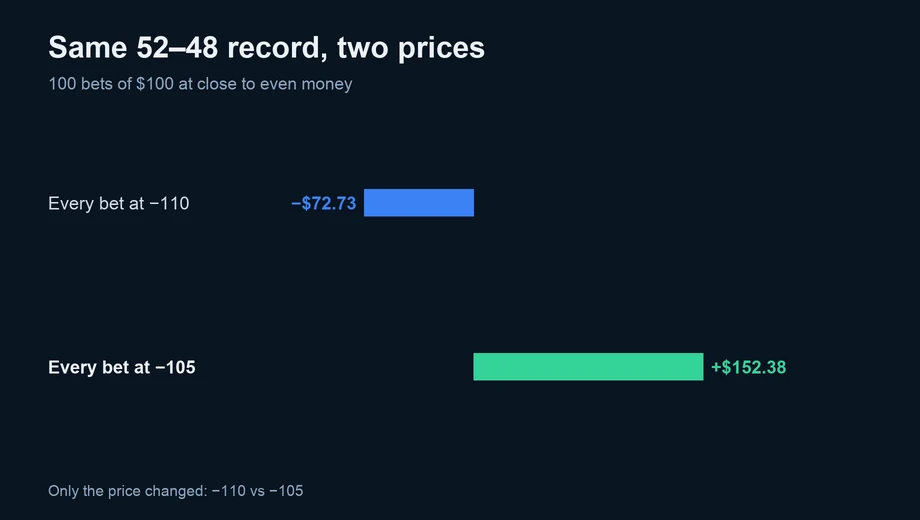
Same picks, same 52–48 record, a $225 swing, and the difference between a losing year and a winning one. Nothing about your handicapping changed. Only the price did.
Shopping spreads and totals: half points
On spreads and totals, shopping is not only about price. The line itself can differ by half a point, and half a point can decide a bet.
If you like Seattle and one book offers −2.5 while another offers −3, the −2.5 wins outright if Seattle wins by exactly three. In the NFL, where three and seven are common final margins because of field goals and touchdowns, a half point around those numbers is worth more than a half point elsewhere.
When you compare spreads, compare the line and the price together. Seattle −3 at +105 and Seattle −2.5 at −115 are different bets. The cheaper price is not automatically the better bet if it comes with the worse number. The comparison that matters is how often each version wins, against the price you pay for it.
What OddsBay’s data shows: no single book is always best
If one sportsbook always had the best price, line shopping would be easy: you would just bet there. The data says otherwise.
OddsBay ranks every sportsbook it tracks by its best-price rate: how often that book offers the best available price in head-to-head comparisons of the same bet. As of October 13, 2026, across 55 sportsbooks with enough comparisons to qualify:
- The top-ranked book offered the best price in 52.7% of its comparisons.
- The median book offered the best price in only 6.6%.
- The lowest-ranked qualifying books offered it in less than 1%.
Two lessons follow. First, even the best book is only best about half the time, so loyalty to one account leaves value on the table. Second, the difference between books is enormous: some are rarely competitive at all. You can see the full, live table on the OddsBay sportsbook rankings.
A simple line-shopping routine
You do not need dozens of accounts or a spreadsheet. A short, consistent routine captures most of the value.
- Decide the bet first. Choose the side, the market and the number you are willing to accept before looking at prices. Shopping should improve the price of a bet you already want, not talk you into a new one.
- Compare across your available books. Use a comparison tool such as the OddsBay Price Finder to see the same market across many sportsbooks at once. Our guide to how odds comparison works explains what to check.
- Match like with like. Make sure you are comparing the same market, the same period (full game, first half) and the same line. A −3 and a −2.5 are not the same bet.
- Check the price is still live. Prices move. Confirm the odds on the sportsbook’s own bet slip before you place the bet.
- Keep a record. Note the price you took and the best price that was available. Over time you will see which books are worth keeping.
Most bettors get the majority of the benefit from three to five accounts with books that are licensed where they live and that regularly appear near the top of the rankings.
Common mistakes
- Comparing different bets. A full-game line and a first-half line, or a −3 and a −2.5, are not interchangeable. Compare like with like.
- Chasing a stale price. A comparison shows the last price recorded. If a number looks far out of line with everyone else, it may already have moved.
- Confusing promotions with price. A deposit bonus or boosted odds can be worthwhile, but they are separate from the everyday price. Judge them on their own terms.
- Ignoring where you can legally bet. The best price is only useful if it comes from an operator you can lawfully use.
- Shopping for bets you would not otherwise make. A good price on a bad bet is still a bad bet.
Line shopping and closing line value
Line shopping also connects to a measure many bettors use to judge their own skill: closing line value. The closing line is the final price before an event starts, when the market has absorbed the most information. Consistently beating that number is widely treated as a sign of good betting decisions. Taking the best available price each time is the most direct way to improve your position against the close. Our guide to the closing line explains how to measure it, and our explainer on line movement shows why prices change on the way there.
Line shopping does not remove risk
A better price improves what you are paid when you win. It does not make a bet more likely to win, and it does not make sports betting a reliable source of income. Most bettors lose money over time. Set limits on what you spend (our guide to bankroll management shows how), never bet money you need, and treat betting as entertainment. If gambling stops being fun, help is available: in the United States, the National Problem Gambling Helpline is available 24/7 by calling or texting 1-800-MY-RESET.
Key takeaways
- Line shopping means comparing the same bet across sportsbooks and taking the best line and price.
- Gaps are large: on one NFL moneyline, prices for the same side ranged from +110 to +144 across 47 books.
- Small price differences compound: moving from −110 to −105 turned a 52–48 record from a loss into a profit in our example.
- No book is always best. Even the top-ranked book offered the best price only about half the time.
- Decide the bet first, compare like with like, confirm the live price, and only use operators licensed where you live.
Frequently asked questions
Is line shopping legal?
Comparing prices is legal. Whether you can bet with a particular sportsbook depends on the laws where you are. Only use operators licensed in your jurisdiction.
How many sportsbook accounts do I need?
There is no fixed number, but three to five accounts with competitive, licensed books captures most of the benefit for most bettors.
Does line shopping guarantee profit?
No. It improves the price you get on each bet, which lowers the win rate you need to break even. You still need to make good bets, and losing streaks still happen.
Why are betting exchange prices often better?
Exchanges match bettors against each other and charge a commission on winnings instead of building a margin into every price. That often produces prices close to fair value, which is why exchanges frequently appear near the top of best-price rankings where they are available.