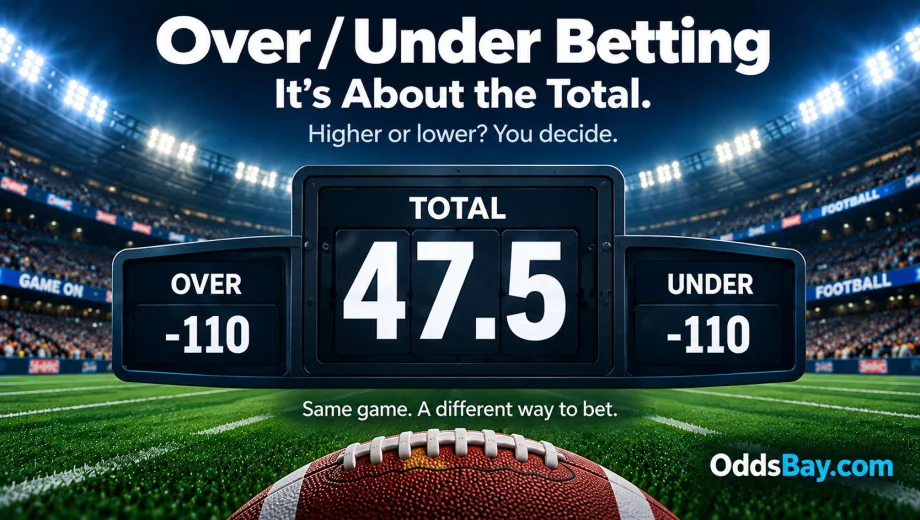
An over/under wager—also called a total—focuses on a scoring threshold rather than which side wins. The sportsbook posts a number, and the market offers positions on whether the defined result will finish over or under that number.
Like a spread, a total has both a line and a price. Understanding that distinction makes it easier to compare offers and to interpret movement without turning every change into a story the data cannot prove.
How a total works
Consider an illustrative total of 47.5. An Over 47.5 position generally needs the applicable combined score to reach at least 48; Under 47.5 generally needs it to finish at 47 or below. The exact statistic being totaled depends on the market—full-game points are common, but sportsbooks can offer team totals, period totals and other variants.
Always confirm the market definition and period. “Over 47.5” is incomplete information if one quote refers to the full game and another to a first half.
Whole numbers, half points and pushes
A half-point total such as 47.5 cannot land exactly on the line. A whole-number total such as 47 can. If the qualifying score equals 47, the market may settle as a push under standard rules, returning the stake. Settlement rules should always be checked rather than assumed.
The price still matters
Two sportsbooks can post the same total but attach different prices. Over 47.5 at -105 and Over 47.5 at -115 represent the same threshold at different costs. Another sportsbook might post Over 47 at -120, introducing a tradeoff between a more favorable number and a more expensive price.
For the price notation itself, see How American Odds Work. For the relationship between line and handicap pricing, How Point Spread Betting Works provides a useful comparison.
How totals move
A total may be observed at 47.5 and later at 48, or remain at 47.5 while the price on Over or Under changes. Both are market changes, but they are not identical. One changes the scoring threshold; the other changes the cost of taking a side at the same threshold.
OddsBay can describe the observations it has actually recorded. Its terminology should distinguish First Observed from an official opening total unless the latter is independently established. Read What Is Line Movement? for the broader framework.
Comparing totals correctly
Comparison starts by matching event, period, market and threshold. If all four match, price differences are straightforward to inspect. If the threshold differs, the bettor must evaluate a number-versus-price tradeoff rather than declaring one quote universally better.
The same logic applies across sports even though scoring distributions differ. Sport-specific OddsBay surfaces such as NFL, NBA, MLB and NHL can provide context where totals are part of the available observed markets.
Totals checklist
- Confirm what statistic is being totaled.
- Confirm the period: game, half, period, team or another scope.
- Read threshold and price together.
- Understand whether the number permits a push.
- Compare identical totals before comparing price alone.
- Do not infer a reason for movement from the movement itself.
Totals FAQ
Does Over mean the favored team will score more?
No. A standard game total concerns the defined combined scoring result, not which team wins. Team totals are separate markets and should be labeled accordingly.
Why can 47 and 47.5 matter so much?
The half point changes settlement possibilities. A total of 47 can potentially push at exactly 47, while 47.5 forces the qualifying result to one side of the threshold.
Can the total stay the same while the market still moves?
Yes. The posted number can remain unchanged while the attached Over or Under price changes. OddsBay’s evidence model can preserve that distinction.
The main idea
An over/under is a threshold with a price. The strongest comparison is not simply “Over versus Under”; it is a precise comparison of the same market definition, number and price at a known observation time.