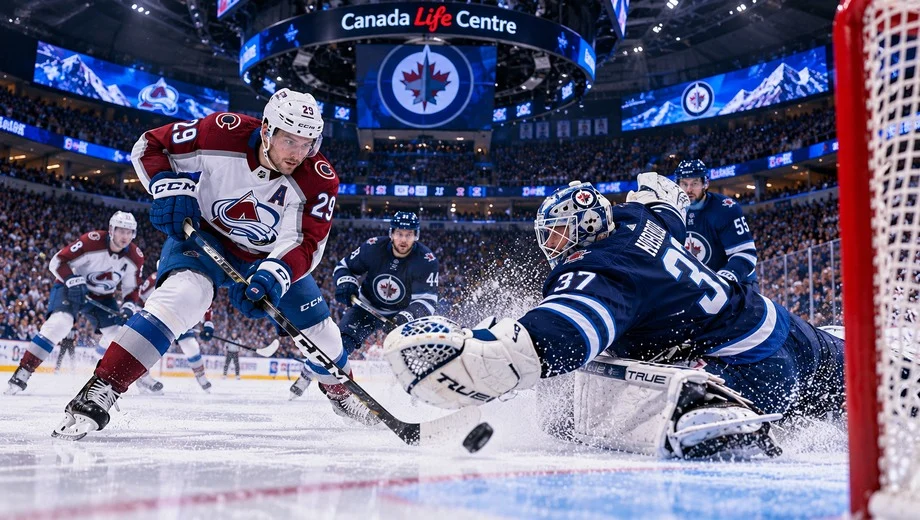
Avalanche at Jets: Winnipeg’s New Crease Faces Colorado’s Decision Machine
Winnipeg's problem is not replacing Hellebuyck save for save
Connor Hellebuyck’s suspension after he did not report to training camp changes the Jets more deeply than a nameplate in the crease. For years, elite goaltending allowed Winnipeg to survive stretches in which opponents owned more of the puck or created the better first chance. Stuart Skinner gives the Jets an experienced option, but the team should not ask him to reproduce Hellebuyck’s value by himself. The real adjustment is collective: how much risk can the defense take, how aggressively can a weak-side defender activate, and how often can Winnipeg allow a broken possession to become a rush against? Colorado is a brutal opponent for learning those limits.
Colorado attacks the decisions that uncertainty makes slower
Nathan MacKinnon and Cale Makar do not merely create speed; they create decision overload. MacKinnon can carry through the neutral zone and force defenders backward, while Makar can change the point of attack before coverage settles. Colorado’s broader scoring depth means Winnipeg cannot solve the game by assigning one checking line to one star. The Jets need connected gaps and early communication. A half-second of hesitation over who takes the carrier and who protects the middle can become a lateral pass, a trailer or a rebound chance before the goalie has a stable sightline.
Skinner's evaluation should begin with the shots Winnipeg prevents
The easiest mistake is to turn every Colorado chance into a referendum on Skinner. A more useful evaluation starts before the shot. Are Jets defenders allowing controlled entries with speed? Are forwards arriving low enough to give the defense an outlet? Are rebounds being cleared before a second attacker arrives? Skinner’s save percentage in one early game will tell less than the repeatability of the environment in front of him. Winnipeg can help its new hierarchy by reducing the number of possessions that require an exceptional save rather than expecting the goalie to erase structural mistakes.
Winnipeg still has enough offense to make Colorado defend
Kyle Connor, Mark Scheifele, Gabriel Vilardi and the rest of the Jets’ attack prevent this from becoming a one-way goalie story. Winnipeg’s best defense may sometimes be forcing Colorado’s stars to begin 180 feet from the Jets’ net. Connor can punish space quickly; Scheifele can create through the middle; Vilardi can make interior possession difficult to defend. If Winnipeg establishes offensive-zone time, Colorado’s defensemen have fewer opportunities to join clean transition waves. That is important because a passive Jets game would expose the exact area of uncertainty they most need to protect.
The 2-2 season split is useful because it refuses to give an easy answer
Colorado and Winnipeg split four meetings last season. Colorado won two 3-2 games; Winnipeg answered with 3-1 and 4-2 victories. That is more informative than a lopsided historical record because it shows several plausible game shapes. It also comes with an expiration warning: Hellebuyck’s status changes the context, and both teams enter a new season with different roles around the edges. The history says Winnipeg can compete with Colorado and that Colorado can win tight games in this building. It does not tell us which version appears on October 7.
Canada Life Centre can help Winnipeg control matchups, not chaos
Home ice gives the Jets a chance to choose who sees MacKinnon after stoppages and to protect certain pairings from repeated exposure. That advantage disappears if Colorado turns the game into continuous transition, because changes happen on the fly and matchups dissolve. Winnipeg therefore has an incentive to create stoppages when needed, manage the puck at both blue lines and avoid hopeful plays through the middle. The objective is not to slow the game for aesthetic reasons; it is to keep the contest inside a structure where the bench can actually use its home-ice choices.
Special teams can magnify the crease transition
A penalty against Colorado can create exactly the kind of lateral movement and layered shooting that makes a changing goaltending environment difficult. Winnipeg’s discipline therefore has tactical value beyond avoiding a power-play percentage. At the other end, the Jets’ own power play can relieve pressure by making Colorado defend set-zone possessions instead of attacking in transition. Early-season conversion rates are too small to carry much predictive weight, but entries, puck recovery and shot location can reveal whether either unit is functioning cleanly.
OddsBay read: uncertainty is not automatically value
Hellebuyck’s suspension is public information. Skinner’s presence is public information. A market will react to both. The useful task is to determine whether the price is treating Winnipeg as if the entire defensive environment disappeared with its goalie, or whether it underestimates how much Colorado can stress a team adjusting its risk tolerance. Confirm the actual starter and final lineups, then watch the first several entries and retrievals. If Winnipeg’s five-man support keeps Colorado outside and turns saves into exits, the new crease can stabilize. If support breaks, the problem is larger than the man wearing the pads.
Winnipeg's defense has to decide how brave it can be
A team accustomed to Hellebuyck can develop habits that are rational only because an elite goalie sits behind them. A defenseman may hold the offensive line an extra second, a weak-side player may jump into a passing lane, or a forward may leave the zone early because the expected cost of a mistake has historically been lower. With the crease hierarchy changing, Winnipeg has to recalibrate those choices. Playing scared would concede too much ice to Colorado; playing as though nothing changed could create the exact rush chances MacKinnon wants. The correct risk level may take several games to discover.
Morrissey becomes central to both sides of the solution
Josh Morrissey is important not only because he must defend Colorado’s best players but because Winnipeg needs him to move the puck out cleanly enough to reduce their attacking volume. A retrieval that becomes a controlled exit is defensive work and offensive creation at once. If Morrissey and his partners are forced into repeated chips that Colorado recovers, the Jets will spend too much time defending. If they can beat the first layer and find Connor or Scheifele with speed, Colorado’s defense has to turn and the game becomes less comfortable for the Avalanche.
MacKinnon's line can make one bad change feel like a system failure
Colorado is especially dangerous when an opponent mistakes a change-management error for an ordinary possession. MacKinnon can cross neutral ice before a fresh defender has established a gap, and Makar can join behind him to create a second layer. Winnipeg must be precise around both benches, particularly in the second period with the long change. That is another reason to avoid unnecessary extended shifts. A tired line facing Colorado does not merely lose a race; it can lose the spacing required to hand off coverage cleanly.
The Jets need secondary scoring because one line cannot spend the night checking
If Connor and Scheifele are used exclusively to neutralize Colorado’s top threats, Winnipeg risks removing its own best offensive counterweight. The second and third lines therefore need to generate enough threat that the coaching staff can distribute assignments. Vilardi’s interior play, Perfetti’s skill and contributions from the lower lines can keep Colorado honest. Secondary scoring does not have to mean multiple goals; a line that owns the puck for forty seconds, draws a penalty or forces an icing can materially reduce the pressure on Winnipeg’s crease.
What would show the Jets have adapted
A successful adjustment should be visible in the shape of Colorado’s chances. Winnipeg does not need to eliminate shots. It needs to reduce clean entries through the middle, keep MacKinnon from attacking defenders with excessive space and make Makar receive more pucks outside the most dangerous lanes. After saves, the first Jet to the rebound must have a clear outlet rather than simply swatting the puck away. Those details would show a team protecting its new goalie through structure rather than retreating into a shell.
A close first period would be a Winnipeg success
Against Colorado, surviving the first period is not about escaping 0-0 at any cost. Winnipeg wants to establish a repeatable defensive picture. If Skinner or the confirmed starter is seeing shots, controlling rebounds and then watching the Jets exit with possession, the crease transition is functioning. If Colorado is creating repeated lateral attacks even without scoring, the scoreboard may be flattering Winnipeg. The distinction matters because goaltending uncertainty tempts observers to judge only goals. The Jets need evidence that their five-man structure can make the workload predictable. A close score supported by clean exits is encouraging; a close score supported by desperate saves is fragile.
The reader's takeaway before Colorado arrives
Winnipeg does not need to prove that life without Hellebuyck is easy. It needs to prove that the rest of the team can change enough to keep the problem manageable. Colorado is an unusually severe test because MacKinnon and Makar punish hesitation and because the Avalanche can score through more than one line. Yet the Jets have enough offense and enough home-ice control to make Colorado defend if they manage the puck well. The central question is therefore not “Can Skinner replace Hellebuyck?” It is “Can Winnipeg build a game in which its goalie does not have to?” That is the standard worth carrying into the final pregame update.
 Penguins at Capitals: Meeting 101 Is About More Than Crosby and Ovechkin
 Panthers at Kings: Florida’s Barkov Problem Meets a New Los Angeles Era
 Islanders at Rangers: Does Last Season’s Sweep Still Explain This Rivalry?