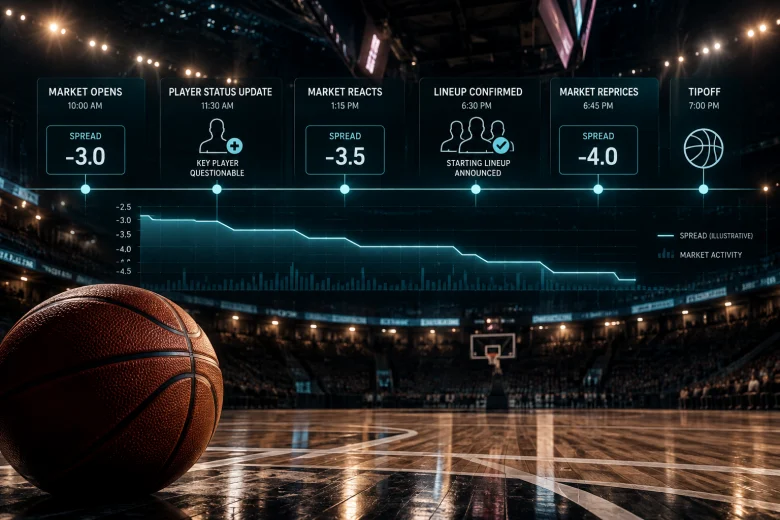
No major sport moves on player news like the NBA. With only five players on the court and stars playing most of the game, one player’s availability can shift a spread by several points, change the total, and reshape dozens of player props at once. Understanding how that news arrives, and how the market reacts, is most of what there is to know about NBA line movement.
This guide explains which news moves NBA lines, when it usually arrives, and how to read a move without assuming you know its cause. For the general mechanics of moves in any sport, see our main guide to line movement.
Why player news matters more in the NBA
- Few players, big roles. A star can be on the floor for 35 minutes and involved in a large share of his team’s possessions. Replacing him with a bench player changes far more than one position.
- Usage moves to teammates. When a star sits, his shots and touches go to others. That changes team totals and individual props, not only the spread.
- Rest is planned. Teams manage workloads over an 82-game season, so healthy players sometimes sit, especially on back-to-backs. Our guide to NBA back-to-backs and rest covers that side.
How NBA availability news arrives
NBA teams must file injury reports that list players with a status such as out, doubtful, questionable, probable or available, and update them as game day approaches. The rough sequence:
| Time | What usually becomes clearer |
|---|---|
| The day before | The first official injury report for the game |
| Game day | Updated reports, shootaround comments and beat reporters’ updates |
| Before tip-off | Final statuses, warmup observations and the confirmed starting lineup |
“Questionable” is where most uncertainty lives. A star listed as questionable can leave the price hanging between two very different games until shortly before tip-off.
How the market reacts
- Before the news: prices on a questionable star usually sit somewhere between “he plays” and “he sits”, weighted by how likely each looks. Some sportsbooks take smaller bets or pull the game until the status is clear.
- When the news breaks: the spread, total and props can all move within minutes. The fastest books move first; others follow.
- After the news: the price usually settles near its new level. By then, betting on the news alone rarely has value.
Reading an NBA line move
A move that lines up in time with injury news is tempting to explain, but other things move lines too: a large bet, another sportsbook’s adjustment, or several pieces of news at once. Before deciding what a move means:
- Check the size. A half-point drift and a four-point jump are different events.
- Check the breadth. Did most books move, or one?
- Check the timing against the report. Did the move come before, with or after the official status change?
- Check the other markets. If the spread moved but the star’s props did not, the move may not be about him.
- Check whether it stuck. Moves that reverse were often noise.
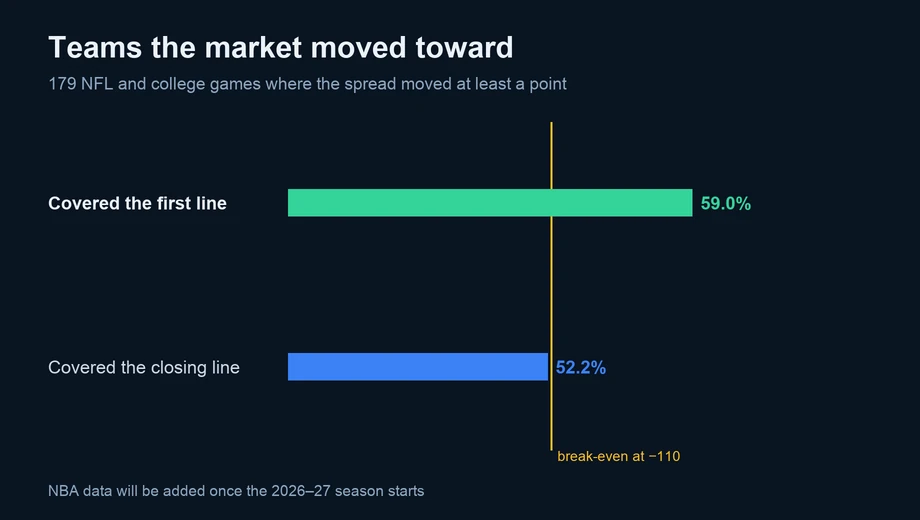
Moves are also not proof of what will happen. Across 309 NFL and college football games, OddsBay found that teams the market moved toward covered the first line 59% of the time but the closing line only about 52%: the value was in being early, not in following. Our guide to the closing line explains why that matters for judging your bets.
Practical rules for NBA betting around news
- Know what the price assumes. If a key player is questionable, ask whether the current line looks like a “plays” or “sits” number.
- Decide whether you want that risk. Betting before the status is final gets you a price before the news, and the risk that it goes against you.
- Watch related markets. Totals and props often react as much as the spread. Our guide to player props and injury status explains how.
- Compare books after news. Sportsbooks update at different speeds; the OddsBay Price Finder shows where each stands.
- Check the confirmed lineup. Starting lineups and rotations, covered in our guide to NBA lineups and rotations, say a lot about how the minutes will be shared.
Common mistakes
- Chasing the move. By the time a star’s absence is public, the line usually reflects it.
- Overrating every absence. A bench player sitting rarely moves a fair price much.
- Ignoring the replacement. Who absorbs the minutes and shots matters as much as who is missing.
- Assuming the cause. A move at the same time as news is not proof that the news caused it.
Betting responsibly
Fast-moving news makes it easy to bet impulsively. Set your stakes in advance (our guide to bankroll management shows how), remember most bettors lose over time, and treat betting as entertainment. If gambling stops being fun, help is available: in the United States, the National Problem Gambling Helpline is available 24/7 by calling or texting 1-800-MY-RESET.
Key takeaways
- Player availability is the main driver of NBA line movement, because stars carry so much of their team’s play.
- Injury reports, game-day updates and confirmed lineups arrive in stages; “questionable” is where uncertainty lives.
- When news breaks, spreads, totals and props can all move within minutes.
- Judge a move by its size, breadth, timing and persistence before deciding what it means.
- Following a move after it happens rarely helps; value comes from better prices, earlier.
Frequently asked questions
Why do NBA lines move so much?
Because one player can change the game more than in other team sports, and availability news often arrives late.
What does questionable mean on the NBA injury report?
That the player’s status for the game is uncertain. It is the status that leaves the most uncertainty in the price until shortly before tip-off.
Should I bet before or after the injury report?
Before gets you a price that has not reacted to news yet, with the risk that the news goes against you. After gets you certainty at a price that usually reflects it.