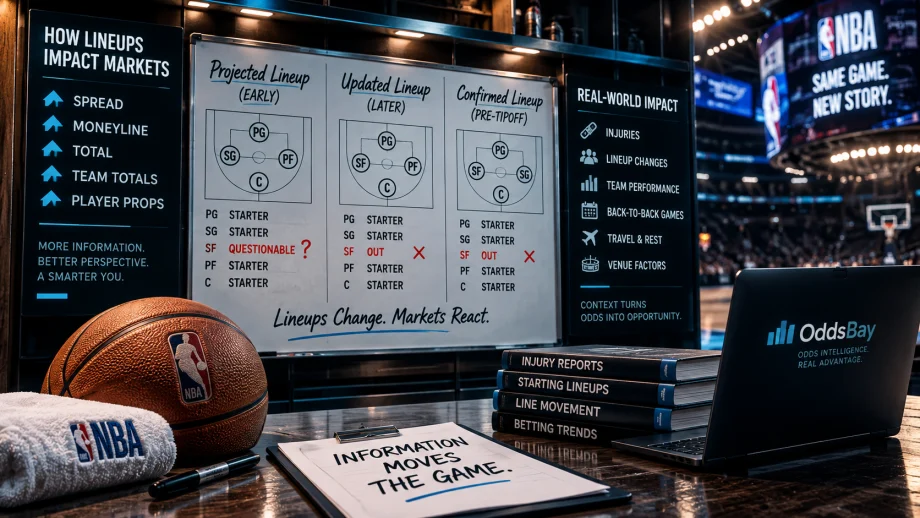
In the NBA, who starts and how the minutes are shared shape a game more than in most sports. Five starters often play the majority of the minutes, a coach’s rotation decides who closes the game, and a single change can shift pace, spacing and defense. That is why bettors watch starting lineups and rotations, and why sportsbooks adjust prices when they change.
This guide explains what lineups and rotations tell you, when that information arrives, and how to use it without reading too much into one game.
Starting lineups: what they tell you
- Who is available. The confirmed starting five is the clearest signal of who is healthy and playing.
- How the team wants to play. A bigger lineup may mean more rebounding and a slower pace; a smaller one, more three-pointers and switching on defense.
- Matchups. Who guards whom often follows from the starting lineups. Our guide to NBA matchup analysis explains why matchups can matter more than overall team strength.
Teams announce starting lineups shortly before tip-off. Earlier in the day, reporters and coaches’ comments usually give strong hints, but changes can come late.
Rotations: who plays, and how much
The rotation is the group of players a coach actually uses and roughly how many minutes each gets. It matters because:
- Minutes drive production. Points, rebounds and assists follow playing time, so rotation changes move player props directly.
- Bench strength varies. Some teams lose little when starters rest; others fall off sharply. That affects spreads, especially in games likely to be decided by the bench.
- Closing lineups decide close games. Who plays the final minutes can matter more than who starts.
When rotations change
- Injuries and returns. A player returning from injury may be on a minutes limit for several games, which spreads his minutes to others.
- Rest and back-to-backs. Teams sometimes rest players or shorten rotations on back-to-backs. Our guide to NBA back-to-backs and rest covers this.
- Early season. Coaches experiment in October and November. Rotations settle as the season goes on. Our guide to the NBA preseason and training camp explains why early minutes say little.
- Trades and signings. A new player can reshuffle minutes for several teammates.
- Game script. In blowouts, starters sit early and deep bench players play the last minutes, which affects props and late spread outcomes.
How the market prices lineup information
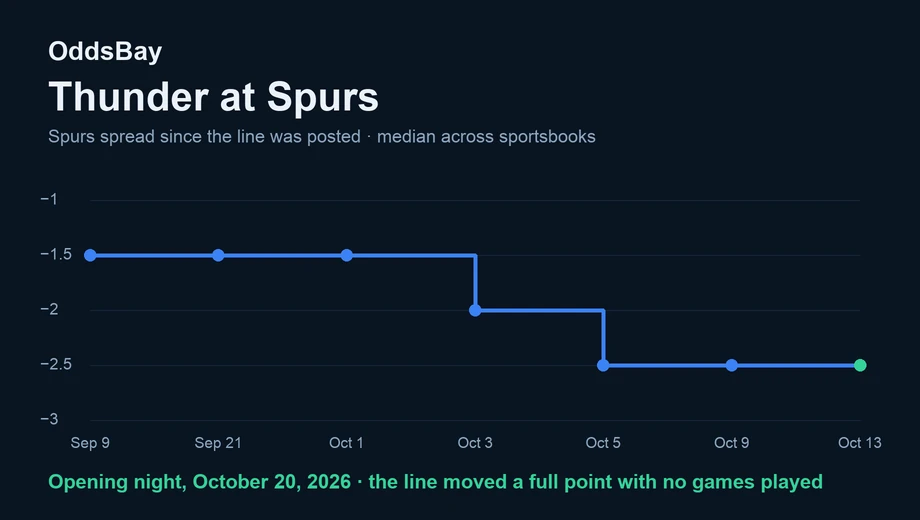
Sportsbooks update spreads, totals and props as lineup news arrives, and prices for stars move most. A few things are worth knowing:
- Major news is priced quickly. Once a starter is confirmed out, the line usually reflects it within minutes. Our guide to NBA line movement and player news explains how those moves unfold.
- Secondary effects can lag. The direct effect of a missing star is obvious; who gets his minutes, and what that does to their props, can take longer to settle.
- Uncertainty is priced too. When a starter is questionable, the price usually sits between the two scenarios.
How to use lineups and rotations
- Check the confirmed starters before betting on anything that depends on them.
- Think about minutes, not just names. Who gains playing time when someone sits? That is often where props are most affected.
- Use several games, not one. One unusual rotation can be a coach’s experiment or a game-script effect. Patterns over several games are more reliable.
- Compare the price. Convert it to implied probability and ask whether it already reflects the lineup news. Compare sportsbooks in the OddsBay Price Finder.
Common mistakes
- Treating a single game’s minutes as the new normal. Blowouts, foul trouble and experiments distort them.
- Ignoring minutes limits. A returning player may start but play far fewer minutes than usual.
- Forgetting the replacement. The player who steps in matters as much as the one who sits.
- Betting old news. If the lineup has been public for an hour, the price has usually caught up.
Betting responsibly
Lineup news can help you avoid stale prices, but it cannot make a bet certain, and most bettors lose money over time. Decide your stakes in advance (our guide to bankroll management shows how) and treat betting as entertainment. If gambling stops being fun, help is available: in the United States, the National Problem Gambling Helpline is available 24/7 by calling or texting 1-800-MY-RESET.
Key takeaways
- Starting lineups show who is available and how a team plans to play; rotations show how the minutes are shared.
- Minutes drive production, so rotation changes move props as much as spreads.
- Rotations change with injuries, rest, early-season experiments, trades and game script.
- Major lineup news is priced within minutes; secondary effects can take longer.
- Judge rotations over several games, and always check whether the price already reflects the news.
Frequently asked questions
When are NBA starting lineups announced?
Shortly before tip-off, although reporters and coaches often make them clear earlier in the day.
Why do rotations matter for player props?
Because playing time drives points, rebounds and assists. A change of a few minutes can move a player’s expected numbers noticeably.
How reliable are early-season rotations?
Not very. Coaches experiment early, and rotations usually settle after the first few weeks.